



Will bring bill to build Ram Temple when BJP has strength in both Houses of Parliament: UP Minister

Agencies
August 19, 2018

Lucknow, Aug 19: Uttar Pradesh Deputy Chief Minister Keshav Prasad Maurya on Sunday said he was hopeful that if the need arose and there was no way out, the Centre could opt for the legislative route in Parliament for the construction of a Ram temple in Ayodhya, when it has adequate numbers in both Houses.
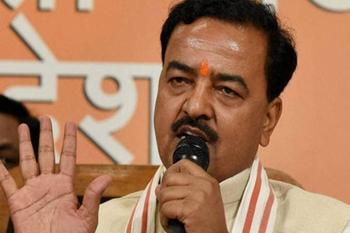
"When such a need arises that there is no way out except bringing a Bill, I am fully confident that in such a situation and when we have adequate strength (in both Houses of Parliament), remember these two things", he said without elaborating.

"At present, in Parliament, we do not have adequate strength. Because even if we bring the matter in Lok Sabha, our strength in the Rajya Sabha is less, and it will definitely be defeated. Every devotee of Lord Ram knows this. The court will soon give its judgement.

"The day we have the strength, it will be constructively used and not misused (Lekin Jis din hamare paas takat hogaa, uss takat ka sadpuyog hoga, durpayog nahi hoga)," Maurya told PTI.

He said the matter was being heard in the Supreme Court.

Maurya said if the grand Ram temple was built, it will be a "true tribute" to VHP stalwart Ashok Singhal, Mahant Sri Ramchandra Das Paramhans (former head of the Ram Janmabhoomi Nyas in Ayodhya) and karsewaks who sacrificed their lives.

The deputy chief minister was also asked whether the Scheduled Castes and the Scheduled Tribes (Prevention of Atrocities) Amendment Bill will anger BJP's core vote bank. Maurya said: "The intention of the government is to not cause any harassment to anyone by bringing in the bill. As a deputy CM of the state, I can say that in UP, no fake case will be registered and no one will be harassed unnecessarily. But, anyone doing any wrong to SC/ST people will not be spared."

On August 9, Parliament had passed the bill to overturn a Supreme Court order concerning certain safeguards against arrest under the Scheduled Caste and Scheduled Tribe law.

The Scheduled Castes and the Scheduled Tribes (Prevention of Atrocities) Amendment Bill, which was passed by the Rajya Sabha by a voice vote, had got the nod of the Lok Sabha on August 6.

On the party's poll preparations, Maurya who had represented Phulpur in the Lok Sabha said, "Our party is working to get at least 51 per cent vote share at every booth, and we are working in this direction."

Taking a jibe at rival political parties, the UP deputy Chief Minister said, "Who is actually nervous can be clearly revealed by the expressions of (Samajwadi Party chief) Akhilesh Yadav and (BSP supremo) Mayawati".

Prime Minister Narendra Modi is an MP from Uttar Pradesh, and the mass crowd which had turned up at the programmes addressed by him drop ample hints that our political rivals have been shaken... There is a special attachment for Modiji among the people. They are in fact complementary to each other."

Comments

Add new comment

  • Coastaldigest.com reserves the right to delete or block any comments.
  • Coastaldigset.com is not responsible for its readers’ comments.
  • Comments that are abusive, incendiary or irrelevant are strictly prohibited.
  • Please use a genuine email ID and provide your name to avoid reject.
News Network
December 13,2025

New Delhi: School-going children are picking up drug and smoking habits and engaging in consumption of alcohol, with the average age of introduction to such harmful substances found to be around 13 years, suggesting a need for earlier interventions as early as primary school, a multi-city survey by AIIMS-Delhi said.

The findings also showed substance use increased in higher grades, with grade XI/XII students two times more likely to report use of substances when compared with grade VIII students. This emphasised the importance of continued prevention and intervention through middle and high school.

The study led by Dr Anju Dhawan of AIIMS's National Drug Dependence Treatment Centre, published in the National Medical Journal of India this month, looks at adolescent substance use across diverse regions.

The survey included 5,920 students from classes 8, 9, 11 and 12 in urban government, private and rural schools across 10 cities -- Bengaluru, Chandigarh, Delhi, Dibrugarh, Hyderabad, Imphal, Jammu, Lucknow, Mumbai, and Ranchi. The data were collected between May 2018 and June 2019.

The average age of initiation for any substance was 12.9 (2.8) years. It was lowest for inhalants (11.3 years) followed by heroin (12.3 years) and opioid pharmaceuticals (without prescription; 12.5 years).

Overall, 15.1 per cent of participants reported lifetime use, 10.3 per cent reported past year use, and 7.2 per cent reported use in the past month of any substance, the study found.

The most common substances used in the past year, after tobacco (4 per cent) and alcohol (3.8 per cent), were opioids (2.8 per cent), followed by cannabis (2 per cent) and inhalants (1.9 per cent). Use of non-prescribed pharmaceutical opioids was most common among opioid users (90.2 per cent).

On being asked, 'Do you think this substance is easily available for a person of your age' separately for each substance category, nearly half the students (46.3 per cent) endorsed that tobacco products and more than one-third of the students (36.5 per cent) agreed that a person of their age can easily procure alcohol products.

Similarly, for Bhang (21.9 per cent), ganja/charas (16.1 per cent), inhalants (15.2 per cent), sedatives (13.7 per cent), opium and heroin (10 per cent each), the students endorsed that these can be easily procured.

About 95 per cent of the children, irrespective of their grade, agreed with the statement that 'drug use is harmful'.

The rates of substance use (any) among boys were significantly higher than those of girls for substance use (ever), use in the past year and use in the past 30 days. Compared to grade VIII students, grade IX students were more likely, and grade XI/XII students were twice as likely to have used any substance (ever).

The likelihood of past-year use of any substance was also higher for grade IX students and for grade XI/XII students as compared to grade VIII students.

About 40 per cent of students mentioned that they had a family member who used tobacco or alcohol each. The use of cannabis (any product) and opioid (any product) by a family member was reported by 8.2 per cent and 3.9 per cent of students, respectively, while the use of other substances, such as inhalants/sedatives by family was 2-3 per cent, the study found.

A relatively smaller percentage of students reported use of tobacco or alcohol among peers as compared to among family members, while a higher percentage reported inhalants, sedatives, cannabis or opioid use among peers.

Children using substances (past year) compared to non-users reported significantly higher any substance use by their family members and peers.

There were 25.7 per cent students who replied 'yes' to the question 'conflicts/fights often occur in your family'. Most students also replied affirmatively to 'family members are aware of how their time is being spent' and 'damily members are aware of with whom they spend their time'.

Comments

Add new comment

  • Coastaldigest.com reserves the right to delete or block any comments.
  • Coastaldigset.com is not responsible for its readers’ comments.
  • Comments that are abusive, incendiary or irrelevant are strictly prohibited.
  • Please use a genuine email ID and provide your name to avoid reject.