



Women groups raise 10 concerns in Triple Talaq Bill

Agencies
December 28, 2018

New Delhi,  Dec 28: A group of 40 women rights activists has opposed the Muslim Women (Protection of Rights on Marriage) Bill, 2018, in its present form, raising concerns over 10 points in the Bill which was passed by the Lok Sabha Thursday.
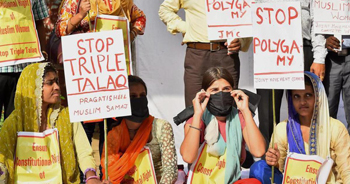
In a statement, they urged the government to withdraw the Bill from consideration in the Rajya Sabha, and review the fundamental flaws pending broad-based community consultations.

Following are the 10 concerns raised by the activists:

1. This Bill disregards the fact that its very objective - to protect the rights of married Muslim women and prohibit divorce by pronouncing 'talaq' by their husband - has already been achieved by the judgement of the Supreme Court.

2. The Supreme Court in Shayara Bano's case held that the practice of 'talaq-e-bidat' is manifestly arbitrary, and therefore, unconstitutional. An act that has no legal consequences being made a criminal offence, cognizable and non-bailable is manifestly arbitrary and therefore, violative of Article 14.

3. There is no rationale to criminalise the practice of talaq-e-biddat and imprison Muslim men. The effect of the Supreme Court's judgment is that the marriage is legally valid and the persons continue to be lawfully wedded. Now, the Muslim men will be incarcerated, thus violating the rights of conjugality of these two persons. Criminalising the husband would also lead to unwanted separation between the couple, against the wishes of the wife.

4. Since Muslim marriage is a civil contract between two adult persons, the procedures to be followed on its breakdown should also be of civil nature. Penal action to discourage the practice of instant triple talaq is a myopic view as it leaves many other issues of economic and social security of women unaddressed.

5. The government should strengthen the negotiating capacities of women by providing them economic and socio-legal support rather than criminalising the pronouncement of triple talaq.

6. The pronouncement of triple talaq having no legal consequences on the marriage means that such a proclamation by a Muslim man is essentially a desertion of the wife. In any of the Personal Laws, the desertion of wife by a man is not a criminal offence. Therefore, while the Bill aims to criminalise the pronouncement of talaq, in effect, it is only criminalising the act of desertion of a Muslim wife by her husband. Criminalising desertion by Muslim men, which constitutes only a civil offence for men of all other religions, is discriminatory under the Constitution.

7. If there is violence within the marriage in addition to the pronouncement of triple talaq, the woman could use the existing provisions of the Protection of Women from Domestic Violence Act, 2005 and Section 498A of the Indian Penal Code. These two laws, taken together, represent a wide spectrum of legal options available for women survivors of domestic violence, encompassing both criminal and civil provisions.

8. No economic and socio-legal support is provided by the government in the Bill to women, children and other dependents, when the erring men are put behind bars. The Domestic Violence Act, 2005 under Section 21 already provides for the aggrieved woman to be provided custody of the child and Section 20 provides for maintenance to be paid to her. Section 125 of the Code of Criminal Procedure, 1973 also provides for maintenance for the aggrieved woman. In fact, the Bill takes a step back in only providing for subsistence allowance for the woman. Subsistence allowance is not defined and is open to interpretation.

9. The Bill allows for the aggrieved woman as well as anyone related to her by blood or marriage to be the complainant. There is no provision for a relative to seek the consent of an aggrieved woman before filing a complaint. The problem becomes particularly acute in the case of inter-religious marriages of Muslim men with a woman of another religion.

10. The terms of imprisonment up to three years is arbitrary and excessive. Serious crimes like Causing death by rash or negligent act (IPC Sec 304A), Rioting (IPC Sec 147), Injuring or defiling place of worship with intent to insult the religion of any class (IPC Sec 295) - all punishable by two years in jail or fine or both. All these criminal acts have lesser punishment than pronouncing triple talaq, which is arbitrary and excessive, and violative of Article 14 of the Constitution.

The statement was signed by 40 activists and women's groups, including Ayesha Kidwai of Jawaharlal Nehru University, Kavita Krishnan of All India Progressive Women's Association (AIPWA), Shabanam Hashmi, Anhad and groups like Bebaak Collective, National Alliance of People's Movements (NAPM), Humsafar Support Centre, Kashmir women's collective, Mahila Sarvangeen Utkarsh Mandal (MASUM), People's Union for Civil Liberties (PUCL), Women's Research & Action Group among others.

The Lok Sabha Thursday passed the Bill which criminalises the practice of instant triple talaq, with the government rejecting the contention that it was aimed at targeting a particular community.

The Muslim Women (Protection of Rights on Marriage) Bill, 2018 was passed by the Lower House with 245 voting in favour and 11 opposing the legislation.


Comments

Add new comment

  • Coastaldigest.com reserves the right to delete or block any comments.
  • Coastaldigset.com is not responsible for its readers’ comments.
  • Comments that are abusive, incendiary or irrelevant are strictly prohibited.
  • Please use a genuine email ID and provide your name to avoid reject.
News Network
December 6,2025

pilot.jpg

New Delhi: IndiGo, India’s largest airline, faced major operational turbulence this week after failing to prepare for new pilot-fatigue regulations issued by the Directorate General of Civil Aviation (DGCA). The stricter rules—designed to improve flight safety—took effect in phases through 2024, with the latest implementation on November 1. IndiGo has acknowledged that inadequate roster planning led to widespread cancellations and delays.

Below are the key DGCA rules that affected IndiGo’s operations:

1. Longer Mandatory Weekly Rest

Weekly rest for pilots has been increased from 36 hours to 48 hours.

The government says the extended break is essential to curb cumulative fatigue. This rule remains in force despite the current crisis.

2. Cap on Night Landings

Pilots can now perform only two night landings per week—a steep reduction from the earlier limit of six.

Night hours, defined as midnight to early morning, are considered the least alert period for pilots.

Given the disruptions, this rule has been temporarily relaxed for IndiGo until February 10.

3. Reduced Maximum Night Flight Duty

Flight duty that stretches into the night is now capped at 10 hours.

This measure has also been kept on hold for IndiGo until February 10 to stabilize operations.

4. Weekly Rest Cannot Be Replaced With Personal Leave

Airlines can no longer count a pilot’s personal leave as part of the mandatory 48-hour rest.

Pilots say this closes a loophole that previously reduced actual rest time.

Currently, all airlines are exempt from this rule to normalise travel.

5. Mandatory Fatigue Monitoring

Airlines must submit quarterly fatigue reports along with corrective actions to DGCA.

This system aims to create a transparent fatigue-tracking framework across the industry.

The DGCA has stressed that these rules were crafted to strengthen flight safety and align India with global fatigue-management standards. The temporary relaxations are expected to remain until February 2025, giving IndiGo time to stabilise its schedules and restore normal air travel.

Comments

Add new comment

  • Coastaldigest.com reserves the right to delete or block any comments.
  • Coastaldigset.com is not responsible for its readers’ comments.
  • Comments that are abusive, incendiary or irrelevant are strictly prohibited.
  • Please use a genuine email ID and provide your name to avoid reject.
News Network
December 16,2025

bengal.jpg

The deletion of over 58 lakh names from West Bengal’s draft electoral rolls following a Special Intensive Revision (SIR) has sparked widespread concern and is likely to deepen political tensions in the poll-bound state.

According to the Election Commission, the revision exercise has identified 24 lakh voters as deceased, 19 lakh as relocated, 12 lakh as missing, and 1.3 lakh as duplicate entries. The draft list, published after the completion of the first phase of SIR, aims to remove errors and duplication from the electoral rolls.

However, the scale of deletions has raised fears that a large number of eligible voters may have been wrongly excluded. The Election Commission has said that individuals whose names are missing can file objections and seek corrections. The final voter list is scheduled to be published in February next year, after which the Assembly election announcement is expected. Notably, the last Special Intensive Revision in Bengal was conducted in 2002.

The development has intensified the political row over the SIR process. Chief Minister Mamata Banerjee and her Trinamool Congress have strongly opposed the exercise, accusing the Centre and the Election Commission of attempting to disenfranchise lakhs of voters ahead of the elections.

Addressing a rally in Krishnanagar earlier this month, Banerjee urged people to protest if their names were removed from the voter list, alleging intimidation during elections and warning of serious consequences if voting rights were taken away.

The BJP, meanwhile, has defended the revision and accused the Trinamool Congress of politicising the issue to protect what it claims is an illegal voter base. Leader of the Opposition Suvendu Adhikari alleged that the ruling party fears losing power due to the removal of deceased, fake, and illegal voters.

The controversy comes amid earlier allegations by the Trinamool Congress that excessive work pressure during the SIR led to the deaths by suicide of some Booth Level Officers (BLOs), for which the party blamed the Election Commission. With the draft list now out, another round of political confrontation appears imminent.

As objections begin to be filed, the focus will be on whether the correction mechanism is accessible, transparent, and timely—critical factors in ensuring that no eligible voter is denied their democratic right ahead of a crucial election.

Comments

Add new comment

  • Coastaldigest.com reserves the right to delete or block any comments.
  • Coastaldigset.com is not responsible for its readers’ comments.
  • Comments that are abusive, incendiary or irrelevant are strictly prohibited.
  • Please use a genuine email ID and provide your name to avoid reject.
News Network
December 19,2025

Mangaluru: Public transport in Mangaluru is set for a state-led transformation as the government moves to deploy 100 new electric govt buses to replace unreliable private services. The initiative aims to provide a dependable alternative to private operators who have been frequently "cutting trips," leaving thousands of commuters stranded.

The announcement was made by Deputy Commissioner and MCC Administrator Darshan HV during a public phone-in session. The move specifically targets routes where private bus service has become erratic, ensuring that citizens no longer have to rely on a fluctuating private sector for their daily commute.

Restoring the Govt Presence

The transport crisis was brought to the forefront by Ramayya, a resident of Bajal, who highlighted a growing trend of private buses skipping morning and night trips. With the previous KSRTC (govt) services discontinued, residents have been left without a fallback option.

To fix this, the DC confirmed that the PM-eBus Sewa Scheme will bring 100 government-owned electric buses to the city:

•    Phased Deployment: The first 50 of the new 100 government buses are scheduled to arrive by March 2026.

•    State Infrastructure: Two new government depots, including one at Mudipu, are being prepared for operations.

•    Recruitment: The state has already begun training a new batch of government bus drivers to ensure the fleet is operational the moment it arrives.

Comments

Add new comment

  • Coastaldigest.com reserves the right to delete or block any comments.
  • Coastaldigset.com is not responsible for its readers’ comments.
  • Comments that are abusive, incendiary or irrelevant are strictly prohibited.
  • Please use a genuine email ID and provide your name to avoid reject.
