Foreign students stuck at Ukraine border witness racist face of Europe

News Network
March 2, 2022

ukrain.jpg

Jean-Jacques Kabeya is furious: like other foreign students in Ukraine -- from Africa, Asia and the Middle East -- he says has been stopped from leaving the country by its border guards.

He and several other foreigners alleged racist treatment by both the border guards and ordinary Ukrainians in interviews to a news agency.

Two days after fleeing the bombing around the eastern city of Kharkiv, Kabeya reached the checkpoint at Shegyni, at the border with Poland, on Sunday evening.

But the soldiers and security guards there turned him back, said the 30-year-old student studying to become a pharmacist.

"They told me 'You're going to stay here, you're fleeing the war, stay here; you are going to fight with us -- you're not leaving, least of all you blacks'," he said.

Now, after 36 hours waiting in vain to get through, he was back at the train station in the western city of Lviv.

There he found some compatriots from the Democratic Republic of Congo, who took him under their wing.

"It's a catastrophe!" said Kabeya, adding that he was still trying to find a way out.

Ukraine is a popular destination for foreign students, with tens of thousands heading there to study.

But other foreign students in Lviv had similar stories to tell, and the governments of Nigeria and South Africa have already called for better treatment for their citizens.

The African Union issued a statement Monday expressing concern at what appeared to be "shockingly racist" treatment of foreign students.

Some countries did however report that a few dozen of their citizens had managed to leave the country.

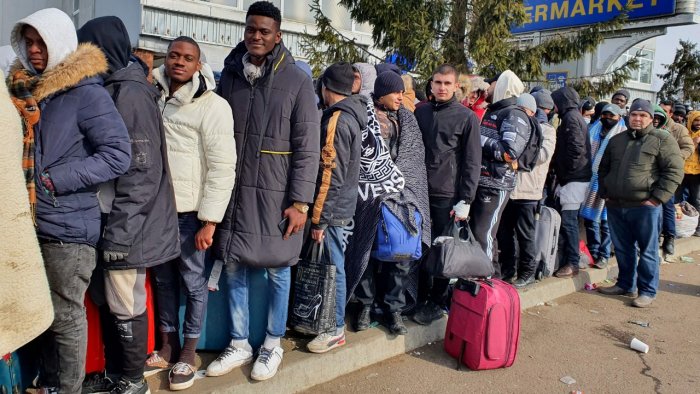
At Shegyni border post on Tuesday morning, there were still several hundred people, muffled up against the cold, queueing patiently to make the crossing.

They were from Pakistan, India, Algeria, DR Congo, Cameroon, Ghana and Algeria. Some said they had spent four nights there, with temperatures dropping as low as -10° (14 degrees Fahrenheit), in a desperate bid to leave.

On the other side of the road was another queue, reserved for Ukrainians -- mainly women and children as most men had stayed behind to fight.

That line was moving more quickly.

"All of us, we've got our papers," said Mesum Ahmed, a 23-year-old computer student from Pakistan. "Because we're foreigners, they are treating us like dogs.

"We've been sleeping here, on this pavement," said Ahmed, dressed in denim and sporting a beanie and a travel pillow around his neck.

"But the Ukrainians, they couldn't care less."

"You can see fine well what separates them from us," a young Nigerian added, bitterly. "We're black, that's what it is."

The only help on hand was from the local volunteers serving them hot drinks and sandwiches.

"We're here, we wait, and they don't tell us anything," said Richard Adjen Kusi, a student from Ghana.

He left the central city of Cherkassy when Russian President Vladimir Putin "started talking about nuclear weapons three days ago."

But everything seemed to be blocked here, he said. "It's not moving one centimetre...I'm scared."

A group of around 30 students from Cameroon who until recently had been in the central city of Kirovograd said it was only in the last few days that they had experienced racism in Ukraine.

Before the war, everything had been fine.

But Bryan Famini, a 22-year-old economics student, said that changed with the invasion.

"In the stations, on the trains, were were systematically kept away from the seating," he said.

"Some Ukrainians even made fun of us from their cars, seeing us walking," said 22-year-old Ghislain Weledji.

"I've been disappointed by this country," he added. "I won't be coming back."

Ukraine's border service denied there had been any difficulties.

"Nobody has been prevented from leaving Ukraine," they told AFP. No they had received no complaints.

On the Polish side, officials confirmed that anyone fleeing Ukraine would be welcomed, whatever their nationality.

As well as the nearly 680,000 refugees who have already left Ukraine, there are an estimated one million who have had fled their homes but are still inside the country.

At Lviv station, 70 kilometres (44 miles) from the border, thousands of Ukrainians -- and some foreigners -- were still waiting Tuesday, in the hope of getting a place on one of the rare trains leaving for Poland.

Amanjyot, a 23-year-old medical student said she had tried to board one train the day before but that Ukrainians had been given priority.

But she and her friends were grateful for the succour provided by Ukraine's Red Cross workers and other charities in front of the station.

"They help so much!" she said. There was plenty of food and they took care of everyone, without discrimination, she added. 

Comments

Add new comment

  • Coastaldigest.com reserves the right to delete or block any comments.
  • Coastaldigset.com is not responsible for its readers’ comments.
  • Comments that are abusive, incendiary or irrelevant are strictly prohibited.
  • Please use a genuine email ID and provide your name to avoid reject.
News Network
December 2,2025

A major upgrade in safety and monitoring is planned for Haj 2026, with every Indian pilgrim set to receive a Haj Suvidha smart wristband linked to the official Haj Suvidha mobile app. The initiative aims to support pilgrims—especially senior citizens—who may struggle with smartphones during the 45-day journey.

What the Smart Wristband Will Do

Officials said the device will come with:
•    Location tracking
•    Pedometer
•    SOS emergency button
•    Qibla compass
•    Prayer timings
•    Basic health monitoring

SP Tiwari, secretary of the UP State Haj Committee, said the goal is to make the pilgrimage safer and more comfortable.

“Most Hajis are elderly and not comfortable with mobile apps,” he said. “The smartwatch will help locate pilgrims who forget their way or cannot communicate their location.”

The wristbands will be monitored by the Consulate General of India in Saudi Arabia, similar to mobile tracking via the Haj Suvidha App.

Free Distribution and Training

•    Smart wristbands will be given free of cost.
•    Training for pilgrims will be conducted between January and February 2026.
•    Sample units will reach state Haj committees soon.
•    Final devices will be distributed as pilgrims begin their journey.

New Rules for Accommodation

Two major decisions have also been finalised for Haj 2026:
1.    Separate rooms for men and women – including married couples. They may stay on the same floor but must occupy different rooms, following stricter Saudi guidelines.
2.    Cooking banned – gas cylinders will not be allowed; all meals will be provided through official catering services arranged by the Haj Committee of India.

These decisions were finalised during a meeting of the Haj Committee of India and state representatives in Mumbai.

Haj Suvidha App Launched Earlier

The government launched the Haj Suvidha App in 2024, offering:

•    Training modules
•    Accommodation and flight details
•    Baggage information
•    SOS and translation tools
•    Grievance redressal

Haj 2026 Quota and Key States

•    India’s total Haj quota for 2026: 1,75,025 pilgrims
•    70% (1,25,000) allotted to the Haj Committee of India
•    30% (around 50,000) reserved for Haj Group Organisers

Uttar Pradesh has the largest allocation (around 30,000 seats), though approximately 18,000 pilgrims are expected to go this year. States with high pilgrim numbers include Kerala, Maharashtra and Gujarat.

Dates of Haj 2026

The pilgrimage is scheduled to take place from 24 May to 29 May, 2026 (tentative).
Haj is one of the five pillars of Islam and is mandatory for Muslims who meet the required conditions.

Comments

Add new comment

  • Coastaldigest.com reserves the right to delete or block any comments.
  • Coastaldigset.com is not responsible for its readers’ comments.
  • Comments that are abusive, incendiary or irrelevant are strictly prohibited.
  • Please use a genuine email ID and provide your name to avoid reject.
News Network
November 21,2025

israel.jpg

Local authorities say the Israeli military has expanded the so-called “yellow line” truce demarcation in Gaza City and repositioned its forces deeper into the territory in violation of a ceasefire agreement that came into force on October 10, besieging dozens of Palestinian families.

Gaza’s Government Media Office announced in a statement on Thursday that Israeli forces widened the boundary by shifting the markers, and advanced roughly 300 meters (984 feet) into the neighborhoods of Ash-Shaaf, An-Nazzaz and Baghdad Street.

The move pushed further into civilian areas, trapping families who were unable to flee as tanks rolled forward, it added.

“The fate of many of these families remains unknown amidst the shelling that targeted the area,” the office said, adding that the expansion of the yellow line shows a “blatant disregard” for the ceasefire deal.

On Friday, sources said the Israeli military carried out continued air and artillery strikes inside the so-called “yellow line” east of Khan Younis in the southern Gaza Strip.

According to the reports, Israeli warplanes and tanks targeted areas within the zone. One Palestinian was reported killed and several others wounded in the strikes, the sources said.

The fresh aggression came only a day after 25 Palestinians were killed in Israeli airstrikes on Gaza City and Khan Younis on Wednesday.

The media office reported that Israel has consistently violated the truce deal since its implementation last month, with near-daily attacks by air, artillery and direct shootings.

The office said over 400 violations have been documented. These breaches have resulted in the deaths of more than 300 Palestinians and left hundreds injured.

The Government Media Office in Gaza urged the guarantors of the ceasefire — the US, Egypt, Qatar and Turkey — to take swift action to halt the ongoing violations and facilitate the delivery of food, shelter materials, medical aid, and infrastructure equipment.

The so-called “yellow line,” set out in the agreement between Israel and Hamas resistance movement, refers to a non-physical partition where the Israeli military repositioned itself when the truce deal took effect.

It has allowed Israel, which routinely fires at Palestinians who approach the line, to retain control over more than half of the Gaza Strip.

International bodies, including the UN Independent International Commission of Inquiry, the International Association of Genocide Scholars, Amnesty International, Human Rights Watch, B’Tselem, and other rights groups, have concluded that the Israeli war on Gaza amounts to genocide.

In the attacks in Gaza since October 2023, Israel has killed at least 69,546 people and injured 170,833 others, leveling large swaths of the territory and displacing almost all of the population. 

Comments

Add new comment

  • Coastaldigest.com reserves the right to delete or block any comments.
  • Coastaldigset.com is not responsible for its readers’ comments.
  • Comments that are abusive, incendiary or irrelevant are strictly prohibited.
  • Please use a genuine email ID and provide your name to avoid reject.
News Network
November 26,2025

Mangaluru, Nov 26: Mangaluru East police have registered a case following a sophisticated online fraud where a 57-year-old local resident was allegedly cheated out of ₹13.4 lakh after being targeted on Facebook.

The scam began in February when the complainant, while browsing Facebook reels, was contacted by a woman identifying herself as "Lillian Mary George" from London. After establishing a chat relationship, the woman claimed she would visit India in November and bring a significant sum of money.

The trap was sprung on November 15, when the victim received a call from a woman named "Sonali Gupta," who claimed Lillian had arrived at Mumbai International Airport but was detained by customs. The fraudsters convinced the man that Lillian was carrying £25,000 (about ₹26 lakh) in traveller’s cheques and 1 kg of gold (valued at around ₹30 lakh).

Under the pretense of clearing these items, the victim was asked to make numerous online transfers between November 15 and 18 for various bogus charges, including:

•    "Pounds exchange registration"
•    "Customs declaration issues"
•    "Discount charges"
•    "Money-laundering charges"

Believing the fictitious story, the complainant transferred the cumulative sum of ₹13.4 lakh to various bank accounts provided by the fraudsters. He realised he was cheated when the culprits later promised a refund within two days but stopped answering his calls. The Mangaluru East police are now investigating the case, which highlights the continuing threat of transnational cyber fraud using social engineering and promises of fictitious wealth.

Comments

Add new comment

  • Coastaldigest.com reserves the right to delete or block any comments.
  • Coastaldigset.com is not responsible for its readers’ comments.
  • Comments that are abusive, incendiary or irrelevant are strictly prohibited.
  • Please use a genuine email ID and provide your name to avoid reject.