



Foreign students stuck at Ukraine border witness racist face of Europe

News Network
March 2, 2022

ukrain.jpg

Jean-Jacques Kabeya is furious: like other foreign students in Ukraine -- from Africa, Asia and the Middle East -- he says has been stopped from leaving the country by its border guards.

He and several other foreigners alleged racist treatment by both the border guards and ordinary Ukrainians in interviews to a news agency.

Two days after fleeing the bombing around the eastern city of Kharkiv, Kabeya reached the checkpoint at Shegyni, at the border with Poland, on Sunday evening.

But the soldiers and security guards there turned him back, said the 30-year-old student studying to become a pharmacist.

"They told me 'You're going to stay here, you're fleeing the war, stay here; you are going to fight with us -- you're not leaving, least of all you blacks'," he said.

Now, after 36 hours waiting in vain to get through, he was back at the train station in the western city of Lviv.

There he found some compatriots from the Democratic Republic of Congo, who took him under their wing.

"It's a catastrophe!" said Kabeya, adding that he was still trying to find a way out.

Ukraine is a popular destination for foreign students, with tens of thousands heading there to study.

But other foreign students in Lviv had similar stories to tell, and the governments of Nigeria and South Africa have already called for better treatment for their citizens.

The African Union issued a statement Monday expressing concern at what appeared to be "shockingly racist" treatment of foreign students.

Some countries did however report that a few dozen of their citizens had managed to leave the country.

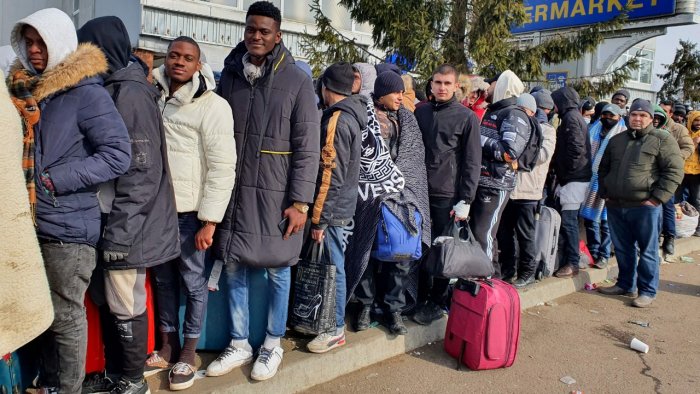
At Shegyni border post on Tuesday morning, there were still several hundred people, muffled up against the cold, queueing patiently to make the crossing.

They were from Pakistan, India, Algeria, DR Congo, Cameroon, Ghana and Algeria. Some said they had spent four nights there, with temperatures dropping as low as -10° (14 degrees Fahrenheit), in a desperate bid to leave.

On the other side of the road was another queue, reserved for Ukrainians -- mainly women and children as most men had stayed behind to fight.

That line was moving more quickly.

"All of us, we've got our papers," said Mesum Ahmed, a 23-year-old computer student from Pakistan. "Because we're foreigners, they are treating us like dogs.

"We've been sleeping here, on this pavement," said Ahmed, dressed in denim and sporting a beanie and a travel pillow around his neck.

"But the Ukrainians, they couldn't care less."

"You can see fine well what separates them from us," a young Nigerian added, bitterly. "We're black, that's what it is."

The only help on hand was from the local volunteers serving them hot drinks and sandwiches.

"We're here, we wait, and they don't tell us anything," said Richard Adjen Kusi, a student from Ghana.

He left the central city of Cherkassy when Russian President Vladimir Putin "started talking about nuclear weapons three days ago."

But everything seemed to be blocked here, he said. "It's not moving one centimetre...I'm scared."

A group of around 30 students from Cameroon who until recently had been in the central city of Kirovograd said it was only in the last few days that they had experienced racism in Ukraine.

Before the war, everything had been fine.

But Bryan Famini, a 22-year-old economics student, said that changed with the invasion.

"In the stations, on the trains, were were systematically kept away from the seating," he said.

"Some Ukrainians even made fun of us from their cars, seeing us walking," said 22-year-old Ghislain Weledji.

"I've been disappointed by this country," he added. "I won't be coming back."

Ukraine's border service denied there had been any difficulties.

"Nobody has been prevented from leaving Ukraine," they told AFP. No they had received no complaints.

On the Polish side, officials confirmed that anyone fleeing Ukraine would be welcomed, whatever their nationality.

As well as the nearly 680,000 refugees who have already left Ukraine, there are an estimated one million who have had fled their homes but are still inside the country.

At Lviv station, 70 kilometres (44 miles) from the border, thousands of Ukrainians -- and some foreigners -- were still waiting Tuesday, in the hope of getting a place on one of the rare trains leaving for Poland.

Amanjyot, a 23-year-old medical student said she had tried to board one train the day before but that Ukrainians had been given priority.

But she and her friends were grateful for the succour provided by Ukraine's Red Cross workers and other charities in front of the station.

"They help so much!" she said. There was plenty of food and they took care of everyone, without discrimination, she added. 

Comments

Add new comment

  • Coastaldigest.com reserves the right to delete or block any comments.
  • Coastaldigset.com is not responsible for its readers’ comments.
  • Comments that are abusive, incendiary or irrelevant are strictly prohibited.
  • Please use a genuine email ID and provide your name to avoid reject.
News Network
November 26,2025

students.jpg

Bengaluru, Nov 26: Karnataka is taking its first concrete steps towards lifting a three-decade-old ban on student elections in colleges and universities. Deputy Chief Minister D.K. Shivakumar announced Wednesday that the state government will form a small committee to study the reintroduction of campus polls, a practice halted in 1989 following incidents of violence.

Speaking at a 'Constitution Day' event organised by the Karnataka Congress, Mr. Shivakumar underscored the move's aim: nurturing new political leadership from the grassroots.

"Recently, (Leader of the Opposition in Lok Sabha) Rahul Gandhi wrote a letter to me and Chief Minister (Siddaramaiah) asking us to think about restarting student elections," Shivakumar stated. "I'm announcing today that we'll form a small committee and seek a report on this."

Student elections were banned in Karnataka in 1989, largely due to concerns over violence and the infiltration of political party affiliates into campus life. The ban effectively extinguished vibrant student bodies and the pipeline of young leaders they often produced.

Mr. Shivakumar, who also serves as the Karnataka Congress president, said that former student leaders will be consulted to "study the pros and cons" of the re-introduction.

Acknowledging the history of the ban, he added, "There were many criminal activities taking place back then. We’ll see how we can conduct (student) elections by regulating such criminal activities."

The Deputy CM reminisced about his own journey, which began on campus. He recalled his political activism at Sri Jagadguru Renukacharya College leading to his first Assembly ticket in 1985 at the age of 23. "That's how student leadership was at the time. Such leadership has gone today. College elections have stopped," he lamented, adding that for many, college elections were "like a big movement" where leaders were forged.

The move, driven by the Congress high command's push to cultivate young talent, will face scrutiny from academics and university authorities who have, in the past, expressed concern that the return of polls could disrupt the peaceful academic environment and turn campuses into political battlegrounds.

Comments

Add new comment

  • Coastaldigest.com reserves the right to delete or block any comments.
  • Coastaldigset.com is not responsible for its readers’ comments.
  • Comments that are abusive, incendiary or irrelevant are strictly prohibited.
  • Please use a genuine email ID and provide your name to avoid reject.
News Network
November 21,2025

Bengaluru, Nov 21: The Karnataka government is facing pressure to overhaul its employment system after a high-level Cabinet sub-committee recommended the complete phase-out of job outsourcing in government offices, boards, and corporations by March 2028. The move is aimed at tackling a systemic issue that has led to the potential violation of constitutional reservation policies and the exploitation of workers.

The Call for Systemic Change

With over three lakh vacant posts currently being filled through private agencies on an outsource, insource, or daily wage basis, the sub-committee highlighted a significant lapse. "As a result, reservations are not being followed as per the Constitution and state laws. It’s an urgent need to take serious steps to change the system. It has been recommended to completely stop the system of outsourcing by March 2028," the panel stated in a document.

The practice of outsourcing involves private companies hiring workers to perform duties for a government agency. Critics argue this model results in lesser salaries, a lack of social security benefits (otherwise available to permanent government employees), and a failure to adhere to the provisions of Articles 14 and 15 of the Constitution, which guarantee equality before the law and prohibit discrimination.

The 'Bidar Model' as a Stop-Gap Solution

To regulate the current mode of employment and reduce worker exploitation until the 2028 deadline, the government plans to establish workers’ services multi-purpose cooperative societies across all districts, following the successful "Bidar Model."

The Bidar District Services of Labour Multi-purpose Cooperative Society Ltd., which operates under the District Commissioner, is cited as a successful example of providing a measure of social security to outsourced staff. Labour Department officials argue this society ensures workers receive their due wages and statutory facilities like ESI (Employees' State Insurance) and PF (Provident Fund), in exchange for a 1% service fee collected from the employees.

legislative push and Priority Insourcing

The recommendations, led by the sub-committee headed by Law and Parliamentary Affairs Minister H K Patil, are set to be discussed at the next Cabinet meeting. The committee has proposed the introduction of the Karnataka Outsourced Employees (Regulation, Placement and Welfare) Bill 2025.

In a move addressing immediate concerns, Labour Minister Santosh Lad, a member of the sub-committee, has reportedly assured that steps will be taken over the next 2-3 years to insource workers in "life-threatening services" on a priority basis. This includes essential personnel like pourakarmikas (sanitation workers), drivers, electrical staff in the Energy Department, and Health Department staff handling contagious diseases. The transition aims to grant these workers the long-term security and benefits they currently lack under the outsourcing system. 

Comments

Add new comment

  • Coastaldigest.com reserves the right to delete or block any comments.
  • Coastaldigset.com is not responsible for its readers’ comments.
  • Comments that are abusive, incendiary or irrelevant are strictly prohibited.
  • Please use a genuine email ID and provide your name to avoid reject.
News Network
December 4,2025

Mangaluru: Chaos erupted at Mangaluru International Airport (MIA) after IndiGo flight 6E 5150, bound for Mumbai, was repeatedly delayed and ultimately cancelled, leaving around 100 passengers stranded overnight. The incident highlights the ongoing country-wide operational disruptions affecting the airline, largely due to the implementation of new Flight Duty Time Limitations (FDTL) norms for crew.

The flight was initially scheduled for 9:25 PM on Tuesday but was first postponed to 11:40 PM, then midnight, before being cancelled around 3:00 AM. Passengers expressed frustration over last-minute communication and the lack of clarity, with elderly and ailing travellers particularly affected. “Though the airline arranged food, there was no proper communication, leaving us confused,” said one family member.

An IndiGo executive at MIA cited the FDTL rules, designed to prevent pilot fatigue by limiting crew working hours, as the cause of the cancellation. While alternative arrangements, including hotel stays, were offered, about 100 passengers chose to remain at the airport, creating tension. A replacement flight was arranged but also faced delays due to the same constraints, finally departing for Mumbai around 1:45 PM on Wednesday. Passengers either flew, requested refunds, or postponed their travel.

The Mangaluru delay is part of a broader crisis for IndiGo. The airline has been forced to make “calibrated schedule adjustments”—a euphemism for widespread cancellations and delays—after stricter FDTL norms came into effect on November 1.

While an IndiGo spokesperson acknowledged unavoidable flight disruptions due to technology issues, operational requirements, and the updated crew rostering rules, the DGCA has intervened, summoning senior airline officials to explain the chaos and outline corrective measures.

The ripple effect has been felt across the country, with major hubs like Bengaluru and Mumbai reporting numerous cancellations. The Mangaluru incident underscores the systemic operational strain currently confronting India’s largest carrier, leaving passengers nationwide grappling with uncertainty and delays.

Comments

Add new comment

  • Coastaldigest.com reserves the right to delete or block any comments.
  • Coastaldigset.com is not responsible for its readers’ comments.
  • Comments that are abusive, incendiary or irrelevant are strictly prohibited.
  • Please use a genuine email ID and provide your name to avoid reject.