India's role in production of vaccine critical in containing covid-19: Bill Gates

Agencies
September 15, 2020

Washington, Sept 15: Billionaire philanthropist Bill Gates has said India's willingness to play a "big role" in manufacturing Covid-19 vaccine and allow it to supply to other developing countries will be a critical part in containing the coronavirus pandemic globally.

In an exclusive interview to PTI, Gates, whose foundation is focusing on fighting the pandemic, called it the "next biggest thing" the world has been confronted with after the World War.

The Microsoft co-founder said the world is looking to India for large scale production of Covid-19 vaccine once it is rolled out.

"Obviously, all of us want to get a vaccine out in India as fast as we can, once we know that it's very effective and very safe, and so the plans are coming into focus that sometime next year, it's very likely that roll-out will take place and take place in fairly big volume," he said.

"The world is also looking to India for some of that capacity to be available to other developing countries. Exactly what that allocation formula looks like will have to be figured out," Gates added.

Scientists and pharmaceutical companies globally are racing against time to find a vaccine for the coronavirus pandemic which has killed about 9,32,000 people and infected around 24 million. Some of the vaccine candidates have entered the third and final phase of testing.

"This is not like a world war, but it's the next biggest thing after that that we've ever had," he said.

The Bill and Melinda Gates Foundation, one of the world's largest charities, has been involved in global efforts to contain the pandemic. In India, the foundation has entered into a partnership with the Serum Institute to accelerate the manufacturing and delivery of Covid-19 vaccines.

"India's willingness to play a big role in the manufacturing and to allow some of those vaccines to go to other developing countries will be an absolutely critical part of that," said Gates.

"India will be helping to make sure we have equity. We have a model that shows that getting the vaccine out to those who need it the most will save half the lives that you'd lose if you only send it out to the rich countries," he said.

In the telephonic interview, the Microsoft co-founder who has donated billions of dollars to fight poverty and diseases, talked extensively about India's strength in production of vaccines and referred to companies like Serum Institute, Bio E and Bharat Biotech.

"We've been brokering the idea of taking a vaccine and manufacturing it in India, even if it comes from AstraZeneca, Oxford or Novavax or Johnson & Johnson. We've publicly talked about the arrangement where a Serum will be able to make very high volume of the AstraZeneca and the Novavax vaccine," said Gates.

"There's discussions with Bio E, their connection with the Johnson & Johnson vaccine, and whether they'll be able to ramp that up," he said.

Gates also said that the foundation has been having "great discussions" with India's NITI-Aayog, adding the ICMR is looking at the regulatory aspects of the Covid-19 vaccines.

"I'm actually very impressed with how our discussions with the government on these issues and the companies, including the Western companies collaborating with these new companies, that's all gone very well," Gates said.

The American business magnate said he was optimistic that by the first quarter of next year, that several of these vaccines will reach the phase three emergency licence approval.

"We still could be disappointed in that. But we have a variety of constructs and the early data from the phase one and phase two, for example the antibody levels, looks pretty promising for quite a few of these vaccines," he said.

He said the focus should be to keep the cost of the vaccines low and it should be ensured that they can be made in very high volume.

"We have to remember that even once a vaccine is approved, the bar for that vaccine in terms of the effectiveness was set as 50 per cent, and so we still may want to continue with other vaccines to get higher effectiveness," he said.

Gates also complimented India's digital cash transfer scheme.

"Getting payments out through digital cash transfers, that has been a fantastic thing, and obviously, India has done that at a scale that no other country ever has," he said.

"The whole Aadhaar digital financial system in India has proven to be once again a huge asset," he said, adding it can be extended to all the countries of the world.

The philanthropist also referred to the foundation's annual Goalkeepers report saying it normally takes stock of the ongoing progress on things like economic growth, literacy, child survival and average lifespan.

"This year's report, unfortunately, we're unable to say that there's been progress. In fact, we talk about the setback, and one way we dimensionalise that for like vaccine coverage globally, which went from 84 per cent to 70 per cent, is we say that's a 25-year setback," he said.

Asked whether India's economic downturn will impact implementation of social welfare schemes, Gates said the foundation is a huge believer that investments in health pay off very strongly.

"It's tragic that all health activities have been so disrupted, and that will lead to increased deaths from other diseases, not just COVID," he said.

"In fact, in many places, and I'm not sure if India will be included in this, but there's a chance that there would be more deaths from other diseases because of the health disruption than from COVID itself," he said.

Comments

Add new comment

  • Coastaldigest.com reserves the right to delete or block any comments.
  • Coastaldigset.com is not responsible for its readers’ comments.
  • Comments that are abusive, incendiary or irrelevant are strictly prohibited.
  • Please use a genuine email ID and provide your name to avoid reject.
News Network
January 23,2026

modIKERALA.jpg

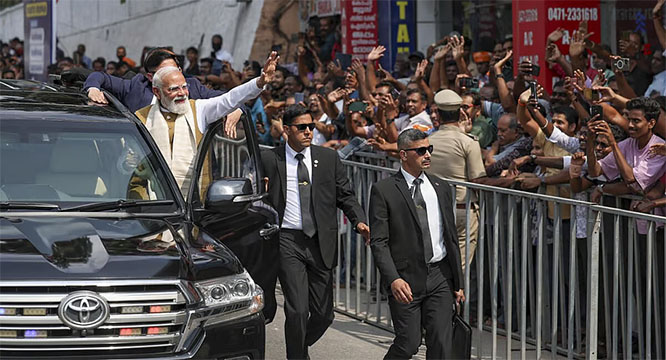
Prime Minister Narendra Modi, during his visit to Thiruvananthapuram on Friday, January 23, indicated that the Bharatiya Janata Party (BJP) is aiming to expand its political footprint in Kerala ahead of the Assembly elections scheduled in the coming months.

Speaking at a BJP-organised public meeting, Modi drew parallels between the party’s early electoral gains in Gujarat and its recent victory in the Thiruvananthapuram Municipal Corporation. The civic body win, which ended decades of Left control, was cited by the Prime Minister as a possible starting point for the party’s broader ambitions in the state.

Recalling BJP’s political trajectory in Gujarat, Modi said the party was largely insignificant before 1987 and received little media attention. He pointed out that the BJP’s first major breakthrough came with its victory in the Ahmedabad Municipal Corporation that year.

“Just as our journey in Gujarat began with one city, Kerala’s journey has also started with a single city,” Modi said, suggesting that the party’s municipal-level success could translate into wider electoral acceptance.

The Prime Minister alleged that successive governments led by the Left Democratic Front (LDF) and the United Democratic Front (UDF) had failed to adequately develop Thiruvananthapuram. He accused both fronts of corruption and neglect, claiming that basic infrastructure and facilities were denied to the capital city for decades.

According to Modi, the BJP’s control of the civic body represents a shift driven by public dissatisfaction with the existing political alternatives. He asserted that the BJP administration in Thiruvananthapuram had begun working towards development, though no specific details or timelines were outlined.

Addressing the gathering at Putharikandam Maidan, Modi said the BJP intended to project Thiruvananthapuram as a “model city,” reiterating his party’s commitment to governance-led change.

The Prime Minister’s visit to Kerala also included the inauguration of several development projects and the flagging off of new train services, as the BJP intensifies its political outreach in the poll-bound state.

Comments

Add new comment

  • Coastaldigest.com reserves the right to delete or block any comments.
  • Coastaldigset.com is not responsible for its readers’ comments.
  • Comments that are abusive, incendiary or irrelevant are strictly prohibited.
  • Please use a genuine email ID and provide your name to avoid reject.
News Network
January 20,2026

DGP.jpg

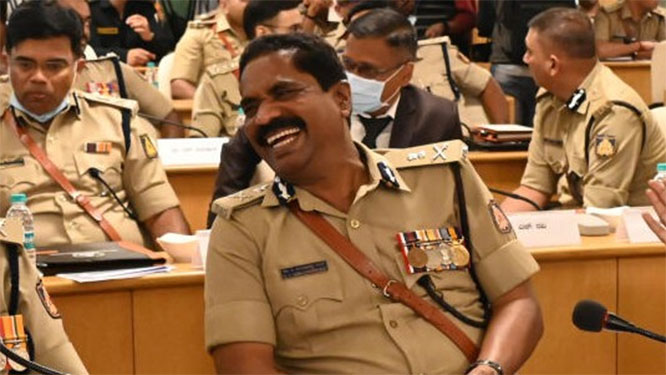
Karnataka DGP (Civil Rights Enforcement) K Ramachandra Rao was suspended with immediate effect, as per a state government order issued on Monday, 19 January. The order cited conduct unbecoming of a government servant and causing embarrassment to the state administration.

The Karnataka government suspended Rao after a purported video showed him in a compromising position with a woman inside his official chamber. The video went viral on social media. Rao rejected the videos outright, terming them "fabricated and false".

Who is K Ramachandra Rao?

Rao is a DGP-rank officer who was heading the Directorate of Civil Rights Enforcement until his suspension. He was promoted to DGP in September 2023 and assumed office in October 2023, the Sunday Guardian reported.

He also served as the Chairman and Managing Director of the Karnataka State Police Housing and Infrastructure Development Corporation Limited.

His stint as the Inspector General of Police (IGP) for the Southern Range was also marred by controversy. In 2014, during a cash seizure near Mysuru’s Yelwal, officials claimed the seized amount was ₹20 lakh, while the accused (Kerala-based merchants) claimed it was around ₹2.27 crore.

Rao, who was present during the seizure, denied all allegations. However, he was transferred soon after.

Allegations of collusion with a businessman surfaced, and a senior police officer was quoted by The Sunday Guardian as saying, “In Rao’s case, the CID has clearly mentioned that there was a great degree of lapse on the part of Rao and a deputy superintendent of police after it was brought to their notice that a few policemen, including a gunman attached to the IGP, were involved in the robbery.”

Rao had denied all wrongdoing in that incident. Despite past controversies, he rose to the state’s top police position, the Sunday Guardian reported.

Ranya Rao’s stepfather

Rao is the stepfather of Kannada actress Harshavardhini Ranya alias Ranya Rao, accused of orchestrating the illegal import of gold worth over ₹12.56 crore from Dubai to India along with two others — businessman Tarun Raju, and jewellery dealer Sahil Jain.

‘Obscene video’ controversy

A viral video showed Rao behaving inappropriately with a woman inside his office while in uniform.

The Karnataka government said in its Monday order that “vide videos and news reports widely broadcast on public news channels and media platforms, it is observed that Dr K Ramachandra Rao has acted in an obscene manner which is unbecoming of a Government Servant and also causing embarrassment to the Government.”

The order said the matter was examined by the state government, which found that the officer's conduct amounted to a violation of Rule 3 of the All India Services (Conduct) Rules, 1968.

The government said it is prima facie satisfied that "it is necessary to place Rao under suspension with immediate effect, pending inquiry".

During the suspension period, Rao will be entitled to subsistence allowance as per Rule 4 of the All India Services (Discipline and Appeal) Rules, 1969.

The order also places restrictions on his movement, stating that during the period of suspension, the officer must not leave headquarters under any circumstances without the written permission of the state government.

Comments

Add new comment

  • Coastaldigest.com reserves the right to delete or block any comments.
  • Coastaldigset.com is not responsible for its readers’ comments.
  • Comments that are abusive, incendiary or irrelevant are strictly prohibited.
  • Please use a genuine email ID and provide your name to avoid reject.
News Network
February 1,2026

Bengaluru: Karnataka Deputy Chief Minister D K Shivakumar on Sunday criticised the Union Budget presented by Finance Minister Nirmala Sitharaman, claiming it offered no tangible benefit to the state.

Though he said he was yet to study the budget in detail, Shivakumar asserted that Karnataka had gained little from it. “There is no benefit for our state from the central budget. I was observing it. They have now named a programme after Mahatma Gandhi, after repealing the MGNREGA Act that was named after him,” he said.

Speaking to reporters here, the Deputy Chief Minister demanded the restoration of MGNREGA, and made it clear that the newly enacted rural employment scheme — VB-G RAM G — which proposes a 60:40 fund-sharing formula between the Centre and the states, would not be implemented in Karnataka.

“I don’t see any major share for our state in this budget,” he added.

Shivakumar, who also holds charge of Bengaluru development, said there were high expectations for the city from the Union Budget. “The Prime Minister calls Bengaluru a ‘global city’, but what has the Centre done for it?” he asked.

He also drew attention to the problems faced by sugar factories, particularly those in the cooperative sector, alleging a lack of timely decisions and support from the central government.

Noting that the Centre has the authority to fix the minimum support price (MSP) for agricultural produce, Shivakumar said the Union government must take concrete steps to protect farmers’ interests.

Comments

Add new comment

  • Coastaldigest.com reserves the right to delete or block any comments.
  • Coastaldigset.com is not responsible for its readers’ comments.
  • Comments that are abusive, incendiary or irrelevant are strictly prohibited.
  • Please use a genuine email ID and provide your name to avoid reject.