Ukraine tensions escalate as West accuses Russia of lying about troop withdrawal

Agencies
February 17, 2022

russia.jpg

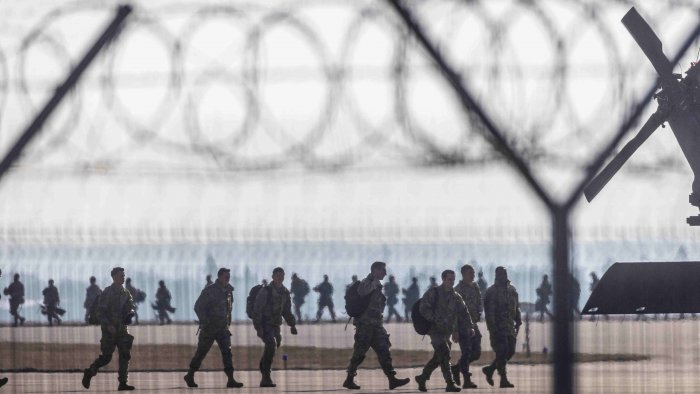
Tensions over Ukraine abruptly ratcheted up Wednesday as Western officials accused Russia of lying about whether it had really begun pulling back troops from the Ukrainian border.

After days marked by flickers of hope that the conflict might be resolved peacefully, a senior US official, who refused to be quoted by name, told reporters that far from winding down its deployment, Moscow had added more than 7,000 combatants. Western allies expressed similar doubts about the Russian claims.

The US official directly accused Russia of lying, saying there was fresh evidence it was mobilizing for war.

British military officials said Wednesday they had spotted Russian armored vehicles, helicopters and a field hospital moving toward Ukraine’s border.

“Contrary to their claims, Russia continues to build up military capabilities near Ukraine,” Lt. Gen. Jim Hockenhull, the British chief of defense intelligence, said in a statement. “Russia has the military mass in place to conduct an invasion of Ukraine.

The Western warnings contrasted sharply with Russia’s attempts to show that it was de-escalating.

Only hours earlier, the Russian Defense Ministry had released a video of a military convoy departing Crimea over the 12-mile bridge to Russia that President Vladimir Putin ordered built after the peninsula’s 2014 annexation. And the Kremlin’s spokesperson praised the United States for being willing to negotiate and for offering constructive ideas.

With the sudden turn of events Wednesday night, the outlines of any diplomatic solution to the crisis once again looked very hard to discern.

In recent days, US officials had pointedly declined to accept Russian claims of a pullback.

On Wednesday, Secretary of State Antony Blinken, in an interview on MSNBC, said that the military units critical for an invasion force were continuing to move “toward the border, not away from the border.”

To some extent, the battle between the West and Moscow over Ukraine has been one of signaling. To keep international pressure on Russia high, the United States has repeatedly declared that an invasion was near, even imminent. Moscow, in turn, has repeatedly accused Washington of exaggerating the threat.

But beyond the verbal dueling, real troops have been repositioned.

In Brussels, defense ministers from the NATO countries discussed ways to reinforce military positions on their eastern perimeter, while the group’s secretary-general, Jens Stoltenberg, said he also saw nothing to support Russia’s claim of a drawdown. “What we see is that Russian troops are moving into position,” Stoltenberg said.

Mixed signals have been emanating virtually daily from Kyiv and Moscow, posing a challenge for diplomats, analysts and military planners. All sides are following delicate strategies, trying to appear resolute but not inflexible, so as to avoid blame in the event of war.

“There’s a lot of bluffing,” said Igor Novikov, a former foreign policy adviser to President Volodymyr Zelenskyy of Ukraine. “It’s a poker game at the moment. But a very dangerous poker game.”

After talking up the prospects for diplomacy in recent days, Putin went silent on the crisis, taking no questions after meeting with President Jair Bolsonaro of Brazil, although his government continued to telegraph openness to diplomacy and dismissed the idea of an invasion.

For Putin, Russian analysts said, the plan remained to use the threat of war to achieve far-reaching objectives that he would prefer to attain peacefully: a rollback of NATO’s presence in Eastern Europe and the recognition of a Russian sphere of interest in the region, including Ukraine.

Dmitri Trenin, director of the Carnegie Moscow Center, said he expected many Russian troops to remain positioned near the border, in part to maintain that state of tension. “He will keep the pressure on until he gets a satisfactory answer to his main question,” he said.

Putin appeared to dial down tensions this week in part because he had already made important early gains in a diplomatic effort that could still last for months. The United States, for instance, said it was prepared to revive talks on the placement of short and intermediate-range missiles in Europe. Some dialogue had already begun last year.

Putin has multiple ways to keep the pressure on, among them ominous new military moves, disinformation and cyberattacks. He can also wield political tactics like Tuesday’s vote in Russia’s Kremlin-controlled parliament that called on Putin to recognize the independence of Russian-backed separatists in eastern Ukraine, a move that he said he was not yet prepared to make.

“We are at the end of the beginning,” Trenin said, suggesting negotiations could continue for some time. “The game itself is still to come.”

One aspect has already emerged into public view: a discussion underway by European, Russian and Ukrainian leaders and officials over whether Ukraine might resolve the threat by abandoning its ambitions to join NATO.

After months of rejecting the Kremlin’s demands that NATO rule out Ukraine’s membership, US officials have also begun to signal that the question is one for Ukrainians themselves to decide. Even Zelenskyy has softened a bit recently, saying, “It seems to me that no one is hiding it anymore.”

Analysts say the trick will be to devise a plan that will be acceptable to the Kremlin without provoking a backlash in Ukraine that could destabilize the government.

“Everyone must step back a bit here and make it clear to themselves that we just can’t have a possible military conflict over a question that is not on the agenda,” German Chancellor Olaf Scholz said after meeting with Putin on Tuesday, speaking of Ukrainian NATO membership.

A Ukrainian deputy prime minister, Iryna Vereshchuk, suggested a referendum as a way to sell what would surely appear to be a concession to the Ukrainian public.

“The president assumes there is such a possibility, if there are no other options or tools,” Vereshchuk said in an interview on Ukrainian television. The prospects of Russia agreeing to a referendum are uncertain, as preparations could take months, during which it would be costly for Moscow to continue to maintain the threat of an imminent invasion.

But in a signal of possible US support, Wendy R. Sherman, a deputy secretary of state who in earlier rounds of talks had refused to accede to Russian demands that the United States rule out NATO membership for Ukraine, said in an interview published Wednesday that the United States would support any decision made by the Ukrainians.

“This decision remains with the Ukrainian people, what they want, where they see their future,” Sherman told Yevropaiska Pravda, a Ukrainian news outlet. “This is your choice.”

It seems certain that Putin will not be satisfied with simple assurances that Ukraine has no intention of joining NATO currently or a vague moratorium. “They are telling us it won’t happen tomorrow,” he said Tuesday. “Well, when will it happen? The day after tomorrow?”

Analysts have suggested setting a length for a moratorium, say 20-25 years, to assuage Putin’s misgivings.

Scholz pressed the idea of a lengthy delay, saying any Ukrainian entry into NATO was not likely during either of their terms in office. “I don’t know how long the president intends to stay in office,” he said, in a rare barb by a German leader directed at Putin. “I have a feeling for a little while yet, but certainly not forever.”

Senior Russian officials had some fun of their own, needling Washington for its prediction that an invasion could start Wednesday — perhaps in the wee hours of the morning, according to some news reports. Maria Zakharova, the Foreign Ministry’s often caustic spokesperson, said she would appreciate US and British news outlets publishing the schedules for Russia’s “invasions” in the coming year, because “I’d like to plan my vacation.”

Comments

Add new comment

  • Coastaldigest.com reserves the right to delete or block any comments.
  • Coastaldigset.com is not responsible for its readers’ comments.
  • Comments that are abusive, incendiary or irrelevant are strictly prohibited.
  • Please use a genuine email ID and provide your name to avoid reject.
News Network
November 27,2025

Bengaluru, Nov 27: Karnataka Chief Minister Siddaramaiah’s camp is reportedly on alert as the Congress leadership tussle in the state intensifies, particularly amid speculation over the potential promotion of Deputy Chief Minister D.K. Shivakumar. Siddaramaiah is said to be in a “wait-and-watch” mode after admitting to “confusion” earlier this week and urging the party to “put a full stop” to it.

Sources say his supporters are ready to act if senior leaders — including party chief Mallikarjun Kharge, Sonia Gandhi, and Rahul Gandhi — give any indication of backing Shivakumar. If the party insists on a leadership change, Siddaramaiah’s camp has a list of alternatives, underscoring the deep rift between the two leaders. One possible candidate is Home Minister G. Parameshwara, a Siddaramaiah loyalist and influential Dalit leader.

The strategy was reportedly finalized at a meeting led by PWD Minister Satish Jarkiholi, another Siddaramaiah supporter, who stressed that Delhi leaders need to resolve the issue. Kharge and the Gandhis are expected to meet soon, after which Siddaramaiah and Shivakumar may be summoned to Delhi.

Shivakumar has largely stayed non-confrontational, publicly endorsing Siddaramaiah and downplaying speculation about his own ambitions. However, he has made pointed comments emphasizing the importance of honoring promises, directed at Siddaramaiah.

The feud traces back to the 2023 state election, when Siddaramaiah was chosen as Chief Minister while Shivakumar, who led the party’s campaign, was made Deputy CM and state party chief — a departure from the Congress’ usual “one post per person” rule.

There were also hints of a prior understanding that Siddaramaiah would step down midway through the term. As the halfway mark passed last week, Shivakumar-aligned lawmakers have ramped up pressure on the party for a leadership change, with Shivakumar himself hinting at stepping down as state party chief to pursue the top job.

Comments

Add new comment

  • Coastaldigest.com reserves the right to delete or block any comments.
  • Coastaldigset.com is not responsible for its readers’ comments.
  • Comments that are abusive, incendiary or irrelevant are strictly prohibited.
  • Please use a genuine email ID and provide your name to avoid reject.
News Network
December 2,2025

A major upgrade in safety and monitoring is planned for Haj 2026, with every Indian pilgrim set to receive a Haj Suvidha smart wristband linked to the official Haj Suvidha mobile app. The initiative aims to support pilgrims—especially senior citizens—who may struggle with smartphones during the 45-day journey.

What the Smart Wristband Will Do

Officials said the device will come with:
•    Location tracking
•    Pedometer
•    SOS emergency button
•    Qibla compass
•    Prayer timings
•    Basic health monitoring

SP Tiwari, secretary of the UP State Haj Committee, said the goal is to make the pilgrimage safer and more comfortable.

“Most Hajis are elderly and not comfortable with mobile apps,” he said. “The smartwatch will help locate pilgrims who forget their way or cannot communicate their location.”

The wristbands will be monitored by the Consulate General of India in Saudi Arabia, similar to mobile tracking via the Haj Suvidha App.

Free Distribution and Training

•    Smart wristbands will be given free of cost.
•    Training for pilgrims will be conducted between January and February 2026.
•    Sample units will reach state Haj committees soon.
•    Final devices will be distributed as pilgrims begin their journey.

New Rules for Accommodation

Two major decisions have also been finalised for Haj 2026:
1.    Separate rooms for men and women – including married couples. They may stay on the same floor but must occupy different rooms, following stricter Saudi guidelines.
2.    Cooking banned – gas cylinders will not be allowed; all meals will be provided through official catering services arranged by the Haj Committee of India.

These decisions were finalised during a meeting of the Haj Committee of India and state representatives in Mumbai.

Haj Suvidha App Launched Earlier

The government launched the Haj Suvidha App in 2024, offering:

•    Training modules
•    Accommodation and flight details
•    Baggage information
•    SOS and translation tools
•    Grievance redressal

Haj 2026 Quota and Key States

•    India’s total Haj quota for 2026: 1,75,025 pilgrims
•    70% (1,25,000) allotted to the Haj Committee of India
•    30% (around 50,000) reserved for Haj Group Organisers

Uttar Pradesh has the largest allocation (around 30,000 seats), though approximately 18,000 pilgrims are expected to go this year. States with high pilgrim numbers include Kerala, Maharashtra and Gujarat.

Dates of Haj 2026

The pilgrimage is scheduled to take place from 24 May to 29 May, 2026 (tentative).
Haj is one of the five pillars of Islam and is mandatory for Muslims who meet the required conditions.

Comments

Add new comment

  • Coastaldigest.com reserves the right to delete or block any comments.
  • Coastaldigset.com is not responsible for its readers’ comments.
  • Comments that are abusive, incendiary or irrelevant are strictly prohibited.
  • Please use a genuine email ID and provide your name to avoid reject.
News Network
November 29,2025

DKSsiddu.jpg

New Delhi: Karnataka chief minister Siddaramaiah and deputy CM DK Shivakumar on Saturday put up a dramatic display of unity at a closely watched joint press briefing, firmly dismissing weeks of speculation about a power-sharing tussle within the Congress. With the high command nudging both leaders to sit together and settle the dust, the meeting became a political spectacle, ending with the duo declaring that there was “no confusion, no differences.”

Calling the reports of a rift “manufactured confusion,” Siddaramaiah said the talks had gone smoothly, even joking about their breakfast. “Breakfast was very good. All three of us enjoyed it,” he said. “We want to end this confusion once and for all. For local elections and for 2028, our mission is clear — Congress must return to power. There is no difference between me and DKS, not now, not before.”

He blamed the media for fuelling rumours and reiterated absolute adherence to the party leadership. “From tomorrow, let there be no confusion. What the high command says, we will follow.”

Siddaramaiah also assured that the Assembly session starting December 8 would run smoothly and vowed that Congress would take on the BJP and JD(S) “together.”

Shivakumar echoed the chief minister word for word, stressing loyalty and discipline. “People have given us a massive mandate. It is our duty to deliver,” he said. “This government was formed under Siddaramaiah’s leadership. We both have complete trust in the high command. If they tell me to wait, I will wait.”

He added that the two leaders had discussed strategy for the 2028 Assembly elections. “Whatever the CM says, I agree. We are loyal soldiers of the party. The party may be facing challenges nationally, but we will keep it strong in Karnataka.”

Shivakumar also said Siddaramaiah would soon visit his home for lunch or dinner — another symbolic gesture meant to underline their unity.

Both leaders later posted on social media describing the breakfast meeting as “productive” and focused on “Karnataka’s priorities.”

The BJP, however, rejected the show of camaraderie as “pure bunkum,” accusing Congress of trying to paper over an internal power struggle. But Siddaramaiah and Shivakumar insisted their united front would continue — and that there was “no confusion” within the state leadership.

Comments

Add new comment

  • Coastaldigest.com reserves the right to delete or block any comments.
  • Coastaldigset.com is not responsible for its readers’ comments.
  • Comments that are abusive, incendiary or irrelevant are strictly prohibited.
  • Please use a genuine email ID and provide your name to avoid reject.