



Ukraine tensions escalate as West accuses Russia of lying about troop withdrawal

Agencies
February 17, 2022

russia.jpg

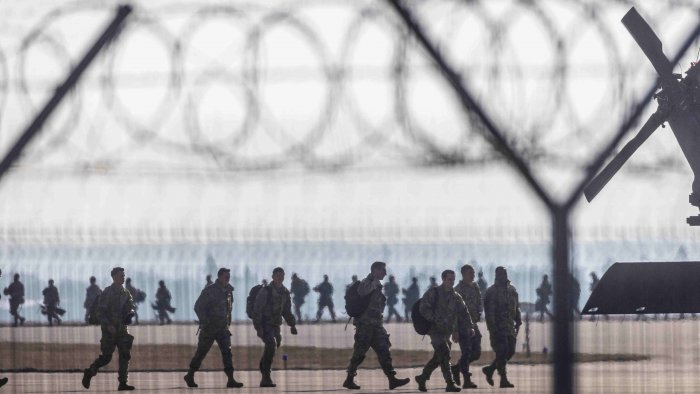
Tensions over Ukraine abruptly ratcheted up Wednesday as Western officials accused Russia of lying about whether it had really begun pulling back troops from the Ukrainian border.

After days marked by flickers of hope that the conflict might be resolved peacefully, a senior US official, who refused to be quoted by name, told reporters that far from winding down its deployment, Moscow had added more than 7,000 combatants. Western allies expressed similar doubts about the Russian claims.

The US official directly accused Russia of lying, saying there was fresh evidence it was mobilizing for war.

British military officials said Wednesday they had spotted Russian armored vehicles, helicopters and a field hospital moving toward Ukraine’s border.

“Contrary to their claims, Russia continues to build up military capabilities near Ukraine,” Lt. Gen. Jim Hockenhull, the British chief of defense intelligence, said in a statement. “Russia has the military mass in place to conduct an invasion of Ukraine.

The Western warnings contrasted sharply with Russia’s attempts to show that it was de-escalating.

Only hours earlier, the Russian Defense Ministry had released a video of a military convoy departing Crimea over the 12-mile bridge to Russia that President Vladimir Putin ordered built after the peninsula’s 2014 annexation. And the Kremlin’s spokesperson praised the United States for being willing to negotiate and for offering constructive ideas.

With the sudden turn of events Wednesday night, the outlines of any diplomatic solution to the crisis once again looked very hard to discern.

In recent days, US officials had pointedly declined to accept Russian claims of a pullback.

On Wednesday, Secretary of State Antony Blinken, in an interview on MSNBC, said that the military units critical for an invasion force were continuing to move “toward the border, not away from the border.”

To some extent, the battle between the West and Moscow over Ukraine has been one of signaling. To keep international pressure on Russia high, the United States has repeatedly declared that an invasion was near, even imminent. Moscow, in turn, has repeatedly accused Washington of exaggerating the threat.

But beyond the verbal dueling, real troops have been repositioned.

In Brussels, defense ministers from the NATO countries discussed ways to reinforce military positions on their eastern perimeter, while the group’s secretary-general, Jens Stoltenberg, said he also saw nothing to support Russia’s claim of a drawdown. “What we see is that Russian troops are moving into position,” Stoltenberg said.

Mixed signals have been emanating virtually daily from Kyiv and Moscow, posing a challenge for diplomats, analysts and military planners. All sides are following delicate strategies, trying to appear resolute but not inflexible, so as to avoid blame in the event of war.

“There’s a lot of bluffing,” said Igor Novikov, a former foreign policy adviser to President Volodymyr Zelenskyy of Ukraine. “It’s a poker game at the moment. But a very dangerous poker game.”

After talking up the prospects for diplomacy in recent days, Putin went silent on the crisis, taking no questions after meeting with President Jair Bolsonaro of Brazil, although his government continued to telegraph openness to diplomacy and dismissed the idea of an invasion.

For Putin, Russian analysts said, the plan remained to use the threat of war to achieve far-reaching objectives that he would prefer to attain peacefully: a rollback of NATO’s presence in Eastern Europe and the recognition of a Russian sphere of interest in the region, including Ukraine.

Dmitri Trenin, director of the Carnegie Moscow Center, said he expected many Russian troops to remain positioned near the border, in part to maintain that state of tension. “He will keep the pressure on until he gets a satisfactory answer to his main question,” he said.

Putin appeared to dial down tensions this week in part because he had already made important early gains in a diplomatic effort that could still last for months. The United States, for instance, said it was prepared to revive talks on the placement of short and intermediate-range missiles in Europe. Some dialogue had already begun last year.

Putin has multiple ways to keep the pressure on, among them ominous new military moves, disinformation and cyberattacks. He can also wield political tactics like Tuesday’s vote in Russia’s Kremlin-controlled parliament that called on Putin to recognize the independence of Russian-backed separatists in eastern Ukraine, a move that he said he was not yet prepared to make.

“We are at the end of the beginning,” Trenin said, suggesting negotiations could continue for some time. “The game itself is still to come.”

One aspect has already emerged into public view: a discussion underway by European, Russian and Ukrainian leaders and officials over whether Ukraine might resolve the threat by abandoning its ambitions to join NATO.

After months of rejecting the Kremlin’s demands that NATO rule out Ukraine’s membership, US officials have also begun to signal that the question is one for Ukrainians themselves to decide. Even Zelenskyy has softened a bit recently, saying, “It seems to me that no one is hiding it anymore.”

Analysts say the trick will be to devise a plan that will be acceptable to the Kremlin without provoking a backlash in Ukraine that could destabilize the government.

“Everyone must step back a bit here and make it clear to themselves that we just can’t have a possible military conflict over a question that is not on the agenda,” German Chancellor Olaf Scholz said after meeting with Putin on Tuesday, speaking of Ukrainian NATO membership.

A Ukrainian deputy prime minister, Iryna Vereshchuk, suggested a referendum as a way to sell what would surely appear to be a concession to the Ukrainian public.

“The president assumes there is such a possibility, if there are no other options or tools,” Vereshchuk said in an interview on Ukrainian television. The prospects of Russia agreeing to a referendum are uncertain, as preparations could take months, during which it would be costly for Moscow to continue to maintain the threat of an imminent invasion.

But in a signal of possible US support, Wendy R. Sherman, a deputy secretary of state who in earlier rounds of talks had refused to accede to Russian demands that the United States rule out NATO membership for Ukraine, said in an interview published Wednesday that the United States would support any decision made by the Ukrainians.

“This decision remains with the Ukrainian people, what they want, where they see their future,” Sherman told Yevropaiska Pravda, a Ukrainian news outlet. “This is your choice.”

It seems certain that Putin will not be satisfied with simple assurances that Ukraine has no intention of joining NATO currently or a vague moratorium. “They are telling us it won’t happen tomorrow,” he said Tuesday. “Well, when will it happen? The day after tomorrow?”

Analysts have suggested setting a length for a moratorium, say 20-25 years, to assuage Putin’s misgivings.

Scholz pressed the idea of a lengthy delay, saying any Ukrainian entry into NATO was not likely during either of their terms in office. “I don’t know how long the president intends to stay in office,” he said, in a rare barb by a German leader directed at Putin. “I have a feeling for a little while yet, but certainly not forever.”

Senior Russian officials had some fun of their own, needling Washington for its prediction that an invasion could start Wednesday — perhaps in the wee hours of the morning, according to some news reports. Maria Zakharova, the Foreign Ministry’s often caustic spokesperson, said she would appreciate US and British news outlets publishing the schedules for Russia’s “invasions” in the coming year, because “I’d like to plan my vacation.”

Comments

Add new comment

  • Coastaldigest.com reserves the right to delete or block any comments.
  • Coastaldigset.com is not responsible for its readers’ comments.
  • Comments that are abusive, incendiary or irrelevant are strictly prohibited.
  • Please use a genuine email ID and provide your name to avoid reject.
News Network
January 23,2026

Karnataka Governor Thaawarchand Gehlot read only three lines from the 122-paragraph address prepared by the Congress-led state government while addressing the joint session of the Legislature on Thursday, effectively bypassing large sections critical of the BJP-led Union government.

The omitted portions of the customary Governor’s address outlined what the state government described as a “suppressive situation in economic and policy matters” under India’s federal framework. The speech also sharply criticised the Centre’s move to replace the Mahatma Gandhi National Rural Employment Guarantee Act (MGNREGA) with the Viksit Bharat–Guarantee for Rozgar and Ajeevika Mission (Gramin) Act, commonly referred to as the VB-GRAM (G) Act.

Governor Gehlot had earlier conveyed his objection to several paragraphs that were explicitly critical of the Union government. On Thursday, he confined himself to the opening lines — “I extend a warm welcome to all of you to the joint session of the State legislature. I am extremely pleased to address this august House” — before jumping directly to the concluding sentence of the final paragraph.

He ended the address by reading the last line of paragraph 122: “Overall, my government is firmly committed to doubling the pace of the State’s economic, social and physical development. Jai Hind — Jai Karnataka.”

According to the prepared speech, the Karnataka government demanded the scrapping of the VB-GRAM (G) Act, describing it as “contractor-centric” and detrimental to rural livelihoods, and called for the full restoration of MGNREGA. The state government argued that the new law undermines decentralisation, weakens labour protections, and centralises decision-making in violation of constitutional norms.

Key points from the unread sections of the speech:

•    Karnataka facing a “suppressive” economic and policy environment within the federal system

•    Repeal of MGNREGA described as a blow to rural livelihoods

•    VB-GRAM (G) Act accused of protecting corporate and contractor interests

•    New law alleged to weaken decentralised governance

•    Decision-making said to be imposed by the Centre without consulting states

•    Rights of Adivasis, women, backward classes and agrarian communities curtailed

•    Labourers allegedly placed under contractor control

•    States facing mounting fiscal stress due to central policies

•    VB-GRAM (G) Act accused of enabling large-scale corruption

Comments

Add new comment

  • Coastaldigest.com reserves the right to delete or block any comments.
  • Coastaldigset.com is not responsible for its readers’ comments.
  • Comments that are abusive, incendiary or irrelevant are strictly prohibited.
  • Please use a genuine email ID and provide your name to avoid reject.
News Network
February 1,2026

Bengaluru: Karnataka Deputy Chief Minister D K Shivakumar on Sunday criticised the Union Budget presented by Finance Minister Nirmala Sitharaman, claiming it offered no tangible benefit to the state.

Though he said he was yet to study the budget in detail, Shivakumar asserted that Karnataka had gained little from it. “There is no benefit for our state from the central budget. I was observing it. They have now named a programme after Mahatma Gandhi, after repealing the MGNREGA Act that was named after him,” he said.

Speaking to reporters here, the Deputy Chief Minister demanded the restoration of MGNREGA, and made it clear that the newly enacted rural employment scheme — VB-G RAM G — which proposes a 60:40 fund-sharing formula between the Centre and the states, would not be implemented in Karnataka.

“I don’t see any major share for our state in this budget,” he added.

Shivakumar, who also holds charge of Bengaluru development, said there were high expectations for the city from the Union Budget. “The Prime Minister calls Bengaluru a ‘global city’, but what has the Centre done for it?” he asked.

He also drew attention to the problems faced by sugar factories, particularly those in the cooperative sector, alleging a lack of timely decisions and support from the central government.

Noting that the Centre has the authority to fix the minimum support price (MSP) for agricultural produce, Shivakumar said the Union government must take concrete steps to protect farmers’ interests.

Comments

Add new comment

  • Coastaldigest.com reserves the right to delete or block any comments.
  • Coastaldigset.com is not responsible for its readers’ comments.
  • Comments that are abusive, incendiary or irrelevant are strictly prohibited.
  • Please use a genuine email ID and provide your name to avoid reject.
News Network
January 23,2026

Mangaluru: The Karnataka Government Polytechnic (KPT), Mangaluru, has achieved autonomous status from the All India Council for Technical Education (AICTE), becoming the first government polytechnic in the country to receive such recognition in its 78-year history. The status was granted by AICTE, New Delhi, and subsequently approved by the Karnataka Board of Technical Education in October last year.

Officials said the autonomy was conferred a few months ago. Until recently, AICTE extended autonomous status only to engineering colleges, excluding diploma institutions. However, with a renewed national focus on skill development, several government polytechnics across India have now been granted autonomy.

KPT, the second-largest polytechnic in Karnataka, was established in 1946 with four branches and has since expanded to offer eight diploma programmes, including computer science and polymer technology. The institution is spread across a 19-acre campus.

Ravindra M Keni, the first dean of the institution, told The Times of India that AICTE had proposed autonomous status for polytechnic institutions that are over 25 years old. “Many colleges applied. In the first round, 100 institutions were shortlisted, which was further narrowed down to 15 in the second round. We have already completed one semester after becoming an autonomous institution,” he said. He added that nearly 500 students are admitted annually across eight three-year diploma courses.

Explaining the factors that helped KPT secure autonomy, Keni said the institution has consistently recorded 100 per cent admissions and placements for its graduates. He also noted its strong performance in sports, with the college emerging champions for 12 consecutive years, along with active student participation in NCC and NSS activities.

Autonomous status allows KPT to design industry-oriented curricula, conduct examinations, prepare question papers, and manage academic documentation independently. The institution can also directly collaborate with industries and receive priority funding from AICTE or the Ministry of Education. While academic autonomy has been granted, financial control will continue to rest with the state government.

“There will be separate committees for examinations, question paper setting, boards of studies, and boards of examiners. The institution will now have the freedom to conduct admissions without government notifications and issue its own marks cards,” Keni said, adding that new academic initiatives would be planned after a year of functioning under the autonomous framework.

Comments

Add new comment

  • Coastaldigest.com reserves the right to delete or block any comments.
  • Coastaldigset.com is not responsible for its readers’ comments.
  • Comments that are abusive, incendiary or irrelevant are strictly prohibited.
  • Please use a genuine email ID and provide your name to avoid reject.