



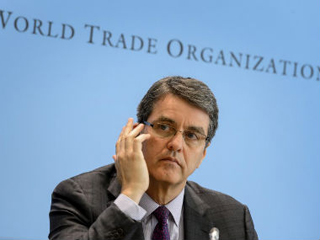
WTO: EU, Aus-led group unite against India over Trade Facilitation Agreement

July 26, 2014

Trade Facilitation
Washington, Jul 26: Unconvinced by India's line that it will not sign the Trade Facilitation Agreement at World Trade Organisation (WTO) unless its food security concerns are addressed, a large block of global powers have joined hands against New Delhi in Geneva where negotiations on this matter are going on.

In two separate statements the European Union and an Australia-led group of more than two dozen countries have asked India not to veto the Trade Facilitation Agreement (TFA) of the World Trade Organization (WTO). "A decision to step away would be in no one's interest. It would seriously undermine the ability of the WTO to deliver for the future," warned the 25-country group led by Australia.

"In practice, it would also block the new capacity building initiatives to assist WTO Members implement the TFA. The new economic growth and jobs that are expected to flow from the implementation of the TFA would not become a reality. It would fundamentally undermine the prospects for progress on the post-Bali work program for the Doha negotiations and on the other decisions that Ministers took in Bali," the Australia-led statement said.

India has made it clear that it will not yield to the pressure of developed nations on pushing the WTO's Bali agreement on trade facilitation agreement without addressing New Delhi's concerns on food security issues. The matter was discussed in the Union Cabinet on Thursday.

India wants a concrete framework on finding a permanent solution for India's public stock holding issue and without that New Delhi will not adopt the TFA protocol.

Sharp differences have emerged between rich economies like the US and Australia and emerging nations, including India and South Africa, on implementation of the Bali package.

In a separate statement, the European Union said without adoption of the Trade Facilitation Protocol by July 31 a great opportunity to mobilise trade as an instrument for growth and development would be lost, and the credibility of the WTO, which has during the financial crisis proven its value as a firewall against protectionism, would be further damaged.In an apparent reference to India's concerns, the European Union said on food security, Bali meeting provided an open-ended solution which addresses effectively the concerns while WTO members continue to work for a permanent solution.

"So far, WTO members have jointly respected and honoured the Bali commitments. Serious work has been done over the last months and good progress been made, including on issues of interest to developing and least developed countries," it said.

"The proper and timely implementation of the Bali package as agreed by Ministers is of crucial importance to the WTO and all WTO members," the European Union added. "Without adoption of the Trade Facilitation Protocol by July 31 a great opportunity to mobilise trade as an instrument for growth and development would be lost, and the credibility of the WTO, which has during the financial crisis proven its value as a firewall against protectionism, would be further damaged," it said.

Urging member nations to respect the decisions taken by Ministers in Bali, the statement said the European Union is not ready to renegotiate basic elements or timelines that were agreed as integral part of the Bali package. "The EU is ready to work with all members to find a solution by the 31 July for Trade Facilitation and to intensify work for satisfactory and timely progress on all aspects of the Bali Ministerial decisions in accordance with the mandate," it said.


Comments

Add new comment

  • Coastaldigest.com reserves the right to delete or block any comments.
  • Coastaldigset.com is not responsible for its readers’ comments.
  • Comments that are abusive, incendiary or irrelevant are strictly prohibited.
  • Please use a genuine email ID and provide your name to avoid reject.
News Network
December 16,2025

bengal.jpg

The deletion of over 58 lakh names from West Bengal’s draft electoral rolls following a Special Intensive Revision (SIR) has sparked widespread concern and is likely to deepen political tensions in the poll-bound state.

According to the Election Commission, the revision exercise has identified 24 lakh voters as deceased, 19 lakh as relocated, 12 lakh as missing, and 1.3 lakh as duplicate entries. The draft list, published after the completion of the first phase of SIR, aims to remove errors and duplication from the electoral rolls.

However, the scale of deletions has raised fears that a large number of eligible voters may have been wrongly excluded. The Election Commission has said that individuals whose names are missing can file objections and seek corrections. The final voter list is scheduled to be published in February next year, after which the Assembly election announcement is expected. Notably, the last Special Intensive Revision in Bengal was conducted in 2002.

The development has intensified the political row over the SIR process. Chief Minister Mamata Banerjee and her Trinamool Congress have strongly opposed the exercise, accusing the Centre and the Election Commission of attempting to disenfranchise lakhs of voters ahead of the elections.

Addressing a rally in Krishnanagar earlier this month, Banerjee urged people to protest if their names were removed from the voter list, alleging intimidation during elections and warning of serious consequences if voting rights were taken away.

The BJP, meanwhile, has defended the revision and accused the Trinamool Congress of politicising the issue to protect what it claims is an illegal voter base. Leader of the Opposition Suvendu Adhikari alleged that the ruling party fears losing power due to the removal of deceased, fake, and illegal voters.

The controversy comes amid earlier allegations by the Trinamool Congress that excessive work pressure during the SIR led to the deaths by suicide of some Booth Level Officers (BLOs), for which the party blamed the Election Commission. With the draft list now out, another round of political confrontation appears imminent.

As objections begin to be filed, the focus will be on whether the correction mechanism is accessible, transparent, and timely—critical factors in ensuring that no eligible voter is denied their democratic right ahead of a crucial election.

Comments

Add new comment

  • Coastaldigest.com reserves the right to delete or block any comments.
  • Coastaldigset.com is not responsible for its readers’ comments.
  • Comments that are abusive, incendiary or irrelevant are strictly prohibited.
  • Please use a genuine email ID and provide your name to avoid reject.