YES Bank tumbles 85% as RBI imposes moratorium; SBI plunges 11%

News Network
March 6, 2020

New Delhi, Mar 6: Shares of YES Bank and State Bank of India came under huge selling pressure on Friday as developments unfolded regarding SBI picking stake in the private lender. Shares of the lender hit record low of Rs 5.55, plunging 85 per cent, and were trading below its previous low of Rs 8.16 hit on March 9, 2009.
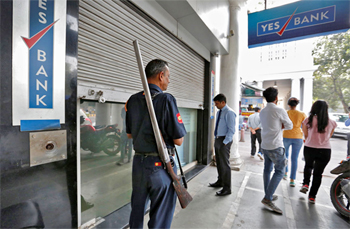
SBI, on the other hand, slumped 11 per cent to Rs 257.35 on the BSE. The benchmark S&P BSE Sensex was trading with a cut of over 3 per cent at 37,251.37 level.

In the past three months, share price of the private lender has plunged 41 per cent, while the state-owned lender has slipped 14 per cent. In comparison, the S&P BSE Sensex has dipped 5.6 per cent till Thursday.

On Thursday, the Reserve Bank of India superseded the board of troubled private sector lender YES Bank and imposed a 30-day moratorium on it “in the absence of a credible revival plan” amid a “serious deterioration” in its financial health.

During the moratorium, which came into effect from 6 pm on Thursday, YES Bank will not be allowed to grant or renew any loans, and “incur any liability”, except for payment towards employees’ salaries, rent, taxes and legal expenses, among others.

This is the first time that a bank of this size will be put under a moratorium by the RBI.

“The financial position of YES Bank had undergone a steady decline “largely due to inability of the bank to raise capital to address potential loan losses and resultant downgrades, triggering invocation of bond covenants by investors, and withdrawal of deposits,” RBI said in a statement.

“After the moratorium, the next step will be to infuse to money and keep the bank afloat. So from shareholders’ point of view, the future is certainly hazy as the capital requirement is huge. The good part, however, is that the RBI has stepped in and depositors don't have to worry,” says Siddharth Purohit, a research analyst at SMC Securities.

Meanwhile, analysts at Nomura believe that placing the Bank under moratorium implies that equity value in the bank would be negligible, and that the chances of private capital participating in future capital raising plan are near zero.

"Any resolution for Yes Bank is more proposed from the perspective of deposit holders and systemic stability, and not from the perspective of Yes Bank equity investors or even perpetual bond holders," they wrote in a note dated March 6.

In another development, SBI’s Board Thursday gave in-principle approval to consider an “investment opportunity” in YES Bank, even as it said “no decision had yet been taken to pick up stake in the bank”.

According to a  report, highly-placed sources indicated a rescue plan involving SBI and Life Insurance Corporation of India (LIC) was being discussed and an announcement in this regard might be made soon.

“While the finer details of the deal are being worked out, it is anticipated that both SBI and LIC together will take a 51 per cent stake in the bank, with a one-year lock-in period,” the report said.

Most analysts believe it is a positive step for the Indian financial sector as the government has tried to avoid a repeat of IL&FS-like crisis.

“The move is a positive step for the financial sector as a whole. By this, the government has tried to avoid a repeat of IL&FS-like crisis and has saved the depositors,” said AK Prabhakar, Head of Research at IDBI Capital. While we know that YES Bank has a huge pile of bad loans, SBI is the only bank that has the capacity to absorb it, he added.

However, the valuation at which YES bank would be taken over remains a cause of concern.

Global brokerage firm JP Morgan Thursday cut its target price for YES Bank on Thursday to Rs 1 per share, taking into account the potential fall in the lender’s net worth due to stressed assets.

“We believe forced bailout investors will likely want the bank to be acquired at near-zero value to account for risks associated with the stress book and likely loss of deposits. We think the bank will need to be recapitalised at nominal equity value and could test dilution of additional tier 1 (AT1) capital. We remain underweight and cut our target price to Rs 1 as we believe net worth is largely impaired,” JP Morgan said in a note.

Global brokerage firm Nomura estimates a need of Rs 25,000-44,000 crore and adjusted for Rs 7,400 crore of current coverage, if the current stress of Rs 65,000-70,000 crore faces 70 per cent loss given default (LGD).

"It implies Rs 18,000-37,000 crore needed for provisioning against the current net worth of Rs 25,700 crore Also, to run as going concern, the bank would require over Rs 20,000 crore of CET-1 capital as well," the note said.

YES Bank has registered slippages of Rs 12,000 crore so far in FY20, while it has placed Rs 30,000 crore of loan assets under the watch list. Its deposits stood at Rs 2.09 trillion on September 30, 2019, while its advances totalled Rs 2.24 trillion. The bank has delayed publishing its December quarter results by a month to March 14.


Comments

Add new comment

  • Coastaldigest.com reserves the right to delete or block any comments.
  • Coastaldigset.com is not responsible for its readers’ comments.
  • Comments that are abusive, incendiary or irrelevant are strictly prohibited.
  • Please use a genuine email ID and provide your name to avoid reject.
News Network
December 19,2025

Saudi Arabia has abolished fees on expatriate workers employed in licensed industrial establishments, signaling a strong push to empower national factories and enhance the Kingdom’s global industrial competitiveness. The move reflects the leadership’s commitment to building a sustainable and resilient industrial economy under Saudi Vision 2030.

The decision was approved by the Council of Ministers, chaired by Crown Prince and Prime Minister Mohammed bin Salman, following a recommendation from the Council of Economic and Development Affairs (CEDA). It forms part of a broader strategy to support, modernize, and strengthen the industrial sector.

By removing fees on foreign workers, industrial establishments gain greater operational flexibility and relief from financial pressures. This is expected to help factories expand production, improve efficiency, and compete more effectively in international markets, while reinforcing long-term sustainability.

The initiative aligns closely with Saudi Vision 2030, which identifies industry as a key pillar of economic diversification. A competitive and resilient industrial base is viewed as essential for driving innovation, attracting investment, and sustaining long-term economic growth.

Overall, the fee exemption underscores the Kingdom’s commitment to creating a supportive environment for industrial development and ensuring that Saudi factories remain globally competitive and capable of leading the nation’s economic transformation.

Comments

Add new comment

  • Coastaldigest.com reserves the right to delete or block any comments.
  • Coastaldigset.com is not responsible for its readers’ comments.
  • Comments that are abusive, incendiary or irrelevant are strictly prohibited.
  • Please use a genuine email ID and provide your name to avoid reject.
News Network
December 6,2025

pilot.jpg

New Delhi: IndiGo, India’s largest airline, faced major operational turbulence this week after failing to prepare for new pilot-fatigue regulations issued by the Directorate General of Civil Aviation (DGCA). The stricter rules—designed to improve flight safety—took effect in phases through 2024, with the latest implementation on November 1. IndiGo has acknowledged that inadequate roster planning led to widespread cancellations and delays.

Below are the key DGCA rules that affected IndiGo’s operations:

1. Longer Mandatory Weekly Rest

Weekly rest for pilots has been increased from 36 hours to 48 hours.

The government says the extended break is essential to curb cumulative fatigue. This rule remains in force despite the current crisis.

2. Cap on Night Landings

Pilots can now perform only two night landings per week—a steep reduction from the earlier limit of six.

Night hours, defined as midnight to early morning, are considered the least alert period for pilots.

Given the disruptions, this rule has been temporarily relaxed for IndiGo until February 10.

3. Reduced Maximum Night Flight Duty

Flight duty that stretches into the night is now capped at 10 hours.

This measure has also been kept on hold for IndiGo until February 10 to stabilize operations.

4. Weekly Rest Cannot Be Replaced With Personal Leave

Airlines can no longer count a pilot’s personal leave as part of the mandatory 48-hour rest.

Pilots say this closes a loophole that previously reduced actual rest time.

Currently, all airlines are exempt from this rule to normalise travel.

5. Mandatory Fatigue Monitoring

Airlines must submit quarterly fatigue reports along with corrective actions to DGCA.

This system aims to create a transparent fatigue-tracking framework across the industry.

The DGCA has stressed that these rules were crafted to strengthen flight safety and align India with global fatigue-management standards. The temporary relaxations are expected to remain until February 2025, giving IndiGo time to stabilise its schedules and restore normal air travel.

Comments

Add new comment

  • Coastaldigest.com reserves the right to delete or block any comments.
  • Coastaldigset.com is not responsible for its readers’ comments.
  • Comments that are abusive, incendiary or irrelevant are strictly prohibited.
  • Please use a genuine email ID and provide your name to avoid reject.
News Network
December 6,2025

indigoticket.jpg

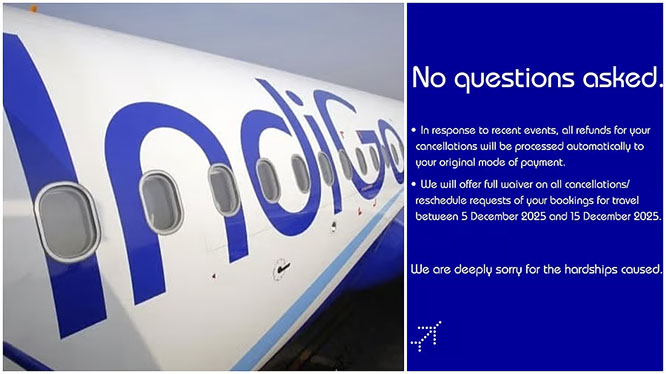
With IndiGo flight disruptions impacting thousands of passengers, the airline on Saturday said that it will offer full waiver on all cancellations/reschedule requests for travel bookings between December 5, 2025 and December 15, 2025.

Earlier in the day, the civil aviation ministry had directed the airline to complete the ticket refund process for the cancelled flights by Sunday evening, as well as ensure baggage separated from the travellers are delivered in the next two days.

In a post on X, titled 'No questions asked', IndiGo wrote, "In response to recent events, all refunds for your cancellations will be processed automatically to your original mode of payment."

"We are deeply sorry for the hardships caused," it further added.

Several passengers, however, complained of not getting full refund as promised by the airline.

Netizens have shared screenchots of getting charged for airline cancellation fee and convenience fee.

"Please tell me why u have did this airline cancellation charges when u say full amount will be refunded (sic)," a user wrote sharing a screenshot of the refund page.

"Well, but you have still debited the convenience charges," wrote another.

Passengers have also raised concerns about the "cancel" option being disabled on the IndiGo app. "First enable the 'Cancel' button on your App & offer full refund on tickets cancelled by customers between the said dates," wrote a user.

A day after the country's largest airline, IndiGo, cancelled more than 1,000 flights and caused disruptions for the fifth day on Saturday, the ministry said that any delay or non-compliance in refund processing will invite immediate regulatory action.

The refund process for all cancelled or disrupted flights must be completed by 8 pm on Sunday, the ministry said in a statement.

"Airlines have also been instructed not to levy any rescheduling charges for passengers whose travel plans were affected by cancellations," it said.

On Saturday, more than 400 flights were cancelled at various airports.

IndiGo has also been instructed to set up dedicated passenger support and refund facilitation cells.

Comments

Add new comment

  • Coastaldigest.com reserves the right to delete or block any comments.
  • Coastaldigset.com is not responsible for its readers’ comments.
  • Comments that are abusive, incendiary or irrelevant are strictly prohibited.
  • Please use a genuine email ID and provide your name to avoid reject.