



Benaulim (Goa), Oct 15: India and Russia today affirmed the need for "zero tolerance" for terrorists and their supporters even as Prime Minister Narendra Modi conveyed to President Vladimir Putin his appreciation of Kremlin's unequivocal condemnation of the Uri attack during their talks on terrorism, including that emanating from Pakistan.
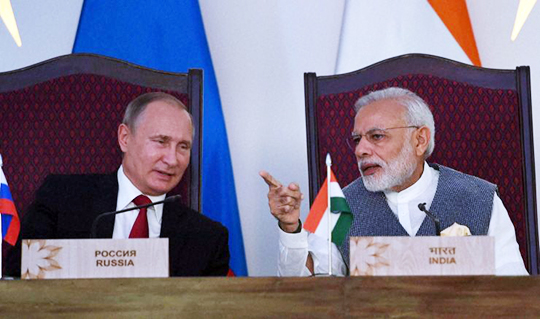
"Russia's clear stand on the need to combat terrorism mirrors our own. We deeply appreciate Russia's understanding and support of our actions to fight cross-border terrorism, that threatens our entire region. We both affirmed the need for zero tolerance in dealing with terrorists and their supporters," Modi said at a joint media event with Putin after their annual summit here.
Asked if the issue of cross-border terrorism emanating from Pakistan figured during the talks, Foreign Secretary S Jaishankar said, "The restricted form did cover Uri and support given for the terror strike (by Pakistan)." He said a more detailed conversation between Modi and Putin on the driving forces behind terrorism would take place at the lunch hosted by the Prime Minister.
On his part, Putin said the two countries were closely cooperating in the fight against terror.
"President Putin reaffirmed Russia’s continued commitment to the Special and Privileged Strategic Partnership with India and noted the commonality of positions of both the countries on such issues as war on terrorism. Indian Side expressed its appreciation for Russia’s unequivocal condemnation of the terrorist attack on army base in Uri," a joint statement issued after the talks said.
India, which has conveyed its opposition to Russia undertaking joint military exercises with Pakistan, a country which "sponsors and practices terrorism as a matter of State policy", also said it was "satisfied" about Russia understanding its interests.
"We are satisfied that Russia understand India's interest and they will never do anything contrary to India's interest and I think there was a strong meeting of minds on this subject," Jaishankar said when asked about the Russian response to India's concern over the recent Pak-Russia joint military exercise.
The Foreign Secretary also asserted that the assumption of friendship with Russia, "which was more than a partner", was that India trusts that they will not do anything contrary to its interest.
Strongly condemning terrorism in all its forms and manifestations, Modi and Putin emphasized on the need for a comprehensive international collaboration for its eradication, the joint statement said.
"India and Russia recognize the threat posed by terrorism, and believe that the full implementation of the relevant UNSC resolutions, the UN Global Counter-Terrorism Strategy without application of any double standards or selectivity will be instrumental in countering this challenge.
"They stressed the need to deny safe havens to terrorists and the importance of countering the spread of terrorist ideology as well as radicalization leading to terrorism, stopping recruitment, preventing travel of terrorists and foreign terrorist fighters, strengthening border management and having effective legal assistance and extradition arrangements," it added.
It said, "The leaders also stressed on the need to have a strong international legal regime built on the principle of 'zero tolerance for direct or indirect support of terrorism', and called upon the international community to make sincere efforts towards the earliest conclusion of the Comprehensive Convention on International Terrorism (CCIT)."
Recognizing that the rapidly expanding role of Information and Communication Technologies (ICTs) has led to certain security vulnerabilities that needed to be addressed through universally applicable rules for responsible behaviour of states to ensure their safe and sustainable use, they welcomed the conclusion of the Indian-Russian Inter- Governmental Agreement for Cooperation in this regard.
The Leaders also expressed concern over the deteriorating security situation in Afghanistan and recognized the need for resolute action against the menace of terrorism and threats of illicit drug-production and drug-trafficking, including elimination of terror sanctuaries, safe havens, and other forms of support to terrorists, the joint statement said.
They also called for constructive international, regional and bilateral cooperation in order to help Afghanistan in addressing the domestic security situation, improving the capabilities of Afghan National Security Forces, strengthening counter-narcotics capabilities, ensuring socio-economic development, and enhancing connectivity, it added.
India and Russia reiterated their support for Afghan government's efforts towards the realization of an Afghan-led and Afghan-owned national reconciliation process based on the principles of international law, the statement said.
Both sides expressed concern over the continuing instability in South-Eastern Ukraine and supported a political and negotiated settlement of the issue through complete implementation of the Package of Measures for the Implementation of Minsk Agreements of February 12, 2015.
The two sides are convinced that the conflict in Syria should be peacefully resolved through comprehensive and inclusive intra-Syrian dialogue based on the Geneva Communique of June 30, 2012, and relevant UN Security Council resolutions.
Both Sides underlined the necessity for cessation of hostilities, delivery of humanitarian aid to besieged areas, and continuation of intra-Syrian dialogue under UN supervision. India recognized Russia's effort towards achieving a political and negotiated settlement of the situation in Syria.


Comments
Add new comment