


Abolition of Article 370: BJP’s propaganda versus Truth

Ram Puniyani
September 11, 2019

The abolition of Article 370 and Article 35 A has been accompanied by propaganda to justify these drastic steps taken by the BJP Government. As such this abolition of Article 370 has been on the agenda of RSS all through and is part of the triad of Hindutva agenda, along with Ram Temple and Uniform Civil Code. The argument being put forward is that due to this special provision for the state, the state has remained undeveloped, as the outside industrialists could not buy land there and bring in Vikas (development). Also it has been alleged that this clause promoted separatism in the region and has been the cause of turmoil in the region.
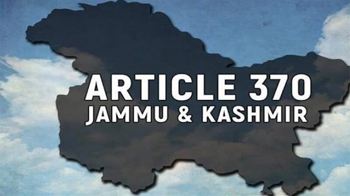
All this forms the part of propaganda blitz launched by BJP. As a part of mass contact program, the Party Working President J.P. Nadda released a video on 4th September 2019, justifying the abolition of the special provisions for the state and bifurcation of the state into two Union Territories. The eleven minute video concludes with the speech of Prime Minster Modi saying that Nehru committed historic blunder on Kashmir; to which Ambedkar and Patel had strong opposition.

On Article 370, the video says that Sardar Patel successfully merged 562 Princely states into India but Nehru decided to handle Kashmir himself and created the blunder of giving special status to the state leading to all the problems. Most of the part of BJP’s statement is far from truth; they pick up one small part of the truth and give it a twist to suit their ultra nationalist agenda.

To begin with, why Nehru had to handle Kashmir issue himself? Patel handled all other Princely states as those states were within the geographical boundaries of India; none of them was attacked by any other foreign power, i.e. Pakistan. Since Kashmir has boundaries common with India and Pakistan, Nehru as Prime Minster and Foreign Minister was duty bound to take responsibility of the issues related to Kashmir. India was forced to intervene into Kashmir affairs as it was attacked from the Pakistan side and Kashmir’s King Harisingh urged upon India to send the army to quell Pakistani attack. In none of the other princely states Pakistan could play such military role which created such a situation in Kashmir. In matters of Kashmir, Pakistan was also trying to follow ‘Two Nation theory’, as Kashmir had Muslim majority. As far as Nehru and Patel are concerned, on the handling of Kashmir, i.e. accession treaty, article 370, declaration of cease fire and taking the matter to United Nations is concerned; they were on the same page as revealed by the ‘Ten volume Correspondence of Sardar Patel’, meticulously edited by the renowned journalist Durga Das.

On nature of intervention in Kashmir, Sardar Patel said at a public meeting in Bombay on October 30, 1948: “Some people consider that a Muslim majority area must necessarily belong to Pakistan. They wonder why we are in Kashmir. The answer is plain and simple. We are in Kashmir because the people of Kashmir want us to be there. The moment we realize that the people of Kashmir do not want us to be there, we shall not be there even for a minute… We shall not let the Kashmir down”. (Hindustan Times October 31, 1948) Quoting from Patel’s correspondence A. G. Noorani points out that in matters of ceasefire Patel not being taken into confidence, as alleged by RSS stable is wrong. Noorani says “Volume one of Patel’s correspondence belies the charge that Patel was not taken into confidence. In that event, he was man enough to resign from the cabinet.”

Article 370 did not drop from the heaven. It was the outcome of serious deliberations in the Constituent Assembly (CA). For the explicit purpose of drafting this Article Sheikh Abdullah and Mirza Afzal Baig were made part of the CA. It was primarily Patel, Ambedkar, Sheikh and Mirza Baig who contributed to the formulation of this provision. Now to say that Ambedkar opposed it or Patel did not approve it is height of false hood. Noorani also points out that it was Patel who moved the resolution of the article 370 in the CA, as Nehru was away to US on an official trip. Patel’s letter to Nehru on date 25th February 1950 shows that they both had similar opinion on taking the matter to United Nations, and they both held that the international body should take a call on that.

As far Ambedkar is concerned our Vice President Venkaiyah Naidu and Central Minster Arjun Ram Meghwal in their articles have given a quote in the name of Ambedkar. Their quote says that in a conversation with Sheikh, Ambedkar said, ““you want India to defend Kashmir, feed its people, and give Kashmiris equal rights all over India. But you want to deny India all rights in Kashmir…” This quote is not part of any official record. It was part of speech of Balraj Madhok of Bharatiya Jansangh (predecessor of BJP), which was picked up by RSS paper Tarun Bharat and Organizer. As such Ambedkar had also opined that Muslim majority part of Kashmir should go to Pakistan. Ambedkar was a strong supporter of plebiscite and Patel himself had gone for the same in Junagadh.  

As far as development of Kashmir is concerned, the first point we should note that Kashmir is much ahead of national averages as far as social indices of development are concerned. The Article 370 in no way stood in the path of development in that sense. Incidentally while Article 370 has being targeted, Article 371 with similar provisions in North Eastern states is promised to be retained as it is, as per the latest statement by Amit Shah.

BJP’s present propaganda, distorting contemporary history is also trying to defame Nehru. Nehru is their prime target as the ‘Architect of Modern India’, Nehru, laid the foundations of pluralism and scientific temper, the values which RSS-BJP wants to do away with.

Comments

Add new comment

  • Coastaldigest.com reserves the right to delete or block any comments.
  • Coastaldigset.com is not responsible for its readers’ comments.
  • Comments that are abusive, incendiary or irrelevant are strictly prohibited.
  • Please use a genuine email ID and provide your name to avoid reject.
News Network
November 21,2025

Bengaluru, Nov 21: The Karnataka government is facing pressure to overhaul its employment system after a high-level Cabinet sub-committee recommended the complete phase-out of job outsourcing in government offices, boards, and corporations by March 2028. The move is aimed at tackling a systemic issue that has led to the potential violation of constitutional reservation policies and the exploitation of workers.

The Call for Systemic Change

With over three lakh vacant posts currently being filled through private agencies on an outsource, insource, or daily wage basis, the sub-committee highlighted a significant lapse. "As a result, reservations are not being followed as per the Constitution and state laws. It’s an urgent need to take serious steps to change the system. It has been recommended to completely stop the system of outsourcing by March 2028," the panel stated in a document.

The practice of outsourcing involves private companies hiring workers to perform duties for a government agency. Critics argue this model results in lesser salaries, a lack of social security benefits (otherwise available to permanent government employees), and a failure to adhere to the provisions of Articles 14 and 15 of the Constitution, which guarantee equality before the law and prohibit discrimination.

The 'Bidar Model' as a Stop-Gap Solution

To regulate the current mode of employment and reduce worker exploitation until the 2028 deadline, the government plans to establish workers’ services multi-purpose cooperative societies across all districts, following the successful "Bidar Model."

The Bidar District Services of Labour Multi-purpose Cooperative Society Ltd., which operates under the District Commissioner, is cited as a successful example of providing a measure of social security to outsourced staff. Labour Department officials argue this society ensures workers receive their due wages and statutory facilities like ESI (Employees' State Insurance) and PF (Provident Fund), in exchange for a 1% service fee collected from the employees.

legislative push and Priority Insourcing

The recommendations, led by the sub-committee headed by Law and Parliamentary Affairs Minister H K Patil, are set to be discussed at the next Cabinet meeting. The committee has proposed the introduction of the Karnataka Outsourced Employees (Regulation, Placement and Welfare) Bill 2025.

In a move addressing immediate concerns, Labour Minister Santosh Lad, a member of the sub-committee, has reportedly assured that steps will be taken over the next 2-3 years to insource workers in "life-threatening services" on a priority basis. This includes essential personnel like pourakarmikas (sanitation workers), drivers, electrical staff in the Energy Department, and Health Department staff handling contagious diseases. The transition aims to grant these workers the long-term security and benefits they currently lack under the outsourcing system. 

Comments

Add new comment

  • Coastaldigest.com reserves the right to delete or block any comments.
  • Coastaldigset.com is not responsible for its readers’ comments.
  • Comments that are abusive, incendiary or irrelevant are strictly prohibited.
  • Please use a genuine email ID and provide your name to avoid reject.
News Network
November 22,2025

The Karnataka government has announced a 50% rebate on pending traffic and transport fines. The discount is available from November 21 to December 12.

The rebate applies to all traffic e-challans and violation cases booked by the RTO between 1991–92 and 2019–20. Officials clarified that the offer is not applicable to pending tax dues and is restricted only to traffic-violation fines.

Across Karnataka, more than 4 lakh RTO cases remain pending, including those involving transport vehicles. While thousands of vehicle owners have already cleared their dues, the department expects to generate substantial revenue through this limited-period rebate.

How to Pay and Avail the Discount

There are three ways to check and pay your pending fines:

1. Through Mobile Apps
Available on both Play Store and App Store:
•    Karnataka State Police (KSP) app
•    KarnatakaOne app
•    ASTraM app

Steps:
•    Enter your vehicle number in any of the above apps
•    Verify the photo/details of your vehicle
•    Pay the fine with the 50% discount applied

2. Visit a Traffic Police Station

You can pay your pending fine at any nearby traffic police station.

3. Visit the Traffic Management Centre (TMC)

•    Location: First Floor, Infantry Road, near Indian Express, Bengaluru

Transport Commissioner Yogeesh A M said, “We don't issue e-challans, so there's no online payment system.”

The department estimates ₹52 crore in pending RTO fines up to March 2020. “With the 50% rebate, we expect to collect around ₹25 crore if all dues are cleared,” he added.

Comments

Add new comment

  • Coastaldigest.com reserves the right to delete or block any comments.
  • Coastaldigset.com is not responsible for its readers’ comments.
  • Comments that are abusive, incendiary or irrelevant are strictly prohibited.
  • Please use a genuine email ID and provide your name to avoid reject.
News Network
November 24,2025

Mangaluru, Nov 24: The original departure time of 11.10 pm was a distant memory for scores of Dammam-bound passengers at Mangaluru International Airport last Friday night, as their Air India Express flight was abruptly cancelled at the eleventh hour, sparking hours of frustration and chaos.

The flight, IX 885, initially scheduled to depart at 11.10 pm on November 22, was subject to two back-to-back reschedules—first pushed to 11.45 pm and then significantly postponed to 1.40 am—before the final, crushing announcement of cancellation was made. For the travellers, many of whom are likely expatriate workers with tight schedules, the last-minute change marked the beginning of a distressing ordeal.

"There was no drinking water, no food, and absolutely no proper guidance. We were left stranded like refugees," complained a stranded passenger.

According to multiple passenger accounts, the airline's ground staff failed to provide adequate support or essential amenities following the cancellation. Complaints poured in about the total absence of drinking water, food provisions, and any reliable guidance from the carrier's representatives. Travellers alleged they were left stranded for a considerable period, with no immediate arrangements or clear communication offered regarding accommodation or alternative travel to send them back home.

The incident has highlighted serious concerns over the carrier's contingency planning and customer service protocols during flight disruptions at one of India's key international gateways. The airline is yet to issue a comprehensive statement addressing the alleged lapse in passenger care.
 

Comments

Add new comment

  • Coastaldigest.com reserves the right to delete or block any comments.
  • Coastaldigset.com is not responsible for its readers’ comments.
  • Comments that are abusive, incendiary or irrelevant are strictly prohibited.
  • Please use a genuine email ID and provide your name to avoid reject.