Anger over US’ Jerusalem move spreads from Jakarta to Rabat

Al Jazeera
December 11, 2017

A wave of anger against a US decision to recognise Jerusalem as Israel's capital has spread from Asia, through the Middle East, to North Africa, with tens of thousands of people taking to the streets to denounce the controversial move.

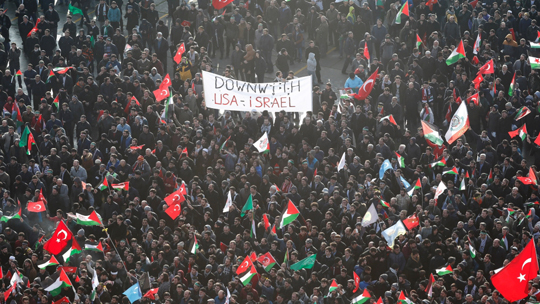
Protesters filled central avenues and squares in a number of major international cities on Sunday, waving the flag of Palestine and shouting slogans to express their solidarity with the Palestinians, who see East Jerusalem as the capital of their future state.

US President Donald Trump's announcement on Wednesday drew near-universal condemnation from world leaders and inflamed the Palestinian-Israeli conflict, with violence flaring up in the occupied Palestinian territories for a fifth day.

According to the Palestinian Red Crescent, 157 people were injured on Sunday in confrontations with Israeli forces in the occupied West Bank, Jerusalem and Gaza.  

At least four Palestinians have been killed in the Gaza Strip since the US declaration.

Clashes also erupted on Sunday at a protest in Beirut, where demonstrators fought with security forces outside the US embassy in the Lebanese capital. 

Demonstrators set fires in the street, torched US and Israeli flags and threw stones at police officers, who responded with tear gas and water cannon.

Adnan Abdullah, a protester in Beirut, said Trump's Jerusalem decision "will not happen as long as there are people like us".

Another demonstrator, whose face was hidden behind a black mask, held up a tear gas canister and condemned Lebanese forces for "defending America".

He went on to add, "There is no one by our side. None of the Arab countries. Oh God, we will raise the Palestinian flag"

Arab foreign ministers, in a resolution on Sunday, urged Trump to rescind the decision and have called for a UN Security Council condemnation of the shift in US policy.

Meanwhile, more than 5,000 Indonesians rallied outside the US embassy in Jakarta to vent their anger for a second day. Protesters carried Palestinian flags and banners saying "Pray for Palestine".

"We are not satisfied with just official statements," said Nurjannah Nurwani, one of the lead organisers of the gathering. "We need follow-up, international lobbying which could pressure them into withdrawing their decision."

Another female protester in Jakarta urged Trump to "use his brain" and "withdraw from Jerusalem".

Indonesian President Joko Widodo has condemned Trump's decision. On Thursday, he ordered the US ambassador in Jakarta to be summoned over the move.

In Turkey's Istanbul, thousands of demonstrators took to the streets again, transforming the city's Yenikapi Square into a sea of Turkish and Palestinian flags.  

"I feel like I should defend Palestine because I don't know any other way to defend them," said Ananda Sereka, who was at the protest. "So this is what I can do. This is the least I can do."

Turkey's President Recep Tayyip Erdogan, one of the most vocal critics of Trump's move, has called the declaration "null and void" and vowed to fight it.

He has also called a summit of Islamic countries to discuss the move on Wednesday.

In Rabat, Morocco's capital, protesters yelled slurs against Trump and carried banners saying Jerusalem belonged to Palestine.

Al Jazeera's Hashem Ahelbarra, reporting from Rabat, said the protest was "a show of solidarity with the Palestinian people but also an opportunity to express anger" over Trump's decision.

"The protesters came from all walks of life," he said. "Government officials, members of the opposition, seculars and conservatives - all denouncing what they consider to be a decision that could destabilise the region."

Mohamed Boussaid, Morocco's finance minister, said the demonstration was a way "to express our indignation and un-satisfaction" and to show that "we refuse completely the decision taken by the president of the US".

Protester Mohamed Alghram agreed.

"We totally reject the decision that targets the most sacred place for us and we say no," he said. "Jerusalem is a red line."

Jerusalem is home to Islam's third holiest site and its status is deeply sensitive for Muslims.

In Indian-administered Kashmir, protesters took a different approach.

Residents of the capital Srinagar, home to 1.1 million people, closed their shops and abandoned the streets in protest. Salman Khan, a Srinagar resident, told the ANI news agency that Trump's decision was "completely unjust".

Muslim solidarity with Palestine also spread to the war-torn nations of Yemen and Syria.

Further protests were held in Egypt, where students and professors demonstrated at the Al-Azhar university.

In Pakistan's Karachi, hundreds of protesters marched towards the US Consulate in the city, but were turned back by riot police.

Comments

Add new comment

  • Coastaldigest.com reserves the right to delete or block any comments.
  • Coastaldigset.com is not responsible for its readers’ comments.
  • Comments that are abusive, incendiary or irrelevant are strictly prohibited.
  • Please use a genuine email ID and provide your name to avoid reject.
News Network
February 3,2026

Bengaluru: Following reports of fresh Nipah virus (NiV) cases in West Bengal and heightened vigilance across parts of Southeast Asia, the Karnataka Health Department has placed the state on high alert and activated emergency preparedness protocols.

Health officials said enhanced surveillance measures have been initiated after two healthcare workers in Barasat, West Bengal, tested positive for the virus earlier this month. While no cases have been reported in Karnataka so far, authorities said the state’s past exposure to Nipah outbreaks and high inter-state mobility warranted preventive action.

Officials have directed district health teams to intensify monitoring, particularly at hospitals and points of entry, and to ensure early detection and isolation of suspected cases.

High Mortality Virus with Multiple Transmission Routes

Nipah virus is a zoonotic disease that can spread from animals to humans and has a reported fatality rate ranging between 60 and 75 per cent. Fruit bats, also known as flying foxes, are the natural reservoirs of the virus and can transmit it by contaminating food sources with saliva or urine.

Known modes of transmission include:

•    Contaminated food: Consumption of fruits partially eaten by bats or raw date-palm sap
•    Animal contact: Exposure to infected pigs or other animals
•    Human-to-human transmission: Close contact with body fluids of infected persons, particularly in healthcare settings

Symptoms and Disease Progression

The incubation period typically ranges from 4 to 14 days, though delayed onset has also been reported. Early symptoms often resemble common viral infections, making prompt clinical suspicion critical.

•    Initial symptoms: Fever, headache, body aches, fatigue, sore throat
•    Progressive symptoms: Drowsiness, disorientation, altered mental state
•    Severe stage: Seizures, neck stiffness and acute encephalitis, which can rapidly progress to coma

Public Health Advisory

The Health Department has issued precautionary guidelines urging the public to adopt risk-avoidance practices to prevent any local spillover.

Do’s
•    Wash fruits thoroughly before consumption
•    Drink boiled and cooled water
•    Use protective equipment while handling livestock
•    Maintain strict hand hygiene

Don’ts
•    Avoid fruits found on the ground or showing bite marks
•    Do not consume beverages made from raw tree sap, including toddy
•    Avoid areas with dense bat populations
•    Do not handle sick or dead animals

Preparedness Measures

Officials confirmed that isolation wards are being readied in major government hospitals and that medical staff are being sensitised to identify early warning signs.

“There is no cause for panic, but there is a need for heightened vigilance,” a senior health official said, adding that there is currently no approved vaccine or specific antiviral treatment for Nipah, and care remains largely supportive.

Comments

Add new comment

  • Coastaldigest.com reserves the right to delete or block any comments.
  • Coastaldigset.com is not responsible for its readers’ comments.
  • Comments that are abusive, incendiary or irrelevant are strictly prohibited.
  • Please use a genuine email ID and provide your name to avoid reject.
News Network
January 23,2026

Karnataka Governor Thaawarchand Gehlot read only three lines from the 122-paragraph address prepared by the Congress-led state government while addressing the joint session of the Legislature on Thursday, effectively bypassing large sections critical of the BJP-led Union government.

The omitted portions of the customary Governor’s address outlined what the state government described as a “suppressive situation in economic and policy matters” under India’s federal framework. The speech also sharply criticised the Centre’s move to replace the Mahatma Gandhi National Rural Employment Guarantee Act (MGNREGA) with the Viksit Bharat–Guarantee for Rozgar and Ajeevika Mission (Gramin) Act, commonly referred to as the VB-GRAM (G) Act.

Governor Gehlot had earlier conveyed his objection to several paragraphs that were explicitly critical of the Union government. On Thursday, he confined himself to the opening lines — “I extend a warm welcome to all of you to the joint session of the State legislature. I am extremely pleased to address this august House” — before jumping directly to the concluding sentence of the final paragraph.

He ended the address by reading the last line of paragraph 122: “Overall, my government is firmly committed to doubling the pace of the State’s economic, social and physical development. Jai Hind — Jai Karnataka.”

According to the prepared speech, the Karnataka government demanded the scrapping of the VB-GRAM (G) Act, describing it as “contractor-centric” and detrimental to rural livelihoods, and called for the full restoration of MGNREGA. The state government argued that the new law undermines decentralisation, weakens labour protections, and centralises decision-making in violation of constitutional norms.

Key points from the unread sections of the speech:

•    Karnataka facing a “suppressive” economic and policy environment within the federal system

•    Repeal of MGNREGA described as a blow to rural livelihoods

•    VB-GRAM (G) Act accused of protecting corporate and contractor interests

•    New law alleged to weaken decentralised governance

•    Decision-making said to be imposed by the Centre without consulting states

•    Rights of Adivasis, women, backward classes and agrarian communities curtailed

•    Labourers allegedly placed under contractor control

•    States facing mounting fiscal stress due to central policies

•    VB-GRAM (G) Act accused of enabling large-scale corruption

Comments

Add new comment

  • Coastaldigest.com reserves the right to delete or block any comments.
  • Coastaldigset.com is not responsible for its readers’ comments.
  • Comments that are abusive, incendiary or irrelevant are strictly prohibited.
  • Please use a genuine email ID and provide your name to avoid reject.
News Network
January 23,2026

oscar.jpg

The Voice of Hind Rajab, inspired by the tragic final moments of a young Palestinian girl killed by Israeli fire in Gaza, has been nominated for an Academy Award in the Best International Feature Film category.

Directed by Tunisian filmmaker Kaouther Ben Hania, the film recounts the true story of five-year-old Hind Rajab, who lost her life in January 2024 while fleeing Israeli bombardment with her family.

The film features the real audio of Hind’s desperate call to the Palestinian Red Crescent Society, where she pleaded for help moments before the vehicle she was in was struck by 355 bullets.

The haunting narrative begins with a brief call made from the besieged Tel al-Hawa neighborhood of Gaza, where gunfire and armored vehicles drowned out every sound.

After witnessing the brutal killing of her family, she made a trembling call, her voice reduced to a whisper as she spoke of the massacre and her unbearable loneliness as the sole survivor.

Premiering at the Venice International Film Festival in September 2025, The Voice of Hind Rajab garnered widespread acclaim, receiving a record-setting 23-minute standing ovation and the Silver Lion Grand Jury Prize, the festival’s second-highest honor.

In her acceptance speech, Ben Hania dedicated the film to humanitarian workers and first responders in Gaza, emphasizing that Hind's voice symbolizes countless civilians affected by war.

She aims to give voice to victims often reduced to mere statistics, highlighting the broader suffering of civilians in war zones.

The film’s Oscar nomination underscores its powerful storytelling and ethical approach to depicting real-life tragedy, making it a crucial piece of contemporary cinema.

It serves not only as a narration of individual tragedy but also as an artistic and documentary response to the silence and censorship that often overshadow West Asian struggles and wars.

Using an innovative method she calls docufiction, Ben Hania bridges unvarnished reality and narrative structure, creating a work that is both artistically valuable and socially impactful.

Born in 1977 in Sidi Bouzid—later the epicenter of the Arab revolution—her background profoundly influenced her worldview and artistic approach.

She is a graduate of the Higher School of Audiovisual Arts of Tunis, Pantheon-Sorbonne University, and La Fémis in Paris, where her studies equipped her with the technical and theoretical tools needed to address complex subjects. 

Comments

Add new comment

  • Coastaldigest.com reserves the right to delete or block any comments.
  • Coastaldigset.com is not responsible for its readers’ comments.
  • Comments that are abusive, incendiary or irrelevant are strictly prohibited.
  • Please use a genuine email ID and provide your name to avoid reject.