



Assassination in Ankara: Cop guns down Russian ambassador

December 20, 2016

Ankara, Dec 20: Russia’s Ambassador to Turkey Andrey Karlov was assassinated Monday night during the opening ceremony of a photo exhibition in Ankara when he took to the podium to make a speech.
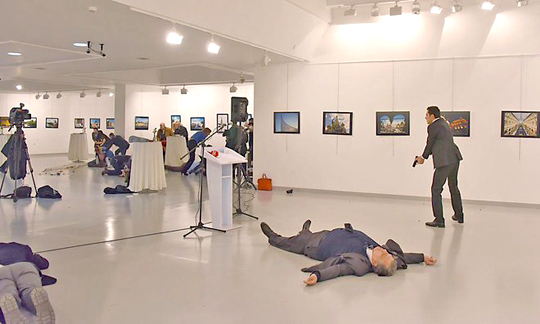
russian

Turkey’s interior minister said the gunman, 22-year-old Mevlut Mert Altintas, who was killed, was part of Ankara’s anti-riot police.

The assailant was on duty as a security officer during rallies by President Recep Tayyip Erdogan, Turkey’s mainstream HaberTurk news reported.

After shooting the ambassador, the gunman shouted: “Don’t forget Aleppo. Don’t forget Syria. Until our towns are safe, you won’t be able to enjoy safety. Whoever has a role in this cruelty will pay for it one by one.”

This marks the first assassination of an ambassador in Turkey. It comes a day before the planned visit of Turkish Foreign Minister Mevlut Cavusoglu to Moscow for talks on Syria with his Russian and Iranian counterparts.

Erdogan phoned his Russian counterpart Vladimir Putin to share information. “We have to know who gave the orders to the assassin,” Putin said. In a public statement, Erdogan condemned the attack and said it aimed to harm improved ties with Moscow.

Experts say the assassination puts Turkey in a difficult diplomatic position.

“It doesn’t look like a Daesh attack because the gunman evacuated the art gallery to shoot the ambassador,” Ahmet Han, an international relations professor from Istanbul Kadir Has University, told Arab News.

“This might be an attack carried out by an individual who is ideologically or emotionally vested in developments in Aleppo,” he said.

“He might be a member or sympathizer of an organization on the ground in Syria, or an isolated individual. Otherwise we have to think of a connection with a national intelligence agency.”

Han added: “Turkey wouldn’t be involved in such a crisis if it hadn’t been so exposed to regional dynamics as a party. It’s inevitable that comments on Turkey’s intelligence deficit will follow from the international community.”

However, he said if Ankara cooperated with Moscow, the assassination would not lead to a crisis similar to which occurred when Turkey shot down a Russian warplane in November 2015. “At this point, common sense and restraint should rule,” Han said.

Aykan Erdemir, a former Turkish MP and now senior fellow at the Foundation for Defense of Democracies, a Washington-based think tank, said Moscow gained concessions from Ankara following the downing of the warplane before going forward with normalization.

“Putin could again leverage the attack to gain further concessions from Turkey,” Erdemir told Arab News.

“Turkish government officials argue that the attack targeted Turkish-Russian cooperation, and point the finger at the West. The assassination could bolster conspiracy theories at home and speed Turkey’s pivot toward Russia.”

Selim Sazak, a researcher at the Century Foundation, a New York-based think tank, said: “The assailant could be a Turkish nationalist gone rogue, a Gulenist (supporter of US-based cleric Fethullah Gulen, whom Ankara accuses of masterminding the July 15 coup attempt in Turkey), a Daesh subvert, or even a Eurasianist, for this plays right into the hands of those trying to bring Turkey and Russia closer.”

Mainstream Turkish media are reporting that the attacker being a Gulenist is the most likely option.

Sazak says this will impact US-Turkish relations more than it will Turkish-Russian ties. “Pro-government media are already spinning this as a US conspiracy, and trying to paint the cop as a Gulenist,” he told Arab News.

Sazak says diplomatically the game plan is fairly simple, at least publicly: “You express condolences, high-level authorities attend the funeral in Moscow, and Putin says a few things about how this is regrettable but thanks Turkish police and reiterates the solidarity of the Turkish and Russian peoples.”

However, Sazak says the only exit strategy for Ankara is to try to spin the assassination into anti-Western propaganda.

“As of today, Turkey’s Syria game is over,” Sazak said, adding that this puts Turkey in the worst bargaining position imaginable.

In a similar vein, the Russian Federation Council considers the assassination a grave failure of Turkish law-enforcement, Interfax reported.

However, other messages coming from Moscow suggest that Russia does not intend to turn the assassination into a major diplomatic crisis.

Frants Klintsevic, deputy chairman of the Russian Federation Council Defense and Security Committee, said the perpetrator wanted “to turn Turkey and Russia against each other.”

In a statement, the Turkish Foreign Ministry said: “Ambassador Karlov was a unique diplomat who earned the appreciation of all state cadres for his professional and personal competencies, as he carried out successful work at a very difficult time in Turkey.

“His memory will always be with us. We will not allow this attack to overshadow Turkish-Russian friendship.”

Comments

Add new comment

  • Coastaldigest.com reserves the right to delete or block any comments.
  • Coastaldigset.com is not responsible for its readers’ comments.
  • Comments that are abusive, incendiary or irrelevant are strictly prohibited.
  • Please use a genuine email ID and provide your name to avoid reject.
News Network
November 28,2025

fire.jpg

Several Syrians were killed and more than two dozen others injured in Israeli strikes on the outskirts of Damascus, amid intensified incursions by the occupying regime since the fall of former president Bashar al-Assad and the rise of Hayat Tahrir al-Sham (HTS) rule.

Syrian state TV reported that the casualties occurred during an overnight Israeli assault involving helicopters and drones on the town of Beit Jinn in the Damascus countryside. The attack followed an Israeli military unit’s entry into the town, where they were surrounded by local residents, leading to gunfire and direct confrontations.

According to the report, “The occupation army’s helicopters and artillery shelled Beit Jinn, located at the foothills of Mount Hermon, resulting in 13 martyrs and 25 injured civilians.” The broadcaster did not specify the full extent of damage.

Al-Ikhbariyah Syria confirmed that the shelling coincided with Israeli soldiers entering Beit Jinn, while artillery pounded surrounding areas. The broadcaster stated that the escalation began after local residents clashed with an Israeli patrol that had infiltrated the southern town and “kidnapped” three young men.

Following a two-hour exchange of heavy fire, Israeli forces withdrew and repositioned on the hill of Butt al-Warda at the town’s outskirts.

Israeli media acknowledged that six soldiers were wounded in the clashes—three of them seriously—describing the confrontation as a “sudden ambush” that forced the deployment of reserve units and air support to secure an exit route. No further details were provided.

The aggression has fueled renewed displacement from Beit Jinn, with residents fleeing to nearby villages amid increasingly frequent Israeli attacks.

The raid came just a day after Israeli troops carried out another ground incursion into Umm al-Luqas village in Quneitra province. According to SANA, an Israeli unit in four vehicles entered the village, raided several homes, and later withdrew.

Syria condemned the repeated incursions as violations of the 1974 Disengagement Agreement and UN resolutions, urging the international community to enforce compliance and pressure Israel to halt its operations and withdraw fully.

Israel has expanded its attacks across Syrian territory following the collapse of the Assad government last year. Prime Minister Benjamin Netanyahu has reportedly instructed his forces to push deeper into Syrian territory and seize strategic positions.

Meanwhile, critics say the HTS-led interim government’s inaction and growing normalization gestures toward Israel have emboldened Tel Aviv to intensify its military operations. HTS, formerly linked to al-Qaeda, seized control of Damascus last December, formally ending Assad’s rule.

Comments

Add new comment

  • Coastaldigest.com reserves the right to delete or block any comments.
  • Coastaldigset.com is not responsible for its readers’ comments.
  • Comments that are abusive, incendiary or irrelevant are strictly prohibited.
  • Please use a genuine email ID and provide your name to avoid reject.
News Network
November 24,2025

lebanon.jpg

Israel has launched a new act of aggression on a residential neighborhood in Lebanon's capital, Beirut, killing and injuring about two dozen civilians.

The Israeli regime's military said in a statement that its forces carried out a so-called precise strike in a residential apartment in Dahiyeh in the southern suburbs of Beirut on Sunday.

The aggression targeted residential areas, killing at least five people and injuring more than 28 people, Lebanon's Health Ministry said. 

Hezbollah announced the martyrdom of senior Hezbollah commander Haytham Ali Tabatabai and four resistance fighters.

Lebanese President Michel Aoun condemned the airstrike, calling it a clear demonstration of Tel Aviv’s disregard for repeated international calls to halt violations on Lebanese soil.

“Israel refuses to implement international resolutions and all efforts aimed at ending the escalation and restoring stability,” Aoun said, urging the international community to take action to prevent further aggression.

The Palestinian Islamic Jihad movement also condemned the attack, holding the international community accountable. 

“The international community bears responsibility and continues to provide cover for these attacks as long as it does not restrain the occupiers,” said Ali Abu Shahin, a member of the group’s political bureau.

Israeli prime minister Benjamin Netanyahu’s office announced that the Israeli army carried out a strike “in the heart of Beirut."

Netanyahu reportedly approved the operation following recommendations from top Israeli security officials.

Two senior US officials commented on the Israeli strike.

The first official said that Israel did not notify Americans in advance about the attack. "We were informed immediately after the strike was carried out."

The second senior official said that the "US knew for several days that Israel was planning to escalate its strikes in Lebanon, but did not know in advance the timing, location, or target of the strike."

Speaking from the site of the Israeli strike, Lebanese MP Ali Ammar condemned the attack as part of a broader campaign of aggression that has targeted "all of Lebanon since the Washington-sponsored ceasefire."

He stated that "any attack on Lebanon is a violation of red lines; this aggression is part and parcel of the entity that targets Lebanon's dignity, sovereignty, and security of citizens."

Ammar went on to say the resistance is responding with "utmost wisdom, patience, and will confront the enemy at the appropriate time."

"Unfortunately, the enemy is emboldened to commit its aggression by voices within Lebanon that have turned themselves into tools that support its aggression," he added.

The Israeli attack on the southern suburbs of the Lebanese capital is the latest blatant violation of the ceasefire Israel signed with Hezbollah in November 2024, which was intended to end hostilities that had escalated into full-scale war.

An Israeli strike on the Ain al-Hilweh camp near Sidon in southern Lebanon late Tuesday killed at least 14 people. It wounded several others, including young students, according to the Lebanese health ministry.

The military claimed the attack targeted “a Hamas training compound” used to plan and carry out attacks against the regime -- a claim that has frequently been made without evidence.

Hamas rejected the allegations as “a blatant lie aimed at justifying the massacre,” stating it had “no military installations in the Palestinian camps in Lebanon” and that the targeted site was merely “an open sports field.”

According to Lebanese authorities, Israeli attacks have killed approximately 4,000 people and displaced more than 1.2 million residents across the country since October 2023.

Comments

Add new comment

  • Coastaldigest.com reserves the right to delete or block any comments.
  • Coastaldigset.com is not responsible for its readers’ comments.
  • Comments that are abusive, incendiary or irrelevant are strictly prohibited.
  • Please use a genuine email ID and provide your name to avoid reject.
News Network
November 24,2025

israelsyra.jpg

Israeli forces have pushed over the Syrian frontier, erecting a checkpoint and stopping vehicles in the southwestern city of Quneitra, in yet another breach of the Arab country’s sovereignty.

The violation took place on Sunday, when the troops made their way across the border, setting up the outpost near the Ain al-Bayda junction in northern Quneitra, Syrian outlets reported.

According to the al-Ikhbariya paper, an Israeli detachment positioned itself at the junction, halting cars and conducting searches.

The Syrian Arab News Agency (SANA) reported that three Israeli military vehicles then moved further into the northern countryside, deploying between the town of Jubata al-Khashab and the villages of Ofaniya and Ain al-Bayda. The agency added that a separate Israeli unit mounted a new incursion in the central region, approaching the villages of Umm Batina and al-Ajraf.

Residents said such activities have surged in recent months, pointing to Israeli advances onto farmland, leveling of extensive forested areas, arrests, and spread of mobile checkpoints.

The Israeli regime began markedly increasing its military aggression against Syria last year.

The escalation coincided with increasingly ferocious onslaughts throughout the country by the so-called Hay'at Tahrir al-Sham (HTS) Takfiri terrorist group, which the government of President Bashar al-Assad had confined to northwestern Syria. The HTS, however, managed to overthrow the government as the Israeli attacks would pummel the country’s civilian and defensive infrastructure.

Various reports have shown that, during the escalation, the regime conducted more than 1,000 airstrikes on the Syrian territory and over 400 ground raids into the south.

Following the collapse of the Assad government, Tel Aviv also widened its grip over the occupied Golan Heights by taking control of a demilitarized buffer zone, in defiance of a 1974 Disengagement Agreement. Earlier this month, senior Israeli officials, including Prime Minister Benjamin Netanyahu, visited the buffer zone, prompting expressions of alarm on the part of the United Nations.

The United States, the regime’s biggest ally, has, meanwhile, been fraternizing the HTS head Abu Mohammed al-Jolani amid the widely reported prospect of rapprochement with Tel Aviv.

Comments

Add new comment

  • Coastaldigest.com reserves the right to delete or block any comments.
  • Coastaldigset.com is not responsible for its readers’ comments.
  • Comments that are abusive, incendiary or irrelevant are strictly prohibited.
  • Please use a genuine email ID and provide your name to avoid reject.