



Aung San Suu Kyi Set To Break Silence On Rohingya Crisis In Live TV Address

Agencies
September 19, 2017

Yangon, Sept 19: Myanmar leader Aung San Suu Kyi is poised today to break her silence on a refugee crisis the UN has decried as "ethnic cleansing", in a live TV address that will be closely watched by nationalists in Myanmar who support an army-led campaign against Rohingya Muslims.

Communal violence has torn through Rakhine state since August 25, leaving hundreds dead and driving more than 410,000 of the Rohingya minority from Myanmar into Bangladesh.

But Suu Kyi, a Nobel laureate, has so far refused to speak up for the stateless Rohingya or publically urge restraint from the military.

Her intransigence in the face of huge international pressure has confounded a global community that once feted her as the champion of Myanmar's democracy struggle.

But inside Myanmar, supporters say the 72-year-old lacks the power to pull in the army, with whom she is in a delicate power-sharing arrangement. 

The UN has accused Myanmar's army of "ethnic cleansing" over a campaign of alleged murder and arson that has left scores of Rohingya villages in ashes.

The army denies that, instead insisting its operations are a proportional response to the late August raids by Rohingya militants, who they label "extremist Bengali terrorists".

Since then just under half of Rakhine's Rohingya population has poured into Bangladesh, where they now languish in one of the world's largest refugee camps.

A further 30,000 ethnic Rakhine Buddhists as well as Hindus have also been displaced -- apparent targets of the August 25 attacks by the Arakan Rohingya Salavation Army (ARSA) militant group. 

Suu Kyi skipped this week's UN General Assembly in New York to manage the crisis at home and deliver her televised address -- the biggest yet of her time in office.

Hours before her speech, British Foreign Secretary called a meeting on the sidelines of the UN gathering, warning that the Rakhine violence was "a stain on the country's reputation" so soon after its transition to democratic rule.

It was a message that fell on deaf ears among the several hundred people gathered near Yangon's famous Sule Pagoda early Tuesday to watch the speech on a big screen.

"She will explain to the world the real situation in Rakhine," Thet Aung Htike, 38, told AFP.

"Western countries and the UN think that her government is badly treating the Bengali people. But there are a lot of Buddhist and Hindu people who have been killed by the terrorists. The world needs to understand this."

Siege mentality

Analysts say Suu Kyi must walk a treacherous line between global opinion and Islamaphobic anti-Rohingya views at home, where the military has curdled hatred for the Muslim minority.

"I'm worried that there is almost no possibility, given the political climate in Myanmar, for balancing the expectations of most of the country and the expectations of the international community," said Richard Horsey, an independent analyst based in Myanmar.

While stories of weary and hungry Rohingya civilians streaming into Bangladesh have dominated global headlines, there is little sympathy for the Muslim group among Myanmar's Buddhist majority.

Many reject the existence of a Rohingya ethnicity and insist they are "Bengalis" -- illegal immigrants from Bangladesh.

That narrative has justified the denial of citizenship for the estimated one million Rohingya who lived in Rakhine before the recent crisis.

Loathing for the Rohingya has brought the public, including prominent pro-democracy activists, into an unlikely alignment with an army that once had them under its heel.

A seige mentality has emerged in Myanmar with the UN, international NGOs and foreign media the focus of ire for apparent pro-Rohingya bias.

Many Facebook users changed their profile picture on Tuesday to carry a banner with a photo of 'The Lady' and saying "We stand with you Daw Aung San Suu Kyi" -- using an honorific.

Tensions over the status of the Rohingya have been brewing for years in Myanmar, with bouts of anti-Muslim violence erupting around the country as Buddhist hardliners fan fears of an Islamic takeover.

Although the military stepped down from outright junta rule in 2011, it kept control of security policy and key levers of government.

Any overt break from the army's policy in Rakhine could enrage the generals and derail Suu Kyi's efforts to prevent a rollback on recent democratic gains.

Observers say the military may be deliberately destabilising her government with one eye on 2020 elections.

Commander-in-chief Min Aung Hlaing has emerged during the crisis as an unexpectedly popular figure, pitching himself as a defender Myanmar's territorial integrity and the Buddhist faith.

Comments

Add new comment

  • Coastaldigest.com reserves the right to delete or block any comments.
  • Coastaldigset.com is not responsible for its readers’ comments.
  • Comments that are abusive, incendiary or irrelevant are strictly prohibited.
  • Please use a genuine email ID and provide your name to avoid reject.
Agencies
November 22,2025

indiapak.jpg

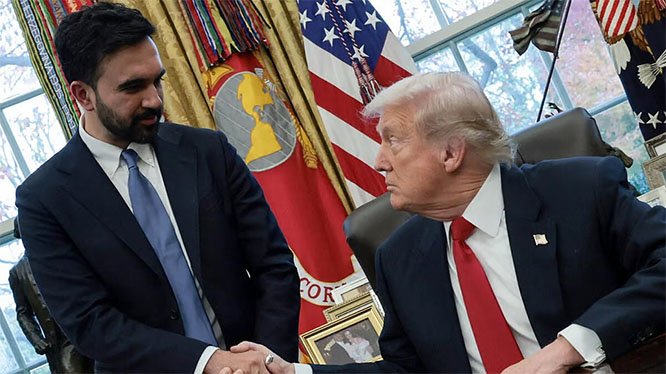
New York/Washington: US President Donald Trump has again claimed to have solved the conflict between India and Pakistan, repeating his assertion during a meeting with New York City Mayor-elect Zohran Mamdani in the Oval Office.

Mamdani flew to Washington DC for his first meeting with Trump in the White House on Friday. Trump said he “enjoyed” the meeting, which he described as “great.”

During remarks in the Oval Office, with Mamdani standing next to him, Trump repeated his claim that he solved the May conflict between India and Pakistan.

"I did eight peace deals of countries, including India and Pakistan,” he said.

On Wednesday, Trump had said he threatened to put 350 per cent tariffs on India and Pakistan if they did not end their conflict, repeating his claim that he solved the fighting between the nuclear-armed neighbours and that Prime Minister Narendra Modi had called him to say “we're not going to go to war.”

Since May 10, when Trump announced on social media that India and Pakistan had agreed to a “full and immediate” ceasefire after a “long night” of talks mediated by Washington, he has repeated his claim over 60 times that he “helped settle” the tensions between India and Pakistan.

India has consistently denied any third-party intervention. India launched Operation Sindoor on May 7, targeting terror infrastructure in Pakistan and Pakistan-occupied Kashmir in retaliation for the April 22 Pahalgam attack that killed 26 civilians. India and Pakistan reached an understanding on May 10 to end the conflict after four days of intense cross-border drone and missile strikes.

Mamdani emerged victorious in the closely-watched battle for New York City Mayor, becoming the first South Asian and Muslim to be elected to sit at the helm of the largest city in the US.

He had been the front-runner in the NYC Mayoral election for months and defeated Republican nominee Curtis Sliwa and political heavyweight former New York State Governor Andrew Cuomo, who ran as an independent candidate and was officially endorsed by Trump just hours before the elections.

Indian-descent Mamdani is the son of renowned filmmaker Mira Nair and Columbia University professor Mahmood Mamdani. He was born and raised in Kampala, Uganda and moved to New York City with his family when he was 7. Mamdani became a naturalised US citizen only recently, in 2018.

Comments

Add new comment

  • Coastaldigest.com reserves the right to delete or block any comments.
  • Coastaldigset.com is not responsible for its readers’ comments.
  • Comments that are abusive, incendiary or irrelevant are strictly prohibited.
  • Please use a genuine email ID and provide your name to avoid reject.
News Network
November 21,2025

Bengaluru, Nov 21: The Karnataka government is facing pressure to overhaul its employment system after a high-level Cabinet sub-committee recommended the complete phase-out of job outsourcing in government offices, boards, and corporations by March 2028. The move is aimed at tackling a systemic issue that has led to the potential violation of constitutional reservation policies and the exploitation of workers.

The Call for Systemic Change

With over three lakh vacant posts currently being filled through private agencies on an outsource, insource, or daily wage basis, the sub-committee highlighted a significant lapse. "As a result, reservations are not being followed as per the Constitution and state laws. It’s an urgent need to take serious steps to change the system. It has been recommended to completely stop the system of outsourcing by March 2028," the panel stated in a document.

The practice of outsourcing involves private companies hiring workers to perform duties for a government agency. Critics argue this model results in lesser salaries, a lack of social security benefits (otherwise available to permanent government employees), and a failure to adhere to the provisions of Articles 14 and 15 of the Constitution, which guarantee equality before the law and prohibit discrimination.

The 'Bidar Model' as a Stop-Gap Solution

To regulate the current mode of employment and reduce worker exploitation until the 2028 deadline, the government plans to establish workers’ services multi-purpose cooperative societies across all districts, following the successful "Bidar Model."

The Bidar District Services of Labour Multi-purpose Cooperative Society Ltd., which operates under the District Commissioner, is cited as a successful example of providing a measure of social security to outsourced staff. Labour Department officials argue this society ensures workers receive their due wages and statutory facilities like ESI (Employees' State Insurance) and PF (Provident Fund), in exchange for a 1% service fee collected from the employees.

legislative push and Priority Insourcing

The recommendations, led by the sub-committee headed by Law and Parliamentary Affairs Minister H K Patil, are set to be discussed at the next Cabinet meeting. The committee has proposed the introduction of the Karnataka Outsourced Employees (Regulation, Placement and Welfare) Bill 2025.

In a move addressing immediate concerns, Labour Minister Santosh Lad, a member of the sub-committee, has reportedly assured that steps will be taken over the next 2-3 years to insource workers in "life-threatening services" on a priority basis. This includes essential personnel like pourakarmikas (sanitation workers), drivers, electrical staff in the Energy Department, and Health Department staff handling contagious diseases. The transition aims to grant these workers the long-term security and benefits they currently lack under the outsourcing system. 

Comments

Add new comment

  • Coastaldigest.com reserves the right to delete or block any comments.
  • Coastaldigset.com is not responsible for its readers’ comments.
  • Comments that are abusive, incendiary or irrelevant are strictly prohibited.
  • Please use a genuine email ID and provide your name to avoid reject.
News Network
November 26,2025

students.jpg

Bengaluru, Nov 26: Karnataka is taking its first concrete steps towards lifting a three-decade-old ban on student elections in colleges and universities. Deputy Chief Minister D.K. Shivakumar announced Wednesday that the state government will form a small committee to study the reintroduction of campus polls, a practice halted in 1989 following incidents of violence.

Speaking at a 'Constitution Day' event organised by the Karnataka Congress, Mr. Shivakumar underscored the move's aim: nurturing new political leadership from the grassroots.

"Recently, (Leader of the Opposition in Lok Sabha) Rahul Gandhi wrote a letter to me and Chief Minister (Siddaramaiah) asking us to think about restarting student elections," Shivakumar stated. "I'm announcing today that we'll form a small committee and seek a report on this."

Student elections were banned in Karnataka in 1989, largely due to concerns over violence and the infiltration of political party affiliates into campus life. The ban effectively extinguished vibrant student bodies and the pipeline of young leaders they often produced.

Mr. Shivakumar, who also serves as the Karnataka Congress president, said that former student leaders will be consulted to "study the pros and cons" of the re-introduction.

Acknowledging the history of the ban, he added, "There were many criminal activities taking place back then. We’ll see how we can conduct (student) elections by regulating such criminal activities."

The Deputy CM reminisced about his own journey, which began on campus. He recalled his political activism at Sri Jagadguru Renukacharya College leading to his first Assembly ticket in 1985 at the age of 23. "That's how student leadership was at the time. Such leadership has gone today. College elections have stopped," he lamented, adding that for many, college elections were "like a big movement" where leaders were forged.

The move, driven by the Congress high command's push to cultivate young talent, will face scrutiny from academics and university authorities who have, in the past, expressed concern that the return of polls could disrupt the peaceful academic environment and turn campuses into political battlegrounds.

Comments

Add new comment

  • Coastaldigest.com reserves the right to delete or block any comments.
  • Coastaldigset.com is not responsible for its readers’ comments.
  • Comments that are abusive, incendiary or irrelevant are strictly prohibited.
  • Please use a genuine email ID and provide your name to avoid reject.