Bangladesh Votes Today, Sheikh Hasina Seeks Fourth Term as Prime Minister

Agencies
December 30, 2018

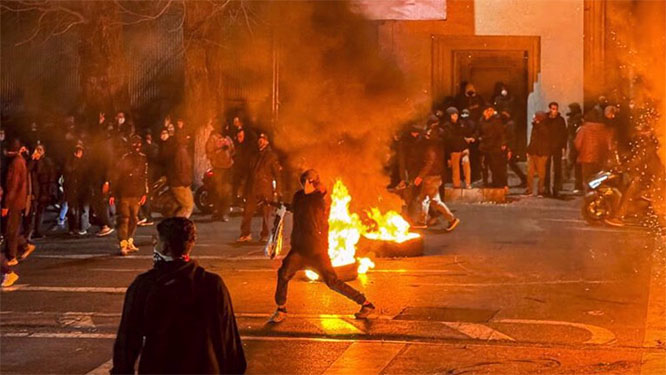
Dhaka, Dec 30: Bangladesh headed to the polls Sunday following a weeks-long campaign that was dominated by deadly violence and allegations of a crackdown on thousands of opposition activists.

Voting began at 8.00 am (0200 GMT) amid tight security in a vote that is expected to deliver a historic but tainted fourth general election victory for Prime Minister Sheikh Hasina.

Some 600,000 security personnel are deployed across the South Asian nation -- including at 40,000 polling stations.

There was fresh violence on the eve of the vote when a ruling party activist was allegedly killed by supporters of the main opposition Bangladesh Nationalist Party (BNP) and its Islamist ally, Jamaat-e-Islami.

"He was attacked with rocks. He died on the way to hospital," Mohammad Niamutullah, police chief in the southern town of Patia said.

The death brought to four the number of people confirmed killed by police since the timetable for the election was announced on November 8, marking the country's 11th parliamentary election since independence in 1971.

The BNP claims eight of its activists have died.

Around 104 million voters are choosing between an alliance led by Hasina's ruling Awami League party and a coalition headed by the BNP which was cobbled together only three months ago.

Opinion polls show Hasina, who has presided over impressive economic growth during an unbroken decade in power but who is also accused of growing authoritarianism, heading for a comfortable victory.

She needs 151 seats in the first-past-the-post system to win in the 300-seat parliament but experts say any victory would be sullied by accusations that she hamstrung her opponents' campaign.

The opposition says more than 15,000 of its activists have been arrested, crippling its ability to mobilise its grassroots support.

Human Rights Watch and other international groups have decried the crackdown, saying it has created a climate of fear which could prevent supporters of opposition parties from casting their ballots.

The United States has also raised concerns about the credibility of the Muslim-majority country's election while the United Nations has called for greater efforts to make the vote fair.

Seventeen opposition candidates were arrested over what they claim are trumped up charges while another 17 were disqualified from running by courts which are allegedly controlled by Hasina.

"This is not (a) free and fair election. It is more a controlled selection," said a Western diplomat who has been monitoring the run-up to the polls and who asked not to be named.

Badiul Alam Majumder, the leader of a Bangladesh civil society group, said the alleged crackdown had "created a perception that the incumbent government will return to power".

"Never in my life I have seen such kind of election. The election commission has totally failed to do its job," he told news agency.

Mobile internet shutdown

The BNP, the main player in the alliance headed by Kamal Hossain, an 82-year-old Oxford-educated lawyer who drew up Bangladesh's constitution, has accused the election commission of bias -- allegations it denies.

Hasina herself has rejected accusations of creeping authoritarianism and called for voters to back her to further bolster the economy which has expanded over six percent a year since she won the 2008 election.

The daughter of Bangladesh's first president Sheikh Mujibur Rahman, Hasina was gifted victory in the 2014 election when the BNP boycotted the vote claiming it wasn't free or fair.

Since then, rights groups have accused Hasina's administration of stifling freedom of speech through the toughening of a draconian anti-press law and the enforced disappearance of government dissenters.

BNP leader Khaleda Zia, an arch-rival of the prime minister, was sentenced to 17 years in jail earlier this year on charges that her party says are politically motivated.

Authorities have ordered the country's mobile operators to shut down 3G and 4G servicesuntil midnight on Sunday "to prevent the spread of rumours" that could trigger unrest.

Polls close at 4:00 pm (1000 GMT).

Comments

Add new comment

  • Coastaldigest.com reserves the right to delete or block any comments.
  • Coastaldigset.com is not responsible for its readers’ comments.
  • Comments that are abusive, incendiary or irrelevant are strictly prohibited.
  • Please use a genuine email ID and provide your name to avoid reject.
News Network
November 27,2025

DKSvokkaliga.jpg

Bengaluru: The Vokkaligara Sangha on Thursday issued a stern warning to the Congress, saying the party could face serious electoral repercussions if Deputy Chief Minister D.K. Shivakumar is not appointed as Chief Minister.

The warning follows the public backing of Shivakumar’s chief ministerial ambition by top Vokkaliga pontiff Nirmalanandanatha Swami, who urged the Congress high command to honor his claim.

“The community supported Congress in the 2023 Assembly elections only because Shivakumar had a real chance to become CM. If he is cheated, we’ll teach the party a big lesson,” said newly elected Sangha president L. Srinivas. He added that Vokkaligas would organize protests under the guidance of community leaders.

General Secretary C.G. Gangadhar pointed out that Congress won more seats in the Vokkaliga-dominated Old Mysuru region due to Shivakumar’s influence, adding, “If Congress wants to retain power, Shivakumar should be made the CM.”

Outgoing president Kenchappa Gowda emphasized Shivakumar’s contribution to Congress’ victory. “Our community voted for Congress thinking he would become CM. Siddaramaiah has also served the party well, but Shivakumar should now be given a chance,” he said.

Former general-secretary Konappa Reddy appealed to Sonia and Rahul Gandhi to recognize Shivakumar’s loyalty and service, saying, “Congress is known to keep its promises. We hope it won’t break the promise made to him.”

Comments

Add new comment

  • Coastaldigest.com reserves the right to delete or block any comments.
  • Coastaldigset.com is not responsible for its readers’ comments.
  • Comments that are abusive, incendiary or irrelevant are strictly prohibited.
  • Please use a genuine email ID and provide your name to avoid reject.
News Network
November 24,2025

lebanon.jpg

Israel has launched a new act of aggression on a residential neighborhood in Lebanon's capital, Beirut, killing and injuring about two dozen civilians.

The Israeli regime's military said in a statement that its forces carried out a so-called precise strike in a residential apartment in Dahiyeh in the southern suburbs of Beirut on Sunday.

The aggression targeted residential areas, killing at least five people and injuring more than 28 people, Lebanon's Health Ministry said. 

Hezbollah announced the martyrdom of senior Hezbollah commander Haytham Ali Tabatabai and four resistance fighters.

Lebanese President Michel Aoun condemned the airstrike, calling it a clear demonstration of Tel Aviv’s disregard for repeated international calls to halt violations on Lebanese soil.

“Israel refuses to implement international resolutions and all efforts aimed at ending the escalation and restoring stability,” Aoun said, urging the international community to take action to prevent further aggression.

The Palestinian Islamic Jihad movement also condemned the attack, holding the international community accountable. 

“The international community bears responsibility and continues to provide cover for these attacks as long as it does not restrain the occupiers,” said Ali Abu Shahin, a member of the group’s political bureau.

Israeli prime minister Benjamin Netanyahu’s office announced that the Israeli army carried out a strike “in the heart of Beirut."

Netanyahu reportedly approved the operation following recommendations from top Israeli security officials.

Two senior US officials commented on the Israeli strike.

The first official said that Israel did not notify Americans in advance about the attack. "We were informed immediately after the strike was carried out."

The second senior official said that the "US knew for several days that Israel was planning to escalate its strikes in Lebanon, but did not know in advance the timing, location, or target of the strike."

Speaking from the site of the Israeli strike, Lebanese MP Ali Ammar condemned the attack as part of a broader campaign of aggression that has targeted "all of Lebanon since the Washington-sponsored ceasefire."

He stated that "any attack on Lebanon is a violation of red lines; this aggression is part and parcel of the entity that targets Lebanon's dignity, sovereignty, and security of citizens."

Ammar went on to say the resistance is responding with "utmost wisdom, patience, and will confront the enemy at the appropriate time."

"Unfortunately, the enemy is emboldened to commit its aggression by voices within Lebanon that have turned themselves into tools that support its aggression," he added.

The Israeli attack on the southern suburbs of the Lebanese capital is the latest blatant violation of the ceasefire Israel signed with Hezbollah in November 2024, which was intended to end hostilities that had escalated into full-scale war.

An Israeli strike on the Ain al-Hilweh camp near Sidon in southern Lebanon late Tuesday killed at least 14 people. It wounded several others, including young students, according to the Lebanese health ministry.

The military claimed the attack targeted “a Hamas training compound” used to plan and carry out attacks against the regime -- a claim that has frequently been made without evidence.

Hamas rejected the allegations as “a blatant lie aimed at justifying the massacre,” stating it had “no military installations in the Palestinian camps in Lebanon” and that the targeted site was merely “an open sports field.”

According to Lebanese authorities, Israeli attacks have killed approximately 4,000 people and displaced more than 1.2 million residents across the country since October 2023.

Comments

Add new comment

  • Coastaldigest.com reserves the right to delete or block any comments.
  • Coastaldigset.com is not responsible for its readers’ comments.
  • Comments that are abusive, incendiary or irrelevant are strictly prohibited.
  • Please use a genuine email ID and provide your name to avoid reject.
News Network
November 26,2025

students.jpg

Bengaluru, Nov 26: Karnataka is taking its first concrete steps towards lifting a three-decade-old ban on student elections in colleges and universities. Deputy Chief Minister D.K. Shivakumar announced Wednesday that the state government will form a small committee to study the reintroduction of campus polls, a practice halted in 1989 following incidents of violence.

Speaking at a 'Constitution Day' event organised by the Karnataka Congress, Mr. Shivakumar underscored the move's aim: nurturing new political leadership from the grassroots.

"Recently, (Leader of the Opposition in Lok Sabha) Rahul Gandhi wrote a letter to me and Chief Minister (Siddaramaiah) asking us to think about restarting student elections," Shivakumar stated. "I'm announcing today that we'll form a small committee and seek a report on this."

Student elections were banned in Karnataka in 1989, largely due to concerns over violence and the infiltration of political party affiliates into campus life. The ban effectively extinguished vibrant student bodies and the pipeline of young leaders they often produced.

Mr. Shivakumar, who also serves as the Karnataka Congress president, said that former student leaders will be consulted to "study the pros and cons" of the re-introduction.

Acknowledging the history of the ban, he added, "There were many criminal activities taking place back then. We’ll see how we can conduct (student) elections by regulating such criminal activities."

The Deputy CM reminisced about his own journey, which began on campus. He recalled his political activism at Sri Jagadguru Renukacharya College leading to his first Assembly ticket in 1985 at the age of 23. "That's how student leadership was at the time. Such leadership has gone today. College elections have stopped," he lamented, adding that for many, college elections were "like a big movement" where leaders were forged.

The move, driven by the Congress high command's push to cultivate young talent, will face scrutiny from academics and university authorities who have, in the past, expressed concern that the return of polls could disrupt the peaceful academic environment and turn campuses into political battlegrounds.

Comments

Add new comment

  • Coastaldigest.com reserves the right to delete or block any comments.
  • Coastaldigset.com is not responsible for its readers’ comments.
  • Comments that are abusive, incendiary or irrelevant are strictly prohibited.
  • Please use a genuine email ID and provide your name to avoid reject.