



Better chance of peace with India if BJP wins again; Cong is scared of BJP’s propaganda: Imran Khan

Agencies
April 10, 2019

Islamabad, Apr 10: Pakistani Prime Minister Imran Khan said he thinks there may be a better chance of peace talks with India if Prime Minister Narendra Modi's Hindu nationalist Bharatiya Janata Party (BJP) wins the general election due to begin there on Thursday.
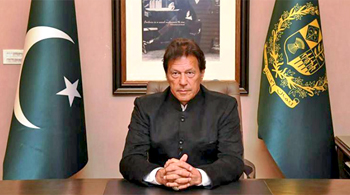
Khan said that if the next Indian government were led by the opposition Congress party, it might be too scared to seek a settlement with Pakistan over disputed Indian-controlled Kashmir, fearing a backlash from the right.

"Perhaps if the BJP - a right-wing party - wins, some kind of settlement in Kashmir could be reached," Khan told a small group of foreign journalists in an interview.

This was despite the massive alienation that Muslims in Kashmir and Muslims in general were facing in Modi's India, said Khan, who took office last August.

"I never thought I would see what is happening in India right now," said the former international cricket star. "Muslim-ness is being attacked."

Khan said Indian Muslims he knew who many years ago had been happy about their situation in India were now very worried by extreme Hindu nationalism.

He said Modi, like Israeli Prime Minister Benjamin Netanyahu, was electioneering based on "fear and nationalist feeling".

The BJP's pledge this week to propose stripping decades-old special rights from the people of Jammu and Kashmir, which prevent outsiders from buying property in the state, was a major concern, though it could also be electioneering, Khan said.

Khan did appear to offer India an olive branch, saying that Islamabad was determined to dismantle all Pakistan-based militias in the country, and that the government had full support from Pakistan's powerful army for the programme. Those to be dismantled include groups involved in Kashmir.

Nuclear-armed neighbours Pakistan and India both claim Kashmir in full but rule in part.

Khan said Kashmir was a political struggle and there was no military solution, adding that Kashmiris suffered if armed militants from Pakistan came across the border, leading to Indian army crackdowns.

Relations between Pakistan and India, which have fought three wars since gaining independence from Britain in 1947, two over Kashmir, reached a crisis point in February after a suicide bombing killed 40 Indian paramilitary police in Kashmir.

Islamabad denied responsibility for the Feb. 14 attack, which was claimed by Pakistan-based militant group Jaish-e-Mohammed, but the bombing prompted India to carry out a cross border air strike against what it said was a militant training camp in Pakistan.

Pakistan responded with air strikes of its own.

Pollsters say Modi and the BJP's re-election bid got a boost from a wave of patriotism after the suicide bomb attack and the Indian government's fast response.

Khan said there was still the possibility if the polls turn against Modi in the next few weeks that India could take some further military action against Pakistan.

The rolling election is held in phases and does not finish until May 19. The result is not due until May 23.

Pakistani Foreign Minister Shah Mahmood Qureshi warned on Sunday that Islamabad had "reliable intelligence" that India would attack again this month. India described the claim as irresponsible.

Khan said that it was vital for Pakistan to have peace with its neighbours, Afghanistan, India and Iran, if it was to have the kind of economy needed to pull 100 million people out of poverty.


Comments

Add new comment

  • Coastaldigest.com reserves the right to delete or block any comments.
  • Coastaldigset.com is not responsible for its readers’ comments.
  • Comments that are abusive, incendiary or irrelevant are strictly prohibited.
  • Please use a genuine email ID and provide your name to avoid reject.
News Network
January 20,2026

iran.jpg

Iranian security and intelligence forces have captured more than 470 individuals in three provinces, identified as key figures behind the recent wave of violent unrest and terrorist activities linked to foreign-backed networks.

The Intelligence Ministry's provincial office in Khorasan Razavi announced on Monday the arrest of 192 armed terrorists, identified as the main agents behind recent riots in the region. 

According to an official statement, the detainees were involved in the killing of several security personnel and civilians, setting fire to mosques, public service facilities, and buses, as well as attacks on military and law enforcement centers.

The seized items from the group include several bulletproof vests, Kalashnikov rifles, hunting weapons, Winchester rifles, and various cold weapons such as daggers, swords, brass knuckles, tactical knives, crossbows, and chains.

Evidence indicates that some of the individuals were tied to hostile movements and terrorist organizations, with links overseas. Others were identified as members of violent criminal gangs, actively taking part in the unrest alongside their associates.

Simultaneously, in the western province of Lorestan, the IRGC announced the arrest of 134 individuals as the main leaders and influential field agents of a US-Israeli terrorist network.

The IRGC statement stated that these individuals formed terrorist cells during the recent unrest, committing "Daesh-like" acts.

They wounded security forces with firearms and cold weapons, and burned and destroyed public and private properties, including mosques, shops, banks, and private and public vehicles.

In the northwestern province of Zanjan, the police reported detaining 150 people identified as principal leaders and agents behind recent riots.

Authorities noted that these individuals were responsible for destroying public and private property and intentionally setting fire to vehicles in the province's squares.

Their crimes include shedding the blood of innocent people, destroying public and private property, attempting to enter military sites, disrupting public order, and spreading terror among citizens.

A variety of cold weapons were reportedly seized from the detainees.

What began late last month as peaceful protests over economic hardship across Iran turned violent after public statements by US and Israeli regime figures encouraged vandalism and disorder.

During the unrest, foreign-backed mercenaries rampaged through cities, killing security forces and civilians and damaging public property.

Comments

Add new comment

  • Coastaldigest.com reserves the right to delete or block any comments.
  • Coastaldigset.com is not responsible for its readers’ comments.
  • Comments that are abusive, incendiary or irrelevant are strictly prohibited.
  • Please use a genuine email ID and provide your name to avoid reject.
News Network
February 1,2026

Bengaluru: The Karnataka High Court has refused to quash an investigation against a WhatsApp group administrator accused of allowing the circulation of obscene and offensive images depicting Hindutva politicians and idols in 2021.

Justice M Nagaprasanna observed that, prima facie, the ingredients of the offence under Section 295A of the Indian Penal Code were made out. “The offence under Section 295A of the IPC is met to every word of its ingredient, albeit prima facie,” the judge said.

The petitioner, Sirajuddin, a resident of Belthangady taluk in Dakshina Kannada district, had challenged the FIR registered against him at the CEN (Cyber, Economics and Narcotics) police station, Mangaluru, for offences under Section 295A of the IPC and Section 67 of the Information Technology Act. Section 295A relates to punishment for deliberate and malicious acts intended to outrage the religious feelings of any class of citizens.

According to the complaint filed by K Jayaraj Salian, also a resident of Belthangady taluk, he received a WhatsApp group link from an unknown source and was added to the group after accessing it. The group reportedly had six administrators and around 250 participants, where obscene and offensive images depicting Hindu deities and certain political figures were allegedly circulated repeatedly.

Sirajuddin was arrested in connection with the case and later released on bail on February 16, 2021. He argued before the court that he was being selectively targeted, while other administrators—including the creator of the group—were neither arrested nor investigated. He also contended that the Magistrate could not have taken cognisance of the offence under Section 295A without prior sanction under Section 196(1) of the CrPC.

Rejecting the argument, Justice Nagaprasanna held that prior sanction is required only at the stage of taking cognisance, and not at the stage of registration of the crime or during investigation.

The judge noted that the State had produced the entire investigation material before the court. “A perusal of the material reveals depictions of Hindu deities in an extraordinarily obscene, demeaning and profane manner. The content is such that its reproduction in a judicial order would itself be inappropriate,” the court said, adding that the material, on its face, had the tendency to outrage religious feelings and disturb communal harmony.

Observing that the case was still at the investigation stage, the court said it could not interdict the probe at this juncture. However, it expressed concern that the investigating officer appeared to have not proceeded uniformly against all administrators. The court clarified that if the investigation revealed the active involvement of any member in permitting the circulation of such content, they must also be proceeded against.

“At this investigative stage, any further observation by this Court would be unnecessary,” the order concluded.

Comments

Add new comment

  • Coastaldigest.com reserves the right to delete or block any comments.
  • Coastaldigset.com is not responsible for its readers’ comments.
  • Comments that are abusive, incendiary or irrelevant are strictly prohibited.
  • Please use a genuine email ID and provide your name to avoid reject.