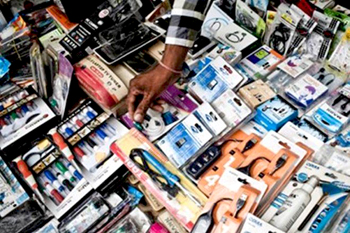
'Chinese goods' sale in India hit record high despite boycott

October 14, 2016

Beijing, Oct 14: Calls for boycott of Chinese goods in India following China's opposition to a UN ban on JeM chief Masood Azhar have failed as sales of Chinese products in the country hit a record high during the festive season, official media here said today.
china
"Diwali, one of the most important Hindu festivals and one of the biggest shopping seasons in India, is coming at the end of October, but encouragement to boycott Chinese goods has been spreading in the last few days on Indian social media, and even a few Indian politicians are exaggerating facts," an article in the state-run Global Times said.

"However, regardless of the passionate boycott in India and Indian media's hysteric reports of a "doomsday" for Chinese products, Chinese goods have never been condemned by Indian government and are popular across the nation," it said.

"The boycott has not achieved success. Sales figures for Chinese products on the top three Indian online retailers in the first week of October hit a new record.

Amazingly, the Chinese mobile phone company Xiaomi sold half a million phones in just three days on the Flipkart, Amazon India, Snapdeal and Tata CLiQ platforms," the article said.

Referring to the boycott calls over China's technical hold on moves to bring about a ban on Azhar as well Beijing obstructing India's membership in the Nuclear Suppliers Group, (NSG), it said.

"Chinese products are often the victim when regional situations get tense, and this phenomenon has been existing for quite a few years. Now Chinese goods are on the stage again due to the Kashmir issue," it said.

"The bilateral trade relationship is one of the pillars of the Sino-Indian relationship. The trade volume was over USD 70 billion in 2015, and China's investment in India soared to around USD 870 million in 2015, six times what it was in 2014," it said.

India has been expressing concern over the trade deficit which last year touched USD 46 billion.

"To some extent, the economic relationship is the barometer of the political relationship. There shouldn't be huge fluctuation in terms of economic cooperation if the political relationship keeps steady between the two," it said.

"For the dragon and elephant, enhancing economic ties would be a preferable way to promote the comprehensive bilateral relationship. The more economic cooperation exists, the more opportunities there will be for Chinese products to enter the Indian market.

"India is a big potential market, and people using smartphones and doing online shopping has become the irreversible trend in the new era," it said.

The commercial cooperation between these two countries could also be focused on e-commerce, service and financial investment. Another article in the same daily said India has to upgrade its industrial structures to address USD 46 billion trade deficit.

Official data during September showed India had exported goods worth USD 922 million to China, while importing goods worth USD 5.4 billion from China.

"The huge trade deficit with China has become an increasingly unharmonious factor in bilateral ties between the two countries, requiring China and India to take practical measures to narrow the trade imbalance when leaders of the two nations meet in India over the weekend for the BRICS summit," the article said.

"The two countries have made concerted efforts to narrow the trade imbalance, including signing a five-year trade and economic cooperation agreement in 2014, but it seems that such moves have had only limited effects. What we need to do now is find out the root causes of the trade imbalance," it said.

The major imports from China include electronic components, telecom instruments, chemicals and pharmaceutical products, while India's major exports to China include ore, plastics and cotton.

"The imbalanced bilateral trade structure is actually a result of the fact that China and India are at different developmental stages in terms of industrialisation. It won't be easy to reduce India's trade deficit with China simply by relying on measures such as seeking greater access to the Chinese market for India's raw materials and agricultural products - India also needs to upgrade its industrial structure," it said.

"In other words, India seeking to solve the problem of the China-India trade imbalance cannot anchor its hopes on efforts such as persuading Chinese people to consume more Indian goods at a time when more and more Indian young people are keen to use Chinese-made goods such as smartphones," it said.

"Efforts such as encouraging Chinese smartphone makers to set up production lines in India may be the most effective way to reduce the trade deficit, which is partly the result of a price gap between India's imports of finished goods and its exports of raw materials," it said.

"But sadly, it seems that India is not on the right path, as the country is trying to reduce its trade deficit with China through trade protectionism," it said, adding that there had been 322 anti-dumping cases in India so far, of which 177 cases involved Chinese products.

"Besides, a social media campaign urging people to refrain from buying China-made products has recently been building in India. Such moves will not help contribute to reducing India's trade deficit, but could damage bilateral ties instead," it said.


Comments

Add new comment

  • Coastaldigest.com reserves the right to delete or block any comments.
  • Coastaldigset.com is not responsible for its readers’ comments.
  • Comments that are abusive, incendiary or irrelevant are strictly prohibited.
  • Please use a genuine email ID and provide your name to avoid reject.
News Network
December 16,2025

jordan.jpg

Prime Minister Narendra Modi on Monday held talks with Jordan’s King Abdullah II in Amman, during which the two leaders discussed ways to further strengthen bilateral relations, with the Prime Minister outlining an eight-point vision covering key areas of cooperation.

Describing the meeting as “productive”, PM Modi said he shared a roadmap focused on trade and economy, fertilisers and agriculture, information technology, healthcare, infrastructure, critical and strategic minerals, civil nuclear cooperation, and people-to-people ties.

In a post on social media platform X, the Prime Minister praised King Abdullah II’s personal commitment to advancing India–Jordan relations, particularly as both countries mark the 75th anniversary of the establishment of diplomatic ties this year.

“Held productive discussions with His Majesty King Abdullah II in Amman. His personal commitment towards vibrant India-Jordan relations is noteworthy. This year, we are celebrating the 75th anniversary of our bilateral diplomatic relations,” PM Modi said.

The meeting took place at the Al Husseiniya Palace, where the two leaders also exchanged views on regional and global issues of mutual interest. According to the Ministry of External Affairs (MEA), both sides agreed to further deepen cooperation in areas including trade and investment, defence and security, counter-terrorism and de-radicalisation, fertilisers and agriculture, infrastructure, renewable energy, tourism, and heritage.

The MEA said both leaders reaffirmed their united stand against terrorism.

PM Modi arrived in Amman earlier on Monday and was received by Jordanian Prime Minister Jafar Hassan, who accorded him a formal welcome. Following the talks, King Abdullah II hosted a banquet dinner in honour of the Prime Minister, reflecting the warmth of bilateral ties.

Jordan is the first leg of PM Modi’s three-nation tour. From Amman, the Prime Minister will travel to Ethiopia at the invitation of Prime Minister Abiy Ahmed Ali, marking his first official visit to the African nation. The tour will conclude with a visit to Oman.

Comments

Add new comment

  • Coastaldigest.com reserves the right to delete or block any comments.
  • Coastaldigset.com is not responsible for its readers’ comments.
  • Comments that are abusive, incendiary or irrelevant are strictly prohibited.
  • Please use a genuine email ID and provide your name to avoid reject.
News Network
December 5,2025

indigoCEO.jpg

New Delhi, Dec 5: IndiGo CEO Pieter Elbers issued a public apology this evening after more than a thousand flights were cancelled today, making it the "most severely impacted day" in terms of cancellations. The biggest airline of the country cancelled "more than half" of its daily number of flights on Friday, said Elbers. He also said that even though the crisis will persist on Saturday, the airline anticipates fewer than 1,000 flight cancellations.

"Full normalisation is expected between December 10 and 15, though IndiGo cautions that recovery will take time due to the scale of operations," the IndiGo CEO said. 

IndiGo operates around 2,300 domestic and international flights daily.

Pieter Elbers, while apologising for the major inconvenience due to delays and cancellations, said the situation is a result of various causes.

The crisis at IndiGo stems from new regulations that boost pilots' weekly rest requirements by 12 hours to 48 and allow only two night-time landings per week, down from six. IndiGo has attributed the mass cancellations to "misjudgment and planning gaps".

Elbers also listed three lines of action that the airline will adopt to address the issue.

"Firstly, customer communication and addressing your needs, for this, messages have been sent on social media. And just now, a more detailed communication with information, refunds, cancellations and other customer support measures was sent," he said.

The airline has also stepped up its call centre capacity.

"Secondly, due to yesterday's situation, we had customers stranded mostly at the nation's largest airports. Our focus was for all of them to be able to travel today itself, which will be achieved. For this, we also ask customers whose flights are cancelled not to come to the airports as notifications are sent," the CEO said.

"Thirdly, cancellations were made for today to align our crew and planes to be where they need to start tomorrow morning afresh. Earlier measures of the last few days, regrettable, have proven not to be enough, but we have decided today to reboot all our systems and schedules, resulting in the highest numbers of cancellations so far, but imperative for progressive improvements starting from tomorrow," he added.

As airports witnessed chaotic scenes, the Directorate General of Civil Aviation (DGCA) stepped in to grant IndiGo a temporary exemption from stricter night duty rules for pilots. It also allowed substitution of leaves with a weekly rest period. 

Civil Aviation Minister Ram Mohan Naidu has said a high-level inquiry will be ordered and accountability will be fixed.

Comments

Add new comment

  • Coastaldigest.com reserves the right to delete or block any comments.
  • Coastaldigset.com is not responsible for its readers’ comments.
  • Comments that are abusive, incendiary or irrelevant are strictly prohibited.
  • Please use a genuine email ID and provide your name to avoid reject.
News Network
December 20,2025

train.jpg

At least seven elephants were killed and one calf injured after a herd collided with the Sairang-New Delhi Rajdhani Express in Assam's Hojai on Saturday morning, leading to disruption of rail services. 

The Sairang-New Delhi Rajdhani Express struck a herd of elephants, resulting in the derailment of the locomotive and five coaches. No passenger casualties or injuries were reported, officials said.

The New Delhi-bound train met with the accident around 2.17 am, PTI reported. The Sairang-New Delhi Rajdhani Express connects Mizoram's Sairang (near Aizawl) to Anand Vihar Terminal (Delhi). 

Railway has issued helpline numbers at the Guwahati Railway Station:-

•    0361-2731621
•    0361-2731622
•    0361-2731623

The accident site is located about 126 km from Guwahati. Following the incident, accident relief trains and railway officials rushed to the spot to initiate rescue operations.

Train Services Disrupted

Sources said that due to the derailment and elephant body parts scattered on the tracks, train services to Upper Assam and other parts of the Northeast were affected.

Passengers from the affected coaches were temporarily accommodated in vacant berths available in other coaches of the train. Once the train reaches Guwahati, additional coaches will be attached to accommodate all passengers, after which the train will resume its onward journey.

The incident occurred at a location that is not a designated elephant corridor. The loco pilot, upon spotting the herd on the tracks, applied emergency brakes. Despite this, the elephants dashed into the train, leading to the collision and derailment.

Last month, an elephant was killed after being hit by a train in Dhupguri in West Bengal's Jalpaiguri district. The incident took place on November 30. 

The adult elephant was killed on the spot, and a calf was discovered lying injured beside the tracks. 

Over 70 Elephants Killed In Train Collisions Over Last 5 Years

At least 79 elephants have died in train collisions across the country in the last five years, the Environment Ministry had informed Parliament in August.

In a written reply in the Lok Sabha, Minister of State for Environment Kirti Vardhan Singh had said the figure is based on reports from state governments and Union Territory administrations for the period 2020-21 to 2024-25.

He said that the ministry does not maintain consolidated data on the deaths of other wild animals on railway tracks, including in designated elephant corridors.

Singh confirmed that three elephants, including a mother and her calf, were killed on July 18 this year after being hit by a speeding express train on the Kharagpur-Tatanagar section in West Bengal's Paschim Midnapore district. The incident took place near Banstala between Jhargram and Banstala stations.

The minister said several measures have been taken jointly by the Environment Ministry and the Railways to prevent such accidents.

These include imposing speed restrictions in elephant habitats, pilot projects such as seismic sensor-based detection of elephants near tracks and construction of underpasses, ramps and fencing at vulnerable points.

The Wildlife Institute of India, in consultation with the ministry and other stakeholders, has also issued guidelines titled 'Eco-friendly Measures to Mitigate Impacts of Linear Infrastructure' to help agencies design railways and other projects in ways that reduce human-animal conflicts.

Singh added that capacity-building workshops were conducted for railway officials at the Wildlife Institute of India in 2023 and 2024 to raise awareness on elephant conservation and protection.

A detailed report titled 'Suggested Measures to Mitigate Elephant & Other Wildlife Train Collisions on Vulnerable Railway Stretches in India' had also been prepared after surveys across 127 railway stretches covering 3,452 km.

Of these, 77 stretches spanning 1,965 km in 14 states were prioritised for mitigation, with site-specific interventions suggested. 

Comments

Add new comment

  • Coastaldigest.com reserves the right to delete or block any comments.
  • Coastaldigset.com is not responsible for its readers’ comments.
  • Comments that are abusive, incendiary or irrelevant are strictly prohibited.
  • Please use a genuine email ID and provide your name to avoid reject.