Media completing ignoring issues of rural India, says Sainath

coastaldigest.com news network
August 21, 2017

Udupi, Aug 21: Veteran journalist P Sainath has expressed frustration over Indian media’s reluctance to cover rural issues.

The Magsaysay award winner was delivering a special lecture on the topic — “The story of rural India in digital age”— here on Sunday. The lecture was organised as part of the endowment lecture series “Talluru Nudimale – 2017” by the Tallur Family Trust.

Mr. Sainath said that the front page of average national dailies dedicated space of just 0.67% to stories of rural India. This was an average of five years. This meant that 69% of the population was marginalised in the media. This also meant that there was an ill-informed society.

Rural India is incredibly complex having 833 million people speaking over 718 different languages, he said and added that six of those languages were being spoken by 50 million people and three languages were spoken by over 80 million people, while one language was spoken by 500 million people. Inequalities in India had grown faster in the last 20 years than in any other country in the world. Some of the finest skills in the country were dying.

The Skills Development Project was taking the weavers of Kanjeevaram, one of the greatest traditions in Indian history, and was making them autorickshaw drivers. The Tamil weavers had given up. Now, it was Padmashalis from Telangana who are doing the work of weaving. A giant de-skilling was taking place in rural India.

Millions of children were entering schools, where they could not own textbooks. But the newspapers, magazines and television channels were silent on it. Even the education sector was getting commercialised and privatised. The high-rung IIMs were charging Rs. 22 lakh as fees. The low-rung IIMs were charging Rs. 10 lakh and above. Though there were only a few freedom fighters living now, the media had not bothered to take their opinion on the freedom movement during the 70th Independence Day. Instead, one of the newspapers had taken the views of CEOs of big companies and Bollywood celebrities on it, he said. Mr. Sainath released “Nunnanabetta”, a collection of articles written by Rajaram Tallur.

G.N. Mohan and Nagesh Hegde, journalists, M.S. Sriram, writer and economist, Narayana A., Professor, Azim Premji University, gave their responses to Mr. Sainath’s lecture.

 

Comments

Vinod Acharya
 - 
Monday, 21 Aug 2017

The solo warrier... well said sir. Real face of media..

AR Shetty
 - 
Monday, 21 Aug 2017

I'm a big fan of you sir. 

Hari
 - 
Monday, 21 Aug 2017

Sir, Including you only few people doing true journalism

Danish
 - 
Monday, 21 Aug 2017

Smooth running of media, needed capital. so media cant neglect corperators and MNCs. without them media wont get capital and advts..

Kumar
 - 
Monday, 21 Aug 2017

I remember sir, you told once in a workshop regarding media neglected farmer issues and went for fashion show coverage

Ganesh
 - 
Monday, 21 Aug 2017

Sir, Media and media people (except you) needed more publicity, so they will do unwanted controversy issues. 

Add new comment

  • Coastaldigest.com reserves the right to delete or block any comments.
  • Coastaldigset.com is not responsible for its readers’ comments.
  • Comments that are abusive, incendiary or irrelevant are strictly prohibited.
  • Please use a genuine email ID and provide your name to avoid reject.
News Network
November 21,2025

Tejas.jpg

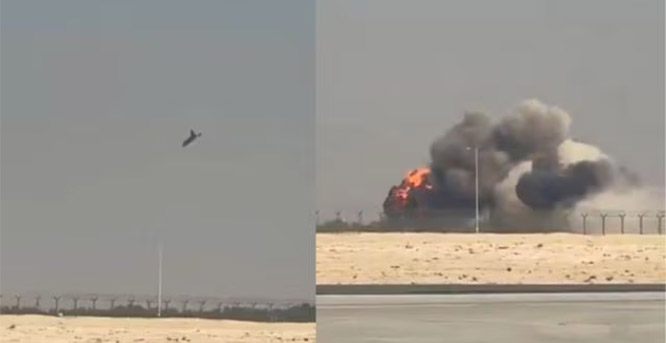
An Indian Air Force (IAF) Tejas fighter jet crashed on Friday, November 21, afternoon during its aerial demonstration at the Dubai Air Show, plunging to the ground at around 2:10 pm local time while performing a manoeuvre before thousands of spectators.

The IAF confirmed the incident, stating that a Tejas aircraft participating in the show had crashed and that further details were being gathered. An Air Force spokesperson said more information would be shared after initial assessments.

The crash sent thick black smoke billowing into the sky near the airport, causing panic among visitors, including families and children who had gathered to watch the display. Authorities have not yet confirmed whether the pilot managed to eject before the aircraft went down. Emergency response teams rushed to the scene, and officials have not released information on casualties or damage so far.

The Tejas is a 4.5-generation, multi-role fighter aircraft developed indigenously by Hindustan Aeronautics Limited (HAL). Designed for versatility, it is capable of offensive air support, close combat, ground attack missions and maritime operations. The aircraft family includes single-seat fighters and twin-seat trainers for both the Air Force and Navy.

HAL describes the latest version, the LCA Mk1A, as the most advanced in the series, featuring an AESA radar, an upgraded electronic warfare suite with radar-warning and self-protection jamming, smart multifunction displays, a digital map generator, a combined interrogator–transponder system and a modern radio altimeter. These enhancements significantly improve the aircraft’s combat capability and survivability.

Further updates from IAF and UAE authorities are awaited.

Comments

Add new comment

  • Coastaldigest.com reserves the right to delete or block any comments.
  • Coastaldigset.com is not responsible for its readers’ comments.
  • Comments that are abusive, incendiary or irrelevant are strictly prohibited.
  • Please use a genuine email ID and provide your name to avoid reject.
News Network
November 21,2025

Bengaluru, Nov 21: The Karnataka government is facing pressure to overhaul its employment system after a high-level Cabinet sub-committee recommended the complete phase-out of job outsourcing in government offices, boards, and corporations by March 2028. The move is aimed at tackling a systemic issue that has led to the potential violation of constitutional reservation policies and the exploitation of workers.

The Call for Systemic Change

With over three lakh vacant posts currently being filled through private agencies on an outsource, insource, or daily wage basis, the sub-committee highlighted a significant lapse. "As a result, reservations are not being followed as per the Constitution and state laws. It’s an urgent need to take serious steps to change the system. It has been recommended to completely stop the system of outsourcing by March 2028," the panel stated in a document.

The practice of outsourcing involves private companies hiring workers to perform duties for a government agency. Critics argue this model results in lesser salaries, a lack of social security benefits (otherwise available to permanent government employees), and a failure to adhere to the provisions of Articles 14 and 15 of the Constitution, which guarantee equality before the law and prohibit discrimination.

The 'Bidar Model' as a Stop-Gap Solution

To regulate the current mode of employment and reduce worker exploitation until the 2028 deadline, the government plans to establish workers’ services multi-purpose cooperative societies across all districts, following the successful "Bidar Model."

The Bidar District Services of Labour Multi-purpose Cooperative Society Ltd., which operates under the District Commissioner, is cited as a successful example of providing a measure of social security to outsourced staff. Labour Department officials argue this society ensures workers receive their due wages and statutory facilities like ESI (Employees' State Insurance) and PF (Provident Fund), in exchange for a 1% service fee collected from the employees.

legislative push and Priority Insourcing

The recommendations, led by the sub-committee headed by Law and Parliamentary Affairs Minister H K Patil, are set to be discussed at the next Cabinet meeting. The committee has proposed the introduction of the Karnataka Outsourced Employees (Regulation, Placement and Welfare) Bill 2025.

In a move addressing immediate concerns, Labour Minister Santosh Lad, a member of the sub-committee, has reportedly assured that steps will be taken over the next 2-3 years to insource workers in "life-threatening services" on a priority basis. This includes essential personnel like pourakarmikas (sanitation workers), drivers, electrical staff in the Energy Department, and Health Department staff handling contagious diseases. The transition aims to grant these workers the long-term security and benefits they currently lack under the outsourcing system. 

Comments

Add new comment

  • Coastaldigest.com reserves the right to delete or block any comments.
  • Coastaldigset.com is not responsible for its readers’ comments.
  • Comments that are abusive, incendiary or irrelevant are strictly prohibited.
  • Please use a genuine email ID and provide your name to avoid reject.
News Network
November 22,2025

The Karnataka government has announced a 50% rebate on pending traffic and transport fines. The discount is available from November 21 to December 12.

The rebate applies to all traffic e-challans and violation cases booked by the RTO between 1991–92 and 2019–20. Officials clarified that the offer is not applicable to pending tax dues and is restricted only to traffic-violation fines.

Across Karnataka, more than 4 lakh RTO cases remain pending, including those involving transport vehicles. While thousands of vehicle owners have already cleared their dues, the department expects to generate substantial revenue through this limited-period rebate.

How to Pay and Avail the Discount

There are three ways to check and pay your pending fines:

1. Through Mobile Apps
Available on both Play Store and App Store:
•    Karnataka State Police (KSP) app
•    KarnatakaOne app
•    ASTraM app

Steps:
•    Enter your vehicle number in any of the above apps
•    Verify the photo/details of your vehicle
•    Pay the fine with the 50% discount applied

2. Visit a Traffic Police Station

You can pay your pending fine at any nearby traffic police station.

3. Visit the Traffic Management Centre (TMC)

•    Location: First Floor, Infantry Road, near Indian Express, Bengaluru

Transport Commissioner Yogeesh A M said, “We don't issue e-challans, so there's no online payment system.”

The department estimates ₹52 crore in pending RTO fines up to March 2020. “With the 50% rebate, we expect to collect around ₹25 crore if all dues are cleared,” he added.

Comments

Add new comment

  • Coastaldigest.com reserves the right to delete or block any comments.
  • Coastaldigset.com is not responsible for its readers’ comments.
  • Comments that are abusive, incendiary or irrelevant are strictly prohibited.
  • Please use a genuine email ID and provide your name to avoid reject.