



Indian expats in Middle East worried about passport reform

News Network
January 18, 2018

The Indian government’s decision to do away with the address page in the Indian passport has received mixed reaction from social workers and expatriates in the Middle Eastern countries.
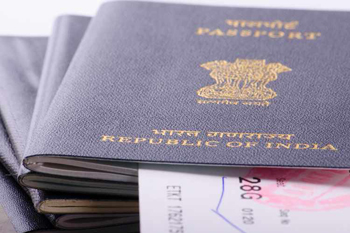
The Ministry of External Affairs (MEA) of government of India recently announced its decision to do away with the last page of the passport and other travel. The last page contains information such the name of parents, spouse, address, Emigration Check Required (ECR) and old passport number with date and place of issue of the holder of the passport.

Late last year, the Indian government also announced that NRIs are not eligible to apply for Aadhar - India's biometric identity card - nor are they required to link their Aadhar details to PAN cards or register it with their SIM cards. The decision to do-away with the address page on the passport raises questions as to what NRIs must do to avail services such as apply for SIM cards or open bank accounts in India.

Indian missions in the United Arab Emirates have stated that they are yet to receive official instruction from the Ministry in New Delhi before new passports can be issued. Pavan K. Rai, first secretary, consular affairs at the Indian Embassy in Abu Dhabi, said: "We are yet to receive official instructions from New Delhi with this regard, and cannot comment on the decision's effects on NRI's in UAE. Once we get clear guidelines from the ministry, we can clarify processes for residents."

Orange is the new blue?

Furthermore, the proposal to issue 'an orange coloured' passport for Emigration Check Required (ECR) categories of people was met with ire, as social workers stated that it is discriminatory to segregate citizens who have not passed Secondary School Leaving Certificate (SSLC) examinations.

The 'ECR' stamp in the current passport ensures the safety of uneducated and unskilled Indian workers, from the deprived socio-economic conditions, against prevailing legal conditions in foreign countries.

KV Shamsudheen, founder and chairman of Pravasi Bandhu Welfare Trust, has written a letter to the Minister of External Affairs Sushma Swaraj requesting her to retract this decision as it would cause severe difficulty for NRI's.

He said: "It is not fair to segregate citizens who in the ECR category with and orange passport. The government is claiming the orange passport will save workers from exploitation. But that is not the case, they will be subject to discrimination, especially at immigration lines at international airports."

Social worker Girish Pant said that the decision has its pros and cons. "If workers are easily identified with the different coloured passport, they can avail services that would protect them against unscrupulous agents and job frauds. However, removal of the address could indeed cause increased paper work for NRIs, especially when it comes to getting their paperwork attested by various authorities."

Many countries demand parents' information for resident and visit visa purposes, said Shamsudheen, adding, "If the new passport is implemented, NRIs have to get a certificate showing parents' names' (birth certificate) from their home cities, that requires attestation by the Indian ministry of foreign affairs, embassies of the home country, and attestation by respective country's foreign ministry. It will be very cumbersome to NRIs. Applying for visas to foreign countries will be a technical nightmare," he said.

Another social worker in Dubai Kusum Dutta said: "When Aadhar was implemented, my family and I got it made. I feel proud to have an Aadhar with me, because it gives me a sense of identity. Though I am very happy that the government has taken such a bold step, I am a bit unsure if we're equipped electronically to handle this shift given our population. Both in India and abroad."

Comments

Muhammed Ali Uchil
 - 
Monday, 22 Jan 2018

Now, passport holders with ECR status would be issued a passport with orange color passport jacket

Treating India's migrant workers like second class citizens is completely unacceptable. This action demonstrates govt.'s discriminatory mindset. However well-intentioned the move to create different coloured passports for different kinds of travellers, it is wrong and must be reconsidered. Already officials treat citizens differently based on their class...different passport colors will worsen it.
While Indian passports have a blue cover, diplomatic and official passports have white and red jackets, respectively. Currently, barring diplomatic and official passports, all Indian passports have blue cover.So,let it be like that!

abbu
 - 
Sunday, 21 Jan 2018

AT THE END OF THE DAY MODI GOVT. SHOULD SHOW THE WORK.. THTS THE REASON HE IS DOING ALL THESE THINGS... THIS IS NOT A PRIMARY REQUIREMENT TO CHANGE THE PASSPORT COLOURS. THERE ARE SOO SOO MANY THINGS TO BE DONE WHICH MODI GOVT. PROMISED AND STILL IN PAGES....... WAKE UP GUYS WAKE UP... IF NOT NOW THEN WE ARE THE ONE WHO IS SUFFREING FROM THIS AND NOT THE MP'S OR MLA'S OR MINISTERS

Parson
 - 
Friday, 19 Jan 2018

Y this degradation for un-educated workers? Already big blunder is been created by MODI Govt by doing De-Monitization. All the black money was made white. No Black money came into govt's Hand. The poeple who will suffer wil be common man. PM, please stop this blunders what are u planing to create. Which fool gives you these idea, he shud be killed. Wasting Tax payers money for silly nonsense. Wake up Guys......Let BLUE b the BLUE.......

Add new comment

  • Coastaldigest.com reserves the right to delete or block any comments.
  • Coastaldigset.com is not responsible for its readers’ comments.
  • Comments that are abusive, incendiary or irrelevant are strictly prohibited.
  • Please use a genuine email ID and provide your name to avoid reject.
News Network
November 21,2025

Bengaluru, Nov 21: The Karnataka government is facing pressure to overhaul its employment system after a high-level Cabinet sub-committee recommended the complete phase-out of job outsourcing in government offices, boards, and corporations by March 2028. The move is aimed at tackling a systemic issue that has led to the potential violation of constitutional reservation policies and the exploitation of workers.

The Call for Systemic Change

With over three lakh vacant posts currently being filled through private agencies on an outsource, insource, or daily wage basis, the sub-committee highlighted a significant lapse. "As a result, reservations are not being followed as per the Constitution and state laws. It’s an urgent need to take serious steps to change the system. It has been recommended to completely stop the system of outsourcing by March 2028," the panel stated in a document.

The practice of outsourcing involves private companies hiring workers to perform duties for a government agency. Critics argue this model results in lesser salaries, a lack of social security benefits (otherwise available to permanent government employees), and a failure to adhere to the provisions of Articles 14 and 15 of the Constitution, which guarantee equality before the law and prohibit discrimination.

The 'Bidar Model' as a Stop-Gap Solution

To regulate the current mode of employment and reduce worker exploitation until the 2028 deadline, the government plans to establish workers’ services multi-purpose cooperative societies across all districts, following the successful "Bidar Model."

The Bidar District Services of Labour Multi-purpose Cooperative Society Ltd., which operates under the District Commissioner, is cited as a successful example of providing a measure of social security to outsourced staff. Labour Department officials argue this society ensures workers receive their due wages and statutory facilities like ESI (Employees' State Insurance) and PF (Provident Fund), in exchange for a 1% service fee collected from the employees.

legislative push and Priority Insourcing

The recommendations, led by the sub-committee headed by Law and Parliamentary Affairs Minister H K Patil, are set to be discussed at the next Cabinet meeting. The committee has proposed the introduction of the Karnataka Outsourced Employees (Regulation, Placement and Welfare) Bill 2025.

In a move addressing immediate concerns, Labour Minister Santosh Lad, a member of the sub-committee, has reportedly assured that steps will be taken over the next 2-3 years to insource workers in "life-threatening services" on a priority basis. This includes essential personnel like pourakarmikas (sanitation workers), drivers, electrical staff in the Energy Department, and Health Department staff handling contagious diseases. The transition aims to grant these workers the long-term security and benefits they currently lack under the outsourcing system. 

Comments

Add new comment

  • Coastaldigest.com reserves the right to delete or block any comments.
  • Coastaldigset.com is not responsible for its readers’ comments.
  • Comments that are abusive, incendiary or irrelevant are strictly prohibited.
  • Please use a genuine email ID and provide your name to avoid reject.
News Network
November 27,2025

siddDKS.jpg

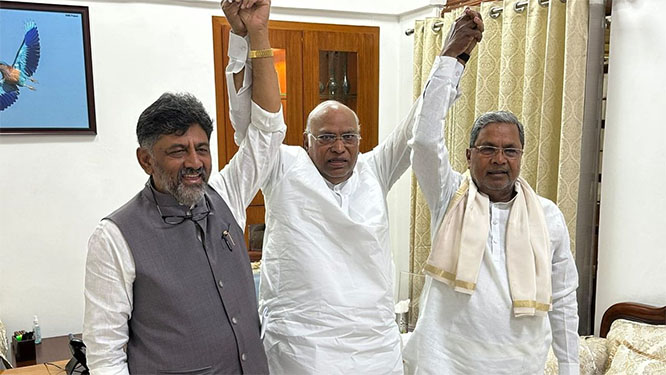
Congress president Mallikarjun Kharge on Thursday announced that he will convene a high-level meeting in New Delhi with senior leaders — including Rahul Gandhi, Karnataka Chief Minister Siddaramaiah and Deputy Chief Minister D.K. Shivakumar — to resolve the escalating leadership turmoil in Karnataka and “put an end to the confusion.”

Kharge said the discussions would focus on the way forward for the ruling party, as rumours of a possible leadership change continue to swirl. The speculation has intensified after the Congress government crossed the halfway mark of its five-year term on November 20, reviving talk of an alleged 2023 “power-sharing agreement” between Siddaramaiah and Shivakumar.

“After reaching Delhi, I will call three or four important leaders and hold discussions. Once we talk, we will decide how to move ahead and end this confusion,” Kharge told reporters in Bengaluru, according to PTI.

When asked specifically about calling Siddaramaiah and Shivakumar to Delhi, he responded: “Certainly, we should call them. We will discuss with them and settle the issue.”

He confirmed that Rahul Gandhi, the Chief Minister, the Deputy Chief Minister and other senior members would be part of the deliberations. “After discussing with everyone, a decision will be made,” he said.

Meanwhile, Siddaramaiah held a separate strategy meeting at his Bengaluru residence with ministers and leaders seen as his close confidants, including G. Parameshwara, Satish Jarkiholi, H.C. Mahadevappa, K. Venkatesh and K.N. Rajanna.
Signalling calm, the Chief Minister told reporters, “Will go to Delhi if the high command calls.”

Shivakumar echoed a similar stance, saying he too would head to the national capital if summoned by the party leadership.

Comments

Add new comment

  • Coastaldigest.com reserves the right to delete or block any comments.
  • Coastaldigset.com is not responsible for its readers’ comments.
  • Comments that are abusive, incendiary or irrelevant are strictly prohibited.
  • Please use a genuine email ID and provide your name to avoid reject.
News Network
November 26,2025

students.jpg

Bengaluru, Nov 26: Karnataka is taking its first concrete steps towards lifting a three-decade-old ban on student elections in colleges and universities. Deputy Chief Minister D.K. Shivakumar announced Wednesday that the state government will form a small committee to study the reintroduction of campus polls, a practice halted in 1989 following incidents of violence.

Speaking at a 'Constitution Day' event organised by the Karnataka Congress, Mr. Shivakumar underscored the move's aim: nurturing new political leadership from the grassroots.

"Recently, (Leader of the Opposition in Lok Sabha) Rahul Gandhi wrote a letter to me and Chief Minister (Siddaramaiah) asking us to think about restarting student elections," Shivakumar stated. "I'm announcing today that we'll form a small committee and seek a report on this."

Student elections were banned in Karnataka in 1989, largely due to concerns over violence and the infiltration of political party affiliates into campus life. The ban effectively extinguished vibrant student bodies and the pipeline of young leaders they often produced.

Mr. Shivakumar, who also serves as the Karnataka Congress president, said that former student leaders will be consulted to "study the pros and cons" of the re-introduction.

Acknowledging the history of the ban, he added, "There were many criminal activities taking place back then. We’ll see how we can conduct (student) elections by regulating such criminal activities."

The Deputy CM reminisced about his own journey, which began on campus. He recalled his political activism at Sri Jagadguru Renukacharya College leading to his first Assembly ticket in 1985 at the age of 23. "That's how student leadership was at the time. Such leadership has gone today. College elections have stopped," he lamented, adding that for many, college elections were "like a big movement" where leaders were forged.

The move, driven by the Congress high command's push to cultivate young talent, will face scrutiny from academics and university authorities who have, in the past, expressed concern that the return of polls could disrupt the peaceful academic environment and turn campuses into political battlegrounds.

Comments

Add new comment

  • Coastaldigest.com reserves the right to delete or block any comments.
  • Coastaldigset.com is not responsible for its readers’ comments.
  • Comments that are abusive, incendiary or irrelevant are strictly prohibited.
  • Please use a genuine email ID and provide your name to avoid reject.