



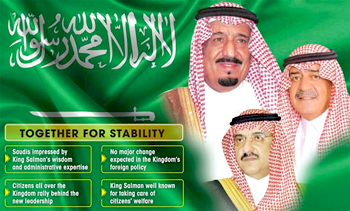
Jeddah, Jan 27: A new era dawned in Saudi Arabia on Monday under the leadership of Custodian of the Two Holy Mosques King Salman as citizens across the country expressed their confidence in the new king’s ability to take the Kingdom to new heights of progress and prosperity.
The three-day mourning period for the late King Abdullah ended Sunday. King Salman, Crown Prince Muqrin, Deputy Crown Prince, Second Deputy Premier and Interior Minister Prince Mohammed bin Naif and other royal family members had received condolences from world leaders and citizens on Saturday and Sunday.
Saudis in the Kingdom and abroad have pledged their allegiance to the country’s new leaders, in personal meetings or through regional governors and ambassadors abroad.
On Sunday, thousands of citizens stood in line in front of Al-Yamamah Palace in Riyadh to meet King Salman. According to a report carried by Asharq Al-Awsat, there was no blockade in front of the palace to restrict entry.
“There was no discrimination. Everybody, including princes, ministers, Shoura members and ordinary citizens were allowed to meet the king without following any protocol,” the report said.
Citizens from across the Kingdom came in their traditional attire. Sheikh Ibrahim bin Mohammed Al-Khereiji, an elderly man who was imam of the big mosque in Al-Kharj, made his way to the palace in a wheelchair.
The man’s son, Abdul Aziz, said his father had met all the previous six kings. “He was a member of the delegation set up by King Abdul Aziz to receive King Farouk of Egypt when the latter visited the Kingdom on Jan. 24, 1945,” the son said.
Al-Khereiji was appointed by King Abdul Aziz as a secretary in Al-Kharj and was in charge of distributing land among citizens. He established contact with King Salman when he was appointed the governor of Riyadh in 1955, the son said.
The smooth transition in Saudi Arabia following the death of King Abdullah has won applause from Saudis and foreign leaders. Saudi Ambassador to Egypt Ahmed bin Abdul Aziz Qattan said the smooth transition has strengthened citizens’ confidence in the new leadership.
Speaking to the Saudi Press Agency after receiving citizens who came to express their condolences and pledge their allegiance to the new leadership, Qattan said Saudis have been impressed by King Salman’s wisdom and administrative expertise.
“King Salman has been in the government for the last 60 years, dedicating his life to the service of the Kingdom and its people. All Saudis will definitely rally behind their wise leadership as usual,” the ambassador said.
In his keynote speech after ascending the throne, King Salman said that his government would follow the straight path, based on the teachings of the Qur’an and Sunnah, without deviating from the policies of his predecessors.
The new leadership has taken over at a time when Saudi Arabia faces several challenges including falling oil prices — the Kingdom depends on oil for about 90 percent of its revenue — and the threat posed by the so-called Islamic State terrorist group in the north and the Houthis in the south.
“It is no secret that there has been no major change for several decades in Saudi foreign policy. It has always been based on certain basic principles and various geographic, historical, religious, economic, security and political factors,” said Salman Aldossary, editor in chief of Asharq Al-Awsat.
He said noninterference in the internal affairs of other countries, establishing strong relations with Gulf, Arab and Islamic countries, supporting Arab and Islamic causes and cooperation with other friendly countries, are the hallmarks of Saudi foreign policy. This included the Kingdom’s continuous efforts to ensure stability in the international oil market because it is one of the world’s largest oil producers, he said.
Mohammed bin Daqqas, a former employee at the royal court, said King Salman has always insisted on punctuality and hard work. “When he was the governor of Riyadh, he used to look into the matters of citizens himself. One day when he was outside the Kingdom, he contacted an official at the governorate to attend to the case of a citizen.
The official had left the office 30 minutes before the end of the working day. He then asked the official to return to the office and complete the work for that citizen.”
Comments
Add new comment