



Donald Trump offers to mediate in 'explosive' Kashmir standoff

Agencies
August 21, 2019

Washington, Aug 21: US President Donald Trump offered on Tuesday to mediate the "explosive" situation in Kashmir amid mounting international concern over a flare-up in violence between India and Pakistan in the divided region.
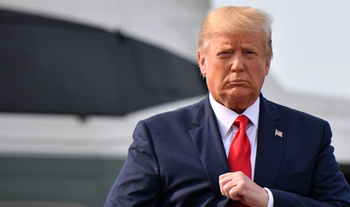
Speaking a day after phone calls with the premiers of both countries, Trump said he was happy to try and help calm the situation in Kashmir where tensions have spiked since India revoked autonomous rule in the part of the region it controls on August 5.

His comments came as Pakistan said three of its civilians died in Indian gunfire from across the de facto border in Kashmir known as the Line of Control.

And the Press Trust of India news agency quoted officials as saying one Indian soldier died and four were wounded when Pakistani troops opened fire on forward posts and villages along the LoC in the Poonch district on Tuesday.

Both India and Pakistan are nuclear powers and the situation in Kashmir is further complicated by the fact that China also claims part of the Himalayan region.

Trump -- who has previously spoken of his willingness to mediate -- said he would raise the situation over the weekend with Indian Prime Minister Narendra Modi. Both men are expected in France for a summit of the Group of Seven industralized nations.

"Kashmir is a very complicated place. You have Hindus and you have the Muslims and I wouldn't say they get along so great," Trump told reporters at the White House.

"I will do the best I can to mediate," he added.

At least 4,000 people have been detained in Indian-controlled Kashmir since early August when authorities imposed a communications blackout and restricted freedom of movement in the region.

A senior US official, who has just returned from a visit to the region, called on India Tuesday to quickly release detainees and restore basic liberties.

"We continue to be very concerned by reports of detentions, and continued restrictions on the residents of the region," the State Department official told reporters.

"We urge respect for individual rights, compliance with legal procedures and inclusive dialogue," said the official, who spoke on condition of anonymity.

Both India and Pakistan have controlled portions of the former princely state of Kashmir since independence in 1947. The dispute over the Muslim-majority region has been the spark for two major wars and countless clashes between them.

Earlier this year they again came close to all-out conflict, after a militant attack in Indian-held Kashmir in February was claimed by a group based in Pakistan, touching off tit-for-tat airstrikes.

India has bristled at any suggestion of foreign mediation and strenuously denied a claim by Trump last month that Modi had invited him to act as a peace broker.

It was also left seething when the UN Security Council held its first formal meeting on Kashmir in nearly half a century last week, saying it would not accept "international busybodies ... tell(ing) us how to run our lives."

British Prime Minister Boris Johnson told Modi in a phone call on Tuesday that the Kashmir dispute must be resolved between India and Pakistan alone.

Johnson "made clear that the UK views the issue of Kashmir as one for India and Pakistan to resolve bilaterally. He underlined the importance of resolving issues through dialogue," a spokeswoman for his Downing Street office said.

But in a further sign of the international concern about the situation, officials in France said that President Emmanuel Macron would bring up Kashmir with Modi when the two meet in Paris ahead of the G7 summit.

In justifying the scrapping of Kashmir's autonomy, Modi said last week that "fresh thinking" was needed after decades of bloodshed in Kashmir. But his decision provoked a widespread backlash and there have been several rallies in the regional capital Srinagar attracting thousands of demonstrators.

Comments

Add new comment

  • Coastaldigest.com reserves the right to delete or block any comments.
  • Coastaldigset.com is not responsible for its readers’ comments.
  • Comments that are abusive, incendiary or irrelevant are strictly prohibited.
  • Please use a genuine email ID and provide your name to avoid reject.
News Network
January 23,2026

Karnataka Governor Thaawarchand Gehlot read only three lines from the 122-paragraph address prepared by the Congress-led state government while addressing the joint session of the Legislature on Thursday, effectively bypassing large sections critical of the BJP-led Union government.

The omitted portions of the customary Governor’s address outlined what the state government described as a “suppressive situation in economic and policy matters” under India’s federal framework. The speech also sharply criticised the Centre’s move to replace the Mahatma Gandhi National Rural Employment Guarantee Act (MGNREGA) with the Viksit Bharat–Guarantee for Rozgar and Ajeevika Mission (Gramin) Act, commonly referred to as the VB-GRAM (G) Act.

Governor Gehlot had earlier conveyed his objection to several paragraphs that were explicitly critical of the Union government. On Thursday, he confined himself to the opening lines — “I extend a warm welcome to all of you to the joint session of the State legislature. I am extremely pleased to address this august House” — before jumping directly to the concluding sentence of the final paragraph.

He ended the address by reading the last line of paragraph 122: “Overall, my government is firmly committed to doubling the pace of the State’s economic, social and physical development. Jai Hind — Jai Karnataka.”

According to the prepared speech, the Karnataka government demanded the scrapping of the VB-GRAM (G) Act, describing it as “contractor-centric” and detrimental to rural livelihoods, and called for the full restoration of MGNREGA. The state government argued that the new law undermines decentralisation, weakens labour protections, and centralises decision-making in violation of constitutional norms.

Key points from the unread sections of the speech:

•    Karnataka facing a “suppressive” economic and policy environment within the federal system

•    Repeal of MGNREGA described as a blow to rural livelihoods

•    VB-GRAM (G) Act accused of protecting corporate and contractor interests

•    New law alleged to weaken decentralised governance

•    Decision-making said to be imposed by the Centre without consulting states

•    Rights of Adivasis, women, backward classes and agrarian communities curtailed

•    Labourers allegedly placed under contractor control

•    States facing mounting fiscal stress due to central policies

•    VB-GRAM (G) Act accused of enabling large-scale corruption

Comments

Add new comment

  • Coastaldigest.com reserves the right to delete or block any comments.
  • Coastaldigset.com is not responsible for its readers’ comments.
  • Comments that are abusive, incendiary or irrelevant are strictly prohibited.
  • Please use a genuine email ID and provide your name to avoid reject.
News Network
February 1,2026

US President Donald Trump on Saturday claimed that the government of India led by Prime Minister Narendra Modi has made a deal to buy Venezuelan oil, as opposed to purchasing it from Iran.

"We've already made that deal, the concept of the deal," he told reporters on Air Force One.

Trump had imposed 25% tariffs on countries buying Venezuelan oil, including India, in March 2025. He had also hit India with tariffs for buying Russian oil, saying it was "funding" President Vladimir Putin's war against Ukraine.

Trump has said that the US has taken control of the oil-rich Venezuela after capturing former President Nicolas Maduro in January.

A fleet of 18 ships loaded with crude oil bound for refineries in Texas, Louisiana, and Mississippi in January, the most since December 2024, according to a report by the news agency Bloomberg.

Combined crude deliveries to the US will reach about 2,75,000 barrels a day, more than doubling volumes seen in December last year. Shipments to China, which averaged 4,00,000 barrels a day last year, fell to zero in January.

PM Modi, Venezuelan President Agree To Expand Ties

Prime Minister Narendra Modi and Venezuela's acting President Delcy Rodriguez spoke on Friday and agreed to take the bilateral relations to "new heights" in the years ahead.

It was the first phone call between the two leaders since the capture of Maduro and his wife by the US on January 3.

"Spoke with Acting President of Venezuela, Ms. Delcy Rodriguez. We agreed to further deepen and expand our bilateral partnership in all areas, with a shared vision of taking India-Venezuela relations to new heights in the years ahead," PM Modi said in a post on X.

A statement from Prime Minister Modi's office said the two leaders agreed to further expand and deepen the India-Venezuela partnership in all areas, including trade and investment, energy, digital technology, health, agriculture, and people-to-people ties.

They exchanged views on various regional and global issues of mutual interest and underscored the importance of their close cooperation for the Global South, the statement said.

Rodriguez also said that they discussed partnerships in the fields of agriculture, science and technology, mining, and tourism, as well as the pharmaceutical and automotive industries.

Comments

Add new comment

  • Coastaldigest.com reserves the right to delete or block any comments.
  • Coastaldigset.com is not responsible for its readers’ comments.
  • Comments that are abusive, incendiary or irrelevant are strictly prohibited.
  • Please use a genuine email ID and provide your name to avoid reject.