



Donald Trump proposes 'merit-based' system for immigration

Agencies
May 17, 2019

Washington, May 17: US President Donald Trump has proposed a sweeping change to the immigration system to make it "merit-based" favouring professionals and well-educated people who will be high earners.

Unveiling his plan at the White House on Thursday, he said the current immigration system discriminates against "genius" and "brilliance" and that he wanted to correct this with a new system he called "Build America Visa" that favours those with demonstrated potential.

The plan is modelled on the immigration systems of Canada, Australia and New Zealand, which prioritise admission based on points awarded for various qualifications.

It will preserve the immigration of spouses and children of permanent residents or green card holders, but eliminate preferences for other relatives like siblings and parents.

"We prioritise the immediate family of new Americans - spouses and children", Trump said. "The loved ones you choose to build a life with, we prioritise... They go right to the front of the line".

Trump said he wants to increase the current allocation of 12% of green cards for highly skilled professionals to 57% at the expense of certain categories of relatives and people immigrating from certain countries based on a lottery system. This would reverse the current system of reserving about 60% of green cards for relatives. About 1.13 million people get permanent resident visas or green cards every year.

Making his case for the merit system, he said that companies were moving offices abroad because the current system prevented them from retaining highly skilled and even "totally brilliant people".

The emphasis on merit has the potential to help Indian professionals who have to wait for ten years or more to get a green card -- but only if the national quotas is lifted. Currently each country's quota is about 25,000, regardless of its population size.

It is not clear if that would happen because Trump did not say if the national limits would be removed or modified.

Some members of both houses of Congress, including presidential aspirant Senator Kamala Harris, have introduced legislation 'Fairness for High-Skilled Immigrants Act' to remove the national quota limits for professionals.

Trump was also silent on the H1-B visas that are given temporarily to skilled professionals. His administration has sought to make the qualifying standards more stringent and has raised the rejection rate for the visa making it an area of contention between India and the US. Trump's plan will also give preference to those who have been educated in the US.

Packaged in Trump's plan crafted by his son-in-law Jared Kushner and a controversial adviser, Stephen Miller, are proposals for tough new measures against illegal immigrants and for strengthening border security by building a wall and tightening asylum requirements. These will be opposed by Democrats.

However, the ambitious plan that essentially restates many of his previous proposals is unlikely to get past Congress.

"Trump's proposal has no chance of becoming law in this Congress," said Doug Rand, who worked on immigration policy at the White House during Barack Obama's presidency and is the co-founder of Boundless Immigration, a company provides help with navigating the system.

Trump himself admitted as much, pinning his hopes on his re-election. If it did not pass in his current term it would "be passed after the election, when Republicans take back the House, hold the Senate and keep the presidency", he claimed.

"This is classic election talk and is designed to cater to the President Trump's voter base" said Vivek Tandon, the CEO of EB5 BRICS, an immigration advisory firm. "I don't believe this to be meaningful proposal".

Democratic Party leaders voiced their strong opposition to the Trump plan even before it was formally unveiled.

Speaker Nancy Pelosi decried the use of the word "merit", telling reporters: "It is really a condescending word."

Democratic Party leader in the Senate, Chuck Schumer, denounced it as "anti-immigration reform".

"It repackages the same partisan, radical, anti-immigrant policies that the administration has pushed for the two years," he said.

Trump hit back at the Democrats accusing them of favouring open borders and lowering wages.

But a leading senator of his own party Lindsey Graham, who chairs the Judiciary Committee, also expressed doubts about the plans viability to become law.

The Trump plan's biggest weakness in getting Democratic Party support is the failure to grant permanent immigration status to those who came to the US illegally as children and are referred to as "Dreamers" for their pursuit of the American dram.

Obama had granted them temporary protection against deportation, but Trump has tried to revoke it, while saying at the same time that he wants it to be made permanent without making a concrete proposal. Democrats insist that any immigration effort should start with "Dreamers".

The "merit-based" reform of awarding points proposed by Trump would favour younger immigrants, those with higher educational qualifications, English language proficiency, job offers with better wages, and entrepreneurs capable of creating jobs.

The preference for entrepreneurs "is good news for potential investors" according to Lawrence Chang, the president, Maryland Center for Foreign Investment.

David Finkelstein, the CEO of American Immigration Group, said that Trump's proposal for increasing the number of skilled immigrants is in line with the EB5 programme, which provides Green Cards for investors.

He added that it "has attracted high net worth families that are highly educated which is exactly what President Trump is supporting, rather than those that are not educated and require continued financial support from our social system".

Comments

Add new comment

  • Coastaldigest.com reserves the right to delete or block any comments.
  • Coastaldigset.com is not responsible for its readers’ comments.
  • Comments that are abusive, incendiary or irrelevant are strictly prohibited.
  • Please use a genuine email ID and provide your name to avoid reject.
News Network
February 1,2026

Bengaluru: The Karnataka High Court has refused to quash an investigation against a WhatsApp group administrator accused of allowing the circulation of obscene and offensive images depicting Hindutva politicians and idols in 2021.

Justice M Nagaprasanna observed that, prima facie, the ingredients of the offence under Section 295A of the Indian Penal Code were made out. “The offence under Section 295A of the IPC is met to every word of its ingredient, albeit prima facie,” the judge said.

The petitioner, Sirajuddin, a resident of Belthangady taluk in Dakshina Kannada district, had challenged the FIR registered against him at the CEN (Cyber, Economics and Narcotics) police station, Mangaluru, for offences under Section 295A of the IPC and Section 67 of the Information Technology Act. Section 295A relates to punishment for deliberate and malicious acts intended to outrage the religious feelings of any class of citizens.

According to the complaint filed by K Jayaraj Salian, also a resident of Belthangady taluk, he received a WhatsApp group link from an unknown source and was added to the group after accessing it. The group reportedly had six administrators and around 250 participants, where obscene and offensive images depicting Hindu deities and certain political figures were allegedly circulated repeatedly.

Sirajuddin was arrested in connection with the case and later released on bail on February 16, 2021. He argued before the court that he was being selectively targeted, while other administrators—including the creator of the group—were neither arrested nor investigated. He also contended that the Magistrate could not have taken cognisance of the offence under Section 295A without prior sanction under Section 196(1) of the CrPC.

Rejecting the argument, Justice Nagaprasanna held that prior sanction is required only at the stage of taking cognisance, and not at the stage of registration of the crime or during investigation.

The judge noted that the State had produced the entire investigation material before the court. “A perusal of the material reveals depictions of Hindu deities in an extraordinarily obscene, demeaning and profane manner. The content is such that its reproduction in a judicial order would itself be inappropriate,” the court said, adding that the material, on its face, had the tendency to outrage religious feelings and disturb communal harmony.

Observing that the case was still at the investigation stage, the court said it could not interdict the probe at this juncture. However, it expressed concern that the investigating officer appeared to have not proceeded uniformly against all administrators. The court clarified that if the investigation revealed the active involvement of any member in permitting the circulation of such content, they must also be proceeded against.

“At this investigative stage, any further observation by this Court would be unnecessary,” the order concluded.

Comments

Add new comment

  • Coastaldigest.com reserves the right to delete or block any comments.
  • Coastaldigset.com is not responsible for its readers’ comments.
  • Comments that are abusive, incendiary or irrelevant are strictly prohibited.
  • Please use a genuine email ID and provide your name to avoid reject.
News Network
January 20,2026

iran.jpg

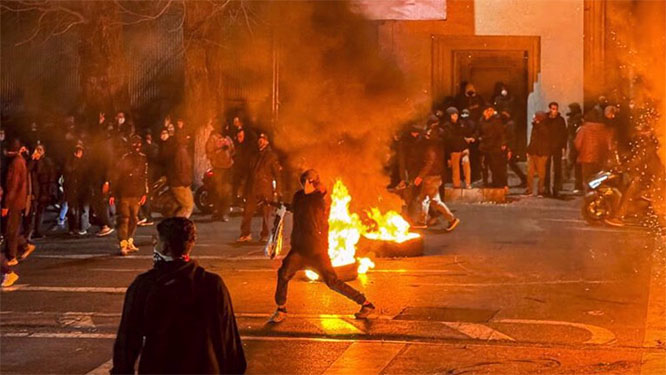
Iranian security and intelligence forces have captured more than 470 individuals in three provinces, identified as key figures behind the recent wave of violent unrest and terrorist activities linked to foreign-backed networks.

The Intelligence Ministry's provincial office in Khorasan Razavi announced on Monday the arrest of 192 armed terrorists, identified as the main agents behind recent riots in the region. 

According to an official statement, the detainees were involved in the killing of several security personnel and civilians, setting fire to mosques, public service facilities, and buses, as well as attacks on military and law enforcement centers.

The seized items from the group include several bulletproof vests, Kalashnikov rifles, hunting weapons, Winchester rifles, and various cold weapons such as daggers, swords, brass knuckles, tactical knives, crossbows, and chains.

Evidence indicates that some of the individuals were tied to hostile movements and terrorist organizations, with links overseas. Others were identified as members of violent criminal gangs, actively taking part in the unrest alongside their associates.

Simultaneously, in the western province of Lorestan, the IRGC announced the arrest of 134 individuals as the main leaders and influential field agents of a US-Israeli terrorist network.

The IRGC statement stated that these individuals formed terrorist cells during the recent unrest, committing "Daesh-like" acts.

They wounded security forces with firearms and cold weapons, and burned and destroyed public and private properties, including mosques, shops, banks, and private and public vehicles.

In the northwestern province of Zanjan, the police reported detaining 150 people identified as principal leaders and agents behind recent riots.

Authorities noted that these individuals were responsible for destroying public and private property and intentionally setting fire to vehicles in the province's squares.

Their crimes include shedding the blood of innocent people, destroying public and private property, attempting to enter military sites, disrupting public order, and spreading terror among citizens.

A variety of cold weapons were reportedly seized from the detainees.

What began late last month as peaceful protests over economic hardship across Iran turned violent after public statements by US and Israeli regime figures encouraged vandalism and disorder.

During the unrest, foreign-backed mercenaries rampaged through cities, killing security forces and civilians and damaging public property.

Comments

Add new comment

  • Coastaldigest.com reserves the right to delete or block any comments.
  • Coastaldigset.com is not responsible for its readers’ comments.
  • Comments that are abusive, incendiary or irrelevant are strictly prohibited.
  • Please use a genuine email ID and provide your name to avoid reject.
News Network
January 23,2026

Karnataka Governor Thaawarchand Gehlot read only three lines from the 122-paragraph address prepared by the Congress-led state government while addressing the joint session of the Legislature on Thursday, effectively bypassing large sections critical of the BJP-led Union government.

The omitted portions of the customary Governor’s address outlined what the state government described as a “suppressive situation in economic and policy matters” under India’s federal framework. The speech also sharply criticised the Centre’s move to replace the Mahatma Gandhi National Rural Employment Guarantee Act (MGNREGA) with the Viksit Bharat–Guarantee for Rozgar and Ajeevika Mission (Gramin) Act, commonly referred to as the VB-GRAM (G) Act.

Governor Gehlot had earlier conveyed his objection to several paragraphs that were explicitly critical of the Union government. On Thursday, he confined himself to the opening lines — “I extend a warm welcome to all of you to the joint session of the State legislature. I am extremely pleased to address this august House” — before jumping directly to the concluding sentence of the final paragraph.

He ended the address by reading the last line of paragraph 122: “Overall, my government is firmly committed to doubling the pace of the State’s economic, social and physical development. Jai Hind — Jai Karnataka.”

According to the prepared speech, the Karnataka government demanded the scrapping of the VB-GRAM (G) Act, describing it as “contractor-centric” and detrimental to rural livelihoods, and called for the full restoration of MGNREGA. The state government argued that the new law undermines decentralisation, weakens labour protections, and centralises decision-making in violation of constitutional norms.

Key points from the unread sections of the speech:

•    Karnataka facing a “suppressive” economic and policy environment within the federal system

•    Repeal of MGNREGA described as a blow to rural livelihoods

•    VB-GRAM (G) Act accused of protecting corporate and contractor interests

•    New law alleged to weaken decentralised governance

•    Decision-making said to be imposed by the Centre without consulting states

•    Rights of Adivasis, women, backward classes and agrarian communities curtailed

•    Labourers allegedly placed under contractor control

•    States facing mounting fiscal stress due to central policies

•    VB-GRAM (G) Act accused of enabling large-scale corruption

Comments

Add new comment

  • Coastaldigest.com reserves the right to delete or block any comments.
  • Coastaldigset.com is not responsible for its readers’ comments.
  • Comments that are abusive, incendiary or irrelevant are strictly prohibited.
  • Please use a genuine email ID and provide your name to avoid reject.