India, China must respect each other’s core concerns: Jaishankar in Beijing

Agencies
August 14, 2019

Beijing, Aug 14: India and China should find stronger convergences, respect each other’s core concerns and manage differences, External Affairs Minister S. Jaishankar has said as he underlined that the relationship between the two Asian giants has become “so big” that it has acquired a “global dimension”.
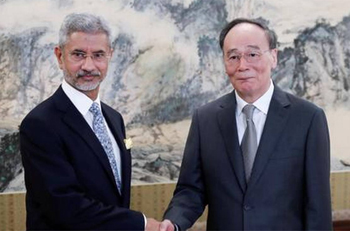
Mr. Jaishankar, who concluded his three-day visit to Beijing on Monday, held extensive and in-depth talks with his counterpart Wang Yi on the entire gamut of the India-China ties.

During his visit, he also met Chinese Vice President Wang Qishan, a close confidant of President Xi Jinping.

As the two largest developing countries and emerging economies, cooperation between India and China is of great importance to the world, Mr. Jaishankar told state-run Xinhua news agency here in an interview on Sunday.

“Our relationship is so big that it is no longer a bilateral relationship. It has global dimensions,” the report quoted Mr. Jaishankar as saying.

Describing the world as “more multi-polar” with changing global order, he said India and China need to enhance communication and coordination to contribute to world peace, stability and development.

‘People-to-people exchanges’

The two countries should find stronger areas of convergence, respect each other’s core concerns, find ways of managing differences and keep a strategic view of the direction of bilateral ties, he said.

The Minister said the two neighbours have a long history that goes back to thousands of years and the two countries’ civilisations are among the oldest that represent two pillars of the civilisation of the East.

“A lot of people, including young people of both countries, really don’t have a good understanding of how much our two cultures of civilisations have affected each other,” Mr. Jaishankar said, underlining that “promoting a greater awareness of that history” through more cultural exchanges is an important task for the two countries.

India and China have agreed to establish a high-level people-to-people exchanges mechanism in April last year and the first meeting was held in New Delhi in December.

Describing the move as “taking the bilateral relationship from the narrow diplomatic field to a larger societal interaction”, Jaishankar said the more people of the two nations interact face-to-face, the more their sense of relating to each other will grow.

“It’s important for our relationship to build popular support. Our people must feel good about each other,” he said.

Jaishankar had also co-chaired the 2nd meeting of the China-India high-level people-to-people exchanges mechanism with Wang Yi, agreeing to further promote friendship between the two peoples.

This was his first visit to China after taking over the position of the External Affairs Minister. He had earlier served as India’s envoy to China from 2009 to 2013, the longest tenure by an Indian diplomat to Beijing.

His visit was finalised much before India’s move to revoke Article 370 of the Constitution that gave special status to J&K.

Jaishankar also discussed arrangements for President Jinping’s visit to India later this year for second informal summit with Prime Minister Narendra Modi.

During his meeting with Mr. Wang Yi, Mr. Jaishankar said India’s decisions on Jammu and Kashmir are country’s “internal” matter and have no implication for either the external boundaries of India or the Line of Actual Control (LAC) with China.

The remarks came in response to Wang, who brought up developments pertaining to legislation passed recently by the Indian Parliament on J&K, saying China is “very closely” following the Indo-Pak tensions over Kashmir and its “ramifications” while asking New Delhi to play a “constructive role” for regional peace and stability.

According to an official release from the external affairs ministry, during the bilateral meeting, Jaishankar conveyed that this was an “internal” matter for India and the issue related to changes in a temporary provision of the Constitution of India and was the sole prerogative of the country.

Asserting that the legislative measures were aimed at promoting better governance and socio-economic development, Jaishankar also said there was no implication for either the external boundaries of India or the LAC with China.

“India was not raising any additional territorial claims. The Chinese concerns in this regard were therefore misplaced. The minister also conveyed that so far as the India China boundary question was concerned the two sides had agreed to a fair, reasonable and mutually acceptable settlement of the Boundary Question on the basis of the 2005 Political Parameters and Guiding Principles,” the release said.

Jaishankar also told Wang that it was important to ensure that bilateral differences should not become disputes and emphasised that the future of the ties will depend on the mutual sensitivity to each other’s “core concerns“.

China on August 6 had objected to the formation of Ladakh as Union Territory by India, saying it undermined its territorial sovereignty, evoking a sharp reaction from New Delhi, which asked Beijing to refrain from commenting on its “internal affairs“.

Ahead of Mr. aishankar’s visit, Pakistan Foreign Minister Shah Mehmood Qureshi air-dashed to Beijing and held talks with Wang, seeking China’s support for Islamabad’s efforts to take India’s decision to revoke special status to Kashmir to the UN Security Council.

Comments

Add new comment

  • Coastaldigest.com reserves the right to delete or block any comments.
  • Coastaldigset.com is not responsible for its readers’ comments.
  • Comments that are abusive, incendiary or irrelevant are strictly prohibited.
  • Please use a genuine email ID and provide your name to avoid reject.
News Network
December 5,2025

indigoCEO.jpg

New Delhi, Dec 5: IndiGo CEO Pieter Elbers issued a public apology this evening after more than a thousand flights were cancelled today, making it the "most severely impacted day" in terms of cancellations. The biggest airline of the country cancelled "more than half" of its daily number of flights on Friday, said Elbers. He also said that even though the crisis will persist on Saturday, the airline anticipates fewer than 1,000 flight cancellations.

"Full normalisation is expected between December 10 and 15, though IndiGo cautions that recovery will take time due to the scale of operations," the IndiGo CEO said. 

IndiGo operates around 2,300 domestic and international flights daily.

Pieter Elbers, while apologising for the major inconvenience due to delays and cancellations, said the situation is a result of various causes.

The crisis at IndiGo stems from new regulations that boost pilots' weekly rest requirements by 12 hours to 48 and allow only two night-time landings per week, down from six. IndiGo has attributed the mass cancellations to "misjudgment and planning gaps".

Elbers also listed three lines of action that the airline will adopt to address the issue.

"Firstly, customer communication and addressing your needs, for this, messages have been sent on social media. And just now, a more detailed communication with information, refunds, cancellations and other customer support measures was sent," he said.

The airline has also stepped up its call centre capacity.

"Secondly, due to yesterday's situation, we had customers stranded mostly at the nation's largest airports. Our focus was for all of them to be able to travel today itself, which will be achieved. For this, we also ask customers whose flights are cancelled not to come to the airports as notifications are sent," the CEO said.

"Thirdly, cancellations were made for today to align our crew and planes to be where they need to start tomorrow morning afresh. Earlier measures of the last few days, regrettable, have proven not to be enough, but we have decided today to reboot all our systems and schedules, resulting in the highest numbers of cancellations so far, but imperative for progressive improvements starting from tomorrow," he added.

As airports witnessed chaotic scenes, the Directorate General of Civil Aviation (DGCA) stepped in to grant IndiGo a temporary exemption from stricter night duty rules for pilots. It also allowed substitution of leaves with a weekly rest period. 

Civil Aviation Minister Ram Mohan Naidu has said a high-level inquiry will be ordered and accountability will be fixed.

Comments

Add new comment

  • Coastaldigest.com reserves the right to delete or block any comments.
  • Coastaldigset.com is not responsible for its readers’ comments.
  • Comments that are abusive, incendiary or irrelevant are strictly prohibited.
  • Please use a genuine email ID and provide your name to avoid reject.
News Network
December 15,2025

Udupi, Dec 15: What was meant to be a post-pilgrimage gathering turned tragic in Padukere village of Brahmavar taluk, Udupi district, late Sunday night, when a clash among youths escalated into a fatal assault, leaving one man dead.

The victim has been identified as 30-year-old Santosh Mogaveera, a resident of Padukere.

According to preliminary information, the incident took place during a late-night drinking party involving a group of local youths who had recently returned after completing their pilgrimage to the Sabarimala shrine. An argument reportedly broke out among the group and soon escalated into a violent confrontation.

During the ensuing brawl, Santosh Mogaveera was allegedly assaulted and collapsed at the spot after sustaining serious injuries. He was rushed by local residents to a private hospital in Brahmavar, where doctors declared him dead.

On receiving information, senior police officials, including Brahmavar Circle Inspector Gopikrishna, Kota Police Sub-Inspector Praveen Kumar T, Station ASI Manthesh Jabagoudar, and head constables Pradeep and Ashok, visited the spot and conducted an inspection.

Police have taken four youths into custody in connection with the incident. A case has been registered at the Kota police station, and further investigation is underway to ascertain the exact sequence of events leading to the death.

Comments

Add new comment

  • Coastaldigest.com reserves the right to delete or block any comments.
  • Coastaldigset.com is not responsible for its readers’ comments.
  • Comments that are abusive, incendiary or irrelevant are strictly prohibited.
  • Please use a genuine email ID and provide your name to avoid reject.
News Network
December 7,2025

envoy.jpg

Since 1946, the United States has attempted 93 coups or “regime change” operations across the world — including two in Iran, US Special Envoy for Syria Tom Barrack has admitted.

Speaking to the UAE-based IMI Media Group, in remarks published by The National, Barrack said Washington tried twice to overthrow the Iranian government but failed both times. 

“For (Trump) then to be imputed with regime change — we had two regime changes in Iran already. Neither one worked. So I think wisely leave it to the region to solve,” said Barrack, who also serves as the US ambassador to Turkey.

His comments come six months after the US joined Israel in airstrikes against Iran during ongoing indirect nuclear negotiations between Tehran and Washington.

On June 13, Israel launched an attack on Iran that killed at least 1,064 people and hit civilian infrastructure. Days later, the United States targeted three nuclear facilities — Fordow, Natanz and Isfahan — in what Iran called a clear violation of international law. Iranian retaliation eventually forced a halt to the assault on June 24.

Barrack further claimed that US President Donald Trump and Foreign Secretary Marco Rubio are “not into regime change” and prefer a regional approach driven by Middle Eastern countries themselves. According to him, regional dialogue and non-interference by outside powers offer a more durable path forward.

He added that Washington is still open to an agreement with Tehran if Iranian authorities show “seriousness” and willingness to engage constructively.

However, Iran maintains the US has not shown readiness for meaningful talks. In an interview with Japan’s Kyodo News, Iranian Foreign Minister Abbas Araghchi said negotiations could advance only if Washington acknowledges Iran’s right to peaceful nuclear energy and lifts unilateral sanctions.

Comments

Add new comment

  • Coastaldigest.com reserves the right to delete or block any comments.
  • Coastaldigset.com is not responsible for its readers’ comments.
  • Comments that are abusive, incendiary or irrelevant are strictly prohibited.
  • Please use a genuine email ID and provide your name to avoid reject.