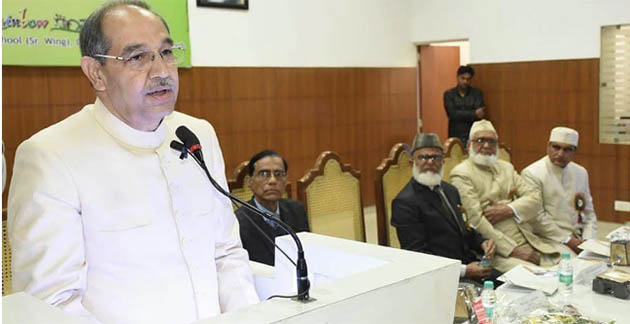
Aligarh Muslim University’s ex Vice-chancellor Tariq Mansoor is BJP’s new Vice President

News Network
July 29, 2023

mansoor.jpg

New Delhi, July 29: In an attempt to strengthen its ongoing outreach among Muslim Pasmanda communities, the BJP on Sunday appointed former Aligarh Muslim University vice-chancellor Tariq Mansoor as one of its vice presidents.

Mr Mansoor was instrumental in steering the AMU, one of the hotbeds of anti-NRC and CAA protests, on a "middle path", and later closely working with the RSS on its project to promote the teachings of Mughal prince Dara Shikoh on peaceful Hindu-Muslim coexistence that was in contradiction to his brother Mughal emperor Aurangzeb's way of working.

The appointment came on a day when Home Minister Amit Shah was in Rameshwaram in Tamil Nadu to launch a book on former president APJ Abdul Kalam, also one of the icons of the party's Pasmanda outreach.

BJP has been continuously reaching out to a section of the Muslim population through Minority Morcha meetings, mostly focused on Pasmanda Muslims, who are from Dalit and other backward class communities. Mr Mansoor was elected to the Uttar Pradesh Legislative Council, the fourth Muslim picked by the BJP for the post in the last few years.

Tariq Mansoor is from Aligarh in Uttar Pradesh, where Muslims constitute roughly 19% of the state's electorate, and have a sizeable presence in at least 30 Lok Sabha seats, out of which they play a major role in deciding the outcome in 15 to 20 constituencies. 

According to an RSS functionary, Mr Mansoor had impressed the sangh's leadership by his work on the Dara Shikoh project, by effectively using the AMU's Persian department to translate much of Shikoh's work on inter-faith dialogue and project him as an ideal for the Muslim community. He organised seminars and conferences on the same.

Mr Mansoor, a surgeon, has been associated with AMU since the 1970s when he completed his MBBS degree in surgery from the university's JN Medical College. He then went on to do his Master of Surgery (MS) degree in 1982 from the same college. Apart from the BJP's focus on the Pasmanda Muslims, which is important in terms of influence, the RSS has been specifically reaching out to Muslim academics, and people of the community from professions such as medicine, law, and bureaucracy, to make a difference in the minority discourse.

Jamal Siddiqui, head of the BJP's Minority Morcha said Mr Mansoor was a "nationalist Muslim" who has always promoted the ideal of "nation first." "His understanding of the fault lines in the Muslim community is as deep as his knowledge about the country and its history. He has led the students of AMU on the right path and prevented them from being misled. His appointment will help the party to expand better."

He was the fourth person from the Muslim community to be promoted to the Legislative Council by the party in UP since 2017, after Bukkal Nawab, Mohsin Raza, and Danish Azad Ansari.

Mr Mansoor was the AMU Vice Chancellor when it witnessed protests against the Citizenship Amendment Act (CAA) and the proposed National Register of Citizens (NRC) in 2020. He was then criticised for "not standing up for students" when policemen allegedly barged into the university, as opposed to the VC of Jamia Millia Islamia in Delhi, who stood by the students. Mr Mansoor has, however, always said he did his best, and talked about the importance of welfare and socio-economic justice over identity issues.

"Mansoor belongs to Aligarh, the hub of Muslim politics, and comes from an educated, middle class family. His family has doctors and lawyers. This is the kind of Muslims we want to work with to take the nation forward," a BJP functionary from UP said.

Khalid Anis Ansari, associate professor from Azim Premji University, who has been actively raising issues pertaining to the community for many years, has often pointed out that Indian Muslims too are victims of caste-based stratification, and are divided into three main classes, and hundreds of biradaris.

The 'Ashraf' Muslims, or native upper caste converts, for instance Syed, Sheikh, Mughal, Pathan, etc are at the top, and the Syed biradari is highly revered. The movements against the Ashraf dominance have been led by the 'lower' ones - Ajlaf (backward Muslims) and Arzal (Dalit Muslims), and these are known as Pasmandas, the community the BJP has been trying to woo. Only 15 percent of the community come from these upper caste communities, while the rest are largely Pasmanda Muslims. The BJP has planned a massive Sneh Yatra to reach out to these Pasmanda Muslims in the coming days.

Muslim intellectuals and opposition parties have, however, said this was an attempt by the BJP to create a divide among the Muslim community, and that often the Muslim victims of hate crimes or economic boycott were Pasmanda themselves.


Comments

Add new comment

  • Coastaldigest.com reserves the right to delete or block any comments.
  • Coastaldigset.com is not responsible for its readers’ comments.
  • Comments that are abusive, incendiary or irrelevant are strictly prohibited.
  • Please use a genuine email ID and provide your name to avoid reject.
News Network
January 23,2026

Mangaluru: The Karnataka Government Polytechnic (KPT), Mangaluru, has achieved autonomous status from the All India Council for Technical Education (AICTE), becoming the first government polytechnic in the country to receive such recognition in its 78-year history. The status was granted by AICTE, New Delhi, and subsequently approved by the Karnataka Board of Technical Education in October last year.

Officials said the autonomy was conferred a few months ago. Until recently, AICTE extended autonomous status only to engineering colleges, excluding diploma institutions. However, with a renewed national focus on skill development, several government polytechnics across India have now been granted autonomy.

KPT, the second-largest polytechnic in Karnataka, was established in 1946 with four branches and has since expanded to offer eight diploma programmes, including computer science and polymer technology. The institution is spread across a 19-acre campus.

Ravindra M Keni, the first dean of the institution, told The Times of India that AICTE had proposed autonomous status for polytechnic institutions that are over 25 years old. “Many colleges applied. In the first round, 100 institutions were shortlisted, which was further narrowed down to 15 in the second round. We have already completed one semester after becoming an autonomous institution,” he said. He added that nearly 500 students are admitted annually across eight three-year diploma courses.

Explaining the factors that helped KPT secure autonomy, Keni said the institution has consistently recorded 100 per cent admissions and placements for its graduates. He also noted its strong performance in sports, with the college emerging champions for 12 consecutive years, along with active student participation in NCC and NSS activities.

Autonomous status allows KPT to design industry-oriented curricula, conduct examinations, prepare question papers, and manage academic documentation independently. The institution can also directly collaborate with industries and receive priority funding from AICTE or the Ministry of Education. While academic autonomy has been granted, financial control will continue to rest with the state government.

“There will be separate committees for examinations, question paper setting, boards of studies, and boards of examiners. The institution will now have the freedom to conduct admissions without government notifications and issue its own marks cards,” Keni said, adding that new academic initiatives would be planned after a year of functioning under the autonomous framework.

Comments

Add new comment

  • Coastaldigest.com reserves the right to delete or block any comments.
  • Coastaldigset.com is not responsible for its readers’ comments.
  • Comments that are abusive, incendiary or irrelevant are strictly prohibited.
  • Please use a genuine email ID and provide your name to avoid reject.
News Network
January 31,2026

Roy.jpg

Bengaluru: The shooting incident involving CJ Roy, founder of the Confident Group, has once again put the spotlight on a businessman whose life has swung between flamboyant global success and persistent controversy at home.

Though Roy’s business interests extended across continents, his roots lay firmly in Karnataka. An alumnus of Christ School in Bengaluru, he later moved to Tumakuru to pursue an engineering degree. Those familiar with his early years describe him as intensely ambitious, beginning his career as a salesman at a small electronics firm dealing in computers.

Roy’s entry into large-scale real estate came through the Crystal Group, where he worked closely with Latha Namboothiri and rose from manager to director. However, the launch of the Confident Group in 2005 was clouded by industry speculation. Insiders speak of a fallout involving alleged “benami” properties and claims of deception that ultimately led to his independent venture—an episode Roy spent years trying to distance himself from, according to associates.

A tale of two cities

Roy’s professional trajectory diverged sharply across geographies.

In Dubai, he built a reputation as a bold and efficient developer, completing massive luxury residential projects in record time—some reportedly within 11 months. His rapid project delivery and lavish lifestyle in the Emirates earned him admiration and visibility in the real estate sector.

In Bengaluru, however, his image remained far more fractured. Sources say Roy stayed away from the city for several years amid disputes over unpaid dues to vendors and suppliers. Several projects were allegedly stalled, with accusations of unfulfilled commitments to cement and steel suppliers continuing to follow him.

Roy’s return to Bengaluru’s business and social circles began around 2018, marked by a conscious attempt at rebranding. His appointment as Honorary Consul of the Slovak Republic added diplomatic legitimacy, which he complemented with visible CSR initiatives, including ambulance donations and high-profile charity events.

Heavy police presence in Langford Town

Following the incident, police personnel from the Central division were deployed outside the Confident Group building in Langford Town, which also houses the Slovak Honorary Consulate in Bengaluru.

The otherwise busy premises near Hosur Road wore a deserted look on Friday, reflecting the shock and uncertainty that followed the tragedy.

Comments

Add new comment

  • Coastaldigest.com reserves the right to delete or block any comments.
  • Coastaldigset.com is not responsible for its readers’ comments.
  • Comments that are abusive, incendiary or irrelevant are strictly prohibited.
  • Please use a genuine email ID and provide your name to avoid reject.
News Network
February 4,2026

gaming.jpg

Ghaziabad: In a tragic incident, three sisters aged 12, 14 and 16 died after jumping from the ninth floor of their apartment in Uttar Pradesh’s Ghaziabad in the early hours of Wednesday. The girls allegedly took the extreme step after becoming deeply obsessed with an online Korean task-based game.

The incident occurred around 2.15 am at a high-rise apartment complex in Bharat City. Before jumping, the sisters — Pakhi (12), Prachi (14) and Vishika (16) — left behind a handwritten note that read, “Sorry, Papa.”

According to police, the girls went to the balcony, bolted the door from inside and jumped one after another. Their screams and the sound alerted their parents, neighbours and security guards. By the time the parents broke open the balcony door, all three had died.

“When we reached the spot, we confirmed that three minor girls, daughters of Chetan Kumar, had died after jumping from the building,” said Assistant Commissioner of Police Atul Kumar Singh.

Visuals from the scene on Wednesday morning showed the bodies lying on the ground, their mother wailing in grief, and stunned neighbours gathering at the complex.

Police said the sisters were heavily influenced by Korean culture and were addicted to an online “Korean love game”, though no specific game has been identified so far. Investigators are examining an eight-page suicide note written in a pocket diary, detailing the girls’ mobile and gaming activities.

“Read everything written in this diary because all of it is true. I’m really sorry. Sorry, Papa,” the note said, accompanied by a hand-drawn crying emoji.

Their father, Chetan Kumar, told police that the girls had even adopted Korean names and had gradually withdrawn from school and daily activities. “They used to say, ‘Korea is our life, Korea is our biggest love. We cannot give it up,’” he said, breaking down.

Police said the parents had recently restricted the girls’ mobile phone usage, which may have triggered distress. “The investigation has not revealed the name of any particular game, but it is evident that the girls were deeply influenced by Korean culture, as mentioned in the suicide note,” said senior police officer Nimish Patel.

The sisters reportedly did everything together, including eating and bathing. Their gaming addiction is believed to have begun during the COVID-19 pandemic, after which they became irregular at school and eventually stopped attending altogether.

Police also revealed that Chetan Kumar is married to two sisters and lives with both wives and their children, all daughters. Two of the deceased girls were daughters of one wife, while the third was their half-sister.

Further investigation is underway.

Comments

Add new comment

  • Coastaldigest.com reserves the right to delete or block any comments.
  • Coastaldigset.com is not responsible for its readers’ comments.
  • Comments that are abusive, incendiary or irrelevant are strictly prohibited.
  • Please use a genuine email ID and provide your name to avoid reject.