‘Billionaire Raj’: India now more unequal than in British Raj; top 1% income, wealth shares reach historical highs

News Network
March 21, 2024

billionairs.jpg

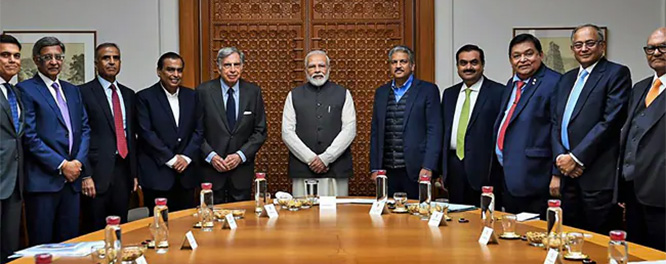
New Delhi: India has now become more unequal in terms of wealth concentration than the British colonial period as income and wealth of the top 1% of the country’s population have hit historical highs, according to a paper released by World Inequality Lab.

By 2022-23, the top 1 per cent income share in India was 22.6 per cent and the top 1 per cent wealth share rose to 40.1 per cent, with India’s top 1 per cent income share among the very highest in the world, higher than even South Africa, Brazil and the US.

Co-authored by economists Nitin Kumar Bharti, Lucas Chancel, Thomas Piketty, and Anmol Somanchi, the paper stated that the “Billionaire Raj” headed by “India’s modern bourgeoisie” is now more unequal than the British Raj headed by the colonialist forces. 

The paper said there is evidence to suggest the Indian tax system might be “regressive when viewed from the lens of net wealth”. A restructuring of the tax code is needed, the paper said, adding that a levy of a “super tax” of 2 per cent on the net wealth of 167 wealthiest families would yield 0.5 per cent of national income in revenues and create space for investments.

“A restructuring of the tax code to account for both income and wealth, and broad-based public investments in health, education and nutrition are needed to enable the average Indian, and not just the elites, to meaningfully benefit from the ongoing wave of globalisation. Besides serving as a tool to fight inequality, a “super tax” of 2% on the net wealth of the 167 wealthiest families in 2022-23 would yield 0.5% of national income in revenues and create valuable fiscal space to facilitate such investments,” the paper said. 

The paper has analysed data based on the annual tax tabulations published by the Indian income tax authorities to extract the distribution of top income earners between 1922-2020.

The share of national income going to the top 10 per cent fell from 37 per cent in 1951 to 30 per cent by 1982 after which it began steadily rising. From the early 1990s onwards, the top 10 per cent share increased substantially over the next three decades, nearly touching 60 per cent in the most recent years, the paper said. This compares with the bottom 50 per cent getting only 15 per cent of India’s national income in 2022-23.

 The top 1 per cent earn on average Rs 5.3 million, 23 times the average Indian (Rs 0.23 million). Average incomes for the bottom 50 per cent and the middle 40 per cent stood at Rs 71,000 (0.3 times national average) and Rs 1,65,000 (0.7 times national average), respectively.
The richest, nearly 10,000 individuals (of 92 million Indian adults) earn on average Rs 480 million (2,069 times the average Indian). “To get a sense of just how skewed the distribution is, one would have to be at nearly the 90th percentile to earn the average income in India,” the paper said.

In 2022, just the top 0.1 per cent in India earned nearly 10 per cent of the national income, while the top 0.01 per cent earned 4.3 per cent share of the national income and top 0.001 per cent earned 2.1 per cent of the national income.

Enlisting the probable reasons for sharp rise in top 1 per cent income shares, the paper said public and private sector wage growth could have played a part till the late 1990s, adding that there are good reasons to believe capital incomes likely played a role in subsequent years. For the shares of the bottom 50 per cent and middle 40 per cent remaining depressed, the paper said, the primary reason has been the lack of quality broad-based education, focused on the masses and not just the elites.

“One reason to be concerned with such high levels of inequality is that extreme concentration of incomes and wealth is likely to facilitate disproportionate influence on society and government. This is even more so in contexts with weak democratic institutions. After largely being a role model among post-colonial nations in this regard, the integrity of various key institutions in India appears to have been compromised in recent years. This makes the possibility of India’s slide towards plutocracy even more real. If only for this reason, income and wealth inequality in India must be closely tracked and challenged,” it said.


Comments

Add new comment

  • Coastaldigest.com reserves the right to delete or block any comments.
  • Coastaldigset.com is not responsible for its readers’ comments.
  • Comments that are abusive, incendiary or irrelevant are strictly prohibited.
  • Please use a genuine email ID and provide your name to avoid reject.
coastaldigest.com news network
November 29,2025

health1.jpg

Mangaluru, Nov 29: Around 12,500 healthcare students from Medical, Dental, AYUSH, Pharmacy, Nursing, Physiotherapy and Allied Health Sciences colleges of Dakshina Kannada, affiliated to Rajiv Gandhi University of Health Sciences (RGUHS), took part in a massive walkathon to promote awareness on Organ Donation and Nasha Mukth Bharat.

The inaugural ceremony was held at Mangala Stadium. Dr Bhagavan B C, Hon’ble Vice-Chancellor of RGUHS, delivered the welcome address. The walkathon was flagged off by Shri U T Khader, Hon’ble Speaker of the Karnataka Legislative Assembly, and presided over by Shri Dinesh Gundu Rao, Hon’ble Minister for Health, Family Welfare and Dakshina Kannada District In-charge. Dakshina Kannada MP Shri Brijesh Chowta also addressed the students.

Music director Guru Kiran, MLA Dr Bharat Shetty (Mangalore North), Police Commissioner Shri Sudheer Kumar Reddy, Shri Manjunath Bhandary and Shri Harish Kumar were among those present.

Institution heads including Dr Haji U K Monu (Kanachur Colleges), Dr Shantharam Shetty (Tejaswini College), Dr Bhaskar Shetty (City Group of Colleges), Mr Abdul Rahiman (Kanachur Institute of Medical Sciences), and the District Health Officer, Mangalore, also participated.

The vote of thanks was delivered by Prof U T Ifthikar Fareed, Syndicate Member, RGUHS.

The event was organised by Dr U T Ifthikar Ali and Dr Shiva Sharan (Syndicate Members), Prof Vaishali (Senate Member), Prof Mohammad Suhail (Chairman, BOS Physiotherapy), Dr Sharan Shetty (Former Senate Member), along with principals and faculty of various colleges.

Students marched from Mangala Stadium to Karavali Grounds via MCC and Lalbagh signal. The event set a record as one of the largest gatherings of healthcare students for a social cause in the RGUHS Dakshina Kannada Zone.

health7.jpg

health6.jpg

health5.jpg

health4.jpg

health3.jpg

health2.jpg

Comments

Add new comment

  • Coastaldigest.com reserves the right to delete or block any comments.
  • Coastaldigset.com is not responsible for its readers’ comments.
  • Comments that are abusive, incendiary or irrelevant are strictly prohibited.
  • Please use a genuine email ID and provide your name to avoid reject.
coastaldigest.com news network
November 28,2025

roadshow.jpg

Udupi district transformed into a sea of saffron and celebration on Friday, November 28, as Prime Minister Narendra Modi’s roadshow swept through the coastal temple town. Thousands of residents lined the streets, turning the event into a vibrant public spectacle filled with cheers, flags, and festive energy.

The procession route—from the helipad to the historic Sri Krishna Math—was decked with buntings, saffron flags, and multilayered security barricades. One of the district’s largest-ever security deployments was put in place for the high-profile visit, with over 3,000 police personnel on duty. The arrangement included ten SPs, 27 DSPs, 49 inspectors, 127 sub-inspectors, 232 assistant sub-inspectors, 1,608 constables, and 39 women staff.

Six platoons of the Karnataka State Reserve Police, six Quick Response Teams, bomb detection units, and dog squads were stationed across Udupi. Enhanced surveillance covered Adi Udupi, Bannanje bus stand, and the Sri Krishna Math parking zone, with combing operations carried out along the roadshow corridor.

At the 800-year-old Sri Krishna Math, preparations reached a ceremonial peak. Paryaya Puttige Math seer Sugunendra Teertha Swamiji said the Prime Minister would take part in the Laksha Kantha Geetha Parayana, a mass chanting of the Bhagavad Gita by one lakh devotees, and inaugurate the new Suvarna Teertha Mantapa.

“He will first offer floral tributes to saint-poet Kanakadasa and then unveil the golden covering over the Kanakana Kindi,” the seer said.

The Prime Minister will also receive a Poorna Kumbha welcome and have darshan of Lord Sri Krishna, Mukhyaprana Devaru, and the Suvarna Paduke. Union Minister Pralhad Joshi, Karnataka Governor Thaawarchand Gehlot, Minister Bairathi Suresh, Dharmadhikari D. Veerendra Heggade, and seers from the Ashta Maths are expected to join the ceremony.

Ahead of his arrival, the Prime Minister posted on X that he felt “honoured” to attend the spiritually significant gathering. “This is a special occasion that brings together people from different sections of society for a recital of the Gita. This Matha has a very special significance in our cultural life,” he wrote, noting the institution’s long-standing legacy rooted in the teachings of Sri Madhvacharya.

roadshow2.jpg

Comments

Add new comment

  • Coastaldigest.com reserves the right to delete or block any comments.
  • Coastaldigset.com is not responsible for its readers’ comments.
  • Comments that are abusive, incendiary or irrelevant are strictly prohibited.
  • Please use a genuine email ID and provide your name to avoid reject.
News Network
November 27,2025

Bengaluru, Nov 27: Karnataka Chief Minister Siddaramaiah’s camp is reportedly on alert as the Congress leadership tussle in the state intensifies, particularly amid speculation over the potential promotion of Deputy Chief Minister D.K. Shivakumar. Siddaramaiah is said to be in a “wait-and-watch” mode after admitting to “confusion” earlier this week and urging the party to “put a full stop” to it.

Sources say his supporters are ready to act if senior leaders — including party chief Mallikarjun Kharge, Sonia Gandhi, and Rahul Gandhi — give any indication of backing Shivakumar. If the party insists on a leadership change, Siddaramaiah’s camp has a list of alternatives, underscoring the deep rift between the two leaders. One possible candidate is Home Minister G. Parameshwara, a Siddaramaiah loyalist and influential Dalit leader.

The strategy was reportedly finalized at a meeting led by PWD Minister Satish Jarkiholi, another Siddaramaiah supporter, who stressed that Delhi leaders need to resolve the issue. Kharge and the Gandhis are expected to meet soon, after which Siddaramaiah and Shivakumar may be summoned to Delhi.

Shivakumar has largely stayed non-confrontational, publicly endorsing Siddaramaiah and downplaying speculation about his own ambitions. However, he has made pointed comments emphasizing the importance of honoring promises, directed at Siddaramaiah.

The feud traces back to the 2023 state election, when Siddaramaiah was chosen as Chief Minister while Shivakumar, who led the party’s campaign, was made Deputy CM and state party chief — a departure from the Congress’ usual “one post per person” rule.

There were also hints of a prior understanding that Siddaramaiah would step down midway through the term. As the halfway mark passed last week, Shivakumar-aligned lawmakers have ramped up pressure on the party for a leadership change, with Shivakumar himself hinting at stepping down as state party chief to pursue the top job.

Comments

Add new comment

  • Coastaldigest.com reserves the right to delete or block any comments.
  • Coastaldigset.com is not responsible for its readers’ comments.
  • Comments that are abusive, incendiary or irrelevant are strictly prohibited.
  • Please use a genuine email ID and provide your name to avoid reject.