



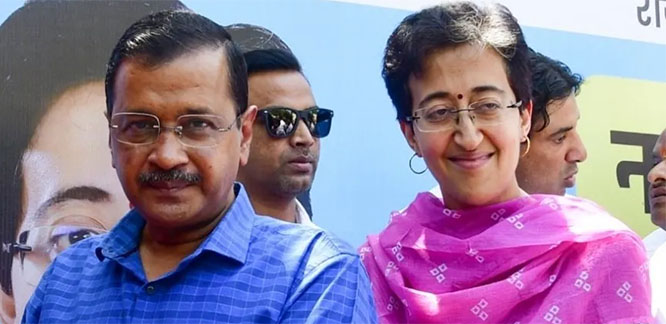
Can Kejriwal run govt from jail? Will Atishi or Saurabh become new CM? Will Centre impose president's rule?

News Network
March 22, 2024

kejriatishi.jpg

New Delhi, Mar 22: The Aam Aadmi Party has made it clear that Arvind Kejriwal will remain the Delhi Chief Minister despite his arrest in the liquor policy case. While no law would stop the AAP leader from running the state from prison, the jail guidelines would make it extremely difficult.

Kejriwal was arrested yesterday by the Directorate of Enforcement (ED), following his avoidance of nine summons issued by the investigative agency in relation to the Delhi liquor policy case. 

The decision to apprehend Kejriwal transpired shortly after the High Court's denial of protection from arrest. With this development, Kejriwal becomes the second opposition Chief Minister to face arrest by the ED within a span of fewer than two months, following Jharkhand Chief Minister Hemant Soren's similar fate in January 2024 due to allegations in a graft case. Subsequently, Hemant Soren was replaced by his party colleague, Champai Soren.

Delhi government minister Atishi declared shortly after Kejriwal's arrest that he would not step down from his position. However, the legality and feasibility of a detained Chief Minister continuing to fulfill official duties warrant examination.

A former law officer of Delhi's Tihar Jail says that an inmate can only hold two meetings in a week, which would make it difficult for Mr Kejriwal to carry out his responsibilities as Chief Minister.

Can he run government from prison?

While theoretically plausible, governing from detention presents logistical challenges. However, there exists no explicit prohibition against a Chief Minister conducting official responsibilities while under arrest. Disqualification only occurs upon conviction.

The Representation of the People Act, 1951 outlines disqualification provisions for specific offenses, necessitating a conviction for those holding office.

Will centre impose president’s rule?

Constitution expert SK Sharma told TOI that there exists no specific legal provision mandating the automatic resignation of a state's Chief Minister upon arrest. He cited the example of former Bihar CM Lalu Prasad Yadav, who appointed his wife Rabri Devi as CM during his arrest. "Former Bihar CM Lalu Prasad Yadav made his wife Rabri Devi the CM of the state when he was arrested. More recently, Hemant Soren in Jharkhand also resigned. Calling cabinet meetings in the jail or review meetings with officials in his cell does not seem practical," said Sharma.

Sharma further indicated that if AAP persisted in retaining Kejriwal as CM, it could lead to a deadlock, potentially prompting the Centre to impose President's rule in Delhi.

What may happen next?

Despite AAP's unwavering stance on Kejriwal's continuation in office, internal sources say that potential successors, including Atishi and health minister Saurabh Bharadwaj. Atishi, known for her extensive portfolio and close ties to Kejriwal, alongside Bharadwaj, a prominent minister with significant responsibilities, emerged as likely contenders. Additionally, sources speculated about the surprise candidacy of Kejriwal's wife, Sunita, given her background as a revenue services officer and active involvement in party affairs.

However, finding a successor of comparable stature to Kejriwal, a national convener of the party and three-time Delhi CM, presents a formidable challenge for AAP.

Role of Delhi's Lieutenant Governor

Delhi's unique power structure, featuring an elected Chief Minister and a Lieutenant Governor appointed by the Centre, presents a complex scenario. Kejriwal's ability to continue as CM hinges on legal relief, failing which the Lieutenant Governor can seek Presidential intervention, potentially leading to the imposition of President's rule.

Recent cases demonstrate how denial of bail can compel resignation, highlighting the precarious position of arrested officials.

In light of these developments, the Lieutenant Governor could invoke 'failure of constitutional machinery' to justify President's rule, thereby bringing the national capital under direct Union government control until the end of the current Assembly's tenure in February 2025.

Comments

Add new comment

  • Coastaldigest.com reserves the right to delete or block any comments.
  • Coastaldigset.com is not responsible for its readers’ comments.
  • Comments that are abusive, incendiary or irrelevant are strictly prohibited.
  • Please use a genuine email ID and provide your name to avoid reject.
News Network
January 23,2026

Karnataka Governor Thaawarchand Gehlot read only three lines from the 122-paragraph address prepared by the Congress-led state government while addressing the joint session of the Legislature on Thursday, effectively bypassing large sections critical of the BJP-led Union government.

The omitted portions of the customary Governor’s address outlined what the state government described as a “suppressive situation in economic and policy matters” under India’s federal framework. The speech also sharply criticised the Centre’s move to replace the Mahatma Gandhi National Rural Employment Guarantee Act (MGNREGA) with the Viksit Bharat–Guarantee for Rozgar and Ajeevika Mission (Gramin) Act, commonly referred to as the VB-GRAM (G) Act.

Governor Gehlot had earlier conveyed his objection to several paragraphs that were explicitly critical of the Union government. On Thursday, he confined himself to the opening lines — “I extend a warm welcome to all of you to the joint session of the State legislature. I am extremely pleased to address this august House” — before jumping directly to the concluding sentence of the final paragraph.

He ended the address by reading the last line of paragraph 122: “Overall, my government is firmly committed to doubling the pace of the State’s economic, social and physical development. Jai Hind — Jai Karnataka.”

According to the prepared speech, the Karnataka government demanded the scrapping of the VB-GRAM (G) Act, describing it as “contractor-centric” and detrimental to rural livelihoods, and called for the full restoration of MGNREGA. The state government argued that the new law undermines decentralisation, weakens labour protections, and centralises decision-making in violation of constitutional norms.

Key points from the unread sections of the speech:

•    Karnataka facing a “suppressive” economic and policy environment within the federal system

•    Repeal of MGNREGA described as a blow to rural livelihoods

•    VB-GRAM (G) Act accused of protecting corporate and contractor interests

•    New law alleged to weaken decentralised governance

•    Decision-making said to be imposed by the Centre without consulting states

•    Rights of Adivasis, women, backward classes and agrarian communities curtailed

•    Labourers allegedly placed under contractor control

•    States facing mounting fiscal stress due to central policies

•    VB-GRAM (G) Act accused of enabling large-scale corruption

Comments

Add new comment

  • Coastaldigest.com reserves the right to delete or block any comments.
  • Coastaldigset.com is not responsible for its readers’ comments.
  • Comments that are abusive, incendiary or irrelevant are strictly prohibited.
  • Please use a genuine email ID and provide your name to avoid reject.
News Network
February 1,2026

Bengaluru, Feb 1: For travelers landing at Kempegowda International Airport (KIA), the sleek, wood-paneled curves of Terminal 2 promise a world-class welcome. But the famed “Garden City” charm quickly withers at the curb. As India’s aviation sector swells to record numbers—handling over 43 million passengers in Bengaluru alone this past year—the “last mile” has turned into a marathon of frustration.

The Bengaluru Logjam: Rules vs Reality

While the city awaits the 2027 completion of the Namma Metro Blue Line, the interim has been chaotic. Recent “decongestion” rules at Terminal 1 have pushed app-based cab pickups to distant parking zones, forcing weary passengers into a 20-minute walk with luggage.

“I landed after ten months away and felt like a stranger in my own city,” says Ruchitha Jain, a Koramangala resident. “My driver couldn’t find me, staff couldn’t guide me, and the so-called ‘Premium’ lane is just a fancy tax on convenience.”

•    The Cost of Distance: A 40-km cab ride can now easily cross ₹1,500, driven by demand pricing and airport surcharges.

•    The Bus Gap: While Vayu Vajra remains a lifeline, its ₹300–₹400 fare is often cited as the most expensive airport bus service in the country.

A National Pattern of Disconnect

The struggle is not unique to Karnataka. From Chennai’s coast to Hyderabad’s plateau, India’s airports tell a familiar story: brilliant runways, broken exits.

City:    Primary Issue   |    Recent Development

Bengaluru:    Cab pickup restrictions & distance  |    App-based taxis shifted to far parking zones; long walks and fare spikes reported

Chennai:    Multi-Level Parking (MLCP) hike  |    Passengers report 40-minute walks to reach cab pickup points

Hyderabad:    “Taxi mafia” & touting  |    Over 440 touting cases reported; security presence intensified

Mumbai:    Fare scams  |     Tourists charged ₹18,000 for just 400 metres, triggering police action

In Hyderabad, travelers continue to battle entrenched local groups that intimidate Uber and Ola drivers, pushing passengers toward overpriced private taxis. Chennai flyers, meanwhile, complain that reaching the designated pickup zones now takes longer than short-haul flights from cities like Coimbatore.

The ‘Budget Day’ Hope

As Finance Minister Nirmala Sitharaman presents the Union Budget 2026 today, the aviation sector is watching closely. With the government’s renewed emphasis on multimodal integration, there is cautious hope for funding toward seamless airport-metro-bus hubs.

The vision is clear: a future where planes, trains, and metros speak the same language. Until then, passengers at KIA—and airports across India—will continue to discover that the hardest part of flying isn’t the thousands of kilometres in the air, but the last few on the ground.

Comments

Add new comment

  • Coastaldigest.com reserves the right to delete or block any comments.
  • Coastaldigset.com is not responsible for its readers’ comments.
  • Comments that are abusive, incendiary or irrelevant are strictly prohibited.
  • Please use a genuine email ID and provide your name to avoid reject.
News Network
February 3,2026

Bengaluru: Following reports of fresh Nipah virus (NiV) cases in West Bengal and heightened vigilance across parts of Southeast Asia, the Karnataka Health Department has placed the state on high alert and activated emergency preparedness protocols.

Health officials said enhanced surveillance measures have been initiated after two healthcare workers in Barasat, West Bengal, tested positive for the virus earlier this month. While no cases have been reported in Karnataka so far, authorities said the state’s past exposure to Nipah outbreaks and high inter-state mobility warranted preventive action.

Officials have directed district health teams to intensify monitoring, particularly at hospitals and points of entry, and to ensure early detection and isolation of suspected cases.

High Mortality Virus with Multiple Transmission Routes

Nipah virus is a zoonotic disease that can spread from animals to humans and has a reported fatality rate ranging between 60 and 75 per cent. Fruit bats, also known as flying foxes, are the natural reservoirs of the virus and can transmit it by contaminating food sources with saliva or urine.

Known modes of transmission include:

•    Contaminated food: Consumption of fruits partially eaten by bats or raw date-palm sap
•    Animal contact: Exposure to infected pigs or other animals
•    Human-to-human transmission: Close contact with body fluids of infected persons, particularly in healthcare settings

Symptoms and Disease Progression

The incubation period typically ranges from 4 to 14 days, though delayed onset has also been reported. Early symptoms often resemble common viral infections, making prompt clinical suspicion critical.

•    Initial symptoms: Fever, headache, body aches, fatigue, sore throat
•    Progressive symptoms: Drowsiness, disorientation, altered mental state
•    Severe stage: Seizures, neck stiffness and acute encephalitis, which can rapidly progress to coma

Public Health Advisory

The Health Department has issued precautionary guidelines urging the public to adopt risk-avoidance practices to prevent any local spillover.

Do’s
•    Wash fruits thoroughly before consumption
•    Drink boiled and cooled water
•    Use protective equipment while handling livestock
•    Maintain strict hand hygiene

Don’ts
•    Avoid fruits found on the ground or showing bite marks
•    Do not consume beverages made from raw tree sap, including toddy
•    Avoid areas with dense bat populations
•    Do not handle sick or dead animals

Preparedness Measures

Officials confirmed that isolation wards are being readied in major government hospitals and that medical staff are being sensitised to identify early warning signs.

“There is no cause for panic, but there is a need for heightened vigilance,” a senior health official said, adding that there is currently no approved vaccine or specific antiviral treatment for Nipah, and care remains largely supportive.

Comments

Add new comment

  • Coastaldigest.com reserves the right to delete or block any comments.
  • Coastaldigset.com is not responsible for its readers’ comments.
  • Comments that are abusive, incendiary or irrelevant are strictly prohibited.
  • Please use a genuine email ID and provide your name to avoid reject.