



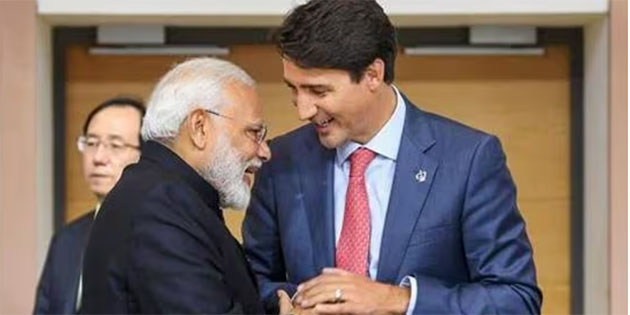
New Delhi, Sept 19: In a major embarrassment to India, the Prime Minister Justin Trudeau told the Canadian parliament on Monday that his country’s security agencies had “credible” intelligence that the Prime Minister Narendra Modi-led government of India was behind the June 2023 murder of a pro-Khalistan leader in British Columbia, Hardeep Singh Nijjar.
Trudeau’s charge was followed up by an official announcement from foreign minister Melanie Joly that Canada had expelled a senior Indian diplomat.
“Over the past number of weeks, Canadian security agencies have been actively pursuing credible allegations of a potential link between agents of the Government of India and the killing of a Canadian citizen, Hardeep Singh Nijjar,” Trudeau told the House of Commons, adding that he raised the issue with Indian Prime Minister Narendra Modi in “no uncertain terms”.
He asserted that “any involvement of a foreign government in the killing of a Canadian citizen on Canadian soil is an unacceptable violation of our sovereignty”.
So far, the Canadian government has not made public any of the evidence it has for its claim of an Indian government hand in Nijjar’s killing.
Joly’s office said that the expelled Indian diplomat is Pavan Kumar Rai, identified by them as the head of the Research and Analysis Wing (RAW), India’s foreign intelligence agency, in Canada. A 1997 batch Indian Police Service officer, he was posted to Ottawa as minister (eco, coordination, community affairs) in the Indian high commission.
It is likely that India will also expel a Canadian diplomat in a reciprocal move.
In a statement on Tuesday morning, the Indian Ministry of External Affairs said it rejected the allegations made by Canada’s prime minister and foreign minister. “Allegations of Government of India’s involvement in any act of violence in Canada are absurd and motivated,” the statement said.
The statement also confirmed Trudeau’s claim that he had brought up this allegation with Modi. “Similar allegations were made by the Canadian Prime Minister to our Prime Minister, and were completely rejected,” MEA’s statement said.
India also alleged that Canada had sympathised with Khalistani terrorists and was trying to deflect from the real issue with these allegations. “Such unsubstantiated allegations seek to shift the focus from Khalistani terrorists and extremists, who have been provided shelter in Canada and continue to threaten India’s sovereignty and territorial integrity. The inaction of the Canadian Government on this matter has been a long-standing and continuing concern,” the statement reads. “That Canadian political figures have openly expressed sympathy for such elements remains a matter of deep concern.”
India’s statement
CBC News reported that Trudeau had already briefed “the leaders of some of Canada’s closest allies about the case, including British Prime Minister Rishi Sunak, French President Emmanuel Macron and U.S. President Joe Biden.”
Joly also stated that she will be raising the assassination issue with her G7 counterparts at the United Nations in New York on Monday evening.
White House National Security Council spokesperson Adrienne Watson said the US is “deeply concerned” about Canada’s allegations. “We remain in regular contact with our Canadian partners. It is critical that Canada’s investigation proceed and the perpetrators be brought to justice,” Watson said.
Before the Ministry of External Affairs’ public statement, the Globe and Mail reported that the Indian government had denied all responsibility for Nijjar’s shooting and was insisting that pro-Khalistan activists in Canada had misled Canadian investigators. The newspaper said it had learned of this Indian response from sources that it was unable to identify “as they could face prosecution under the Security of Information Act” for discussing the issue.
Earlier in June, Hardeep Singh Nijjar, who headed the pro-Khalistan outfits Khalistan Tiger Force and the Canadian arm of Sikhs For Justice (SFJ), was shot dead at a parking lot of a gurdwara in Surrey, Canada. He was wanted for the shooting of a priest in Punjab and was the third pro-Khalistan activist to die abroad in a month and half. Immediately after his death, his supporters had claimed that the Indian government was behind the killing.
Relations between India and Canada have been tense over the activities of pro-Khalistian groups in Canada and Ottawa’s perception that New Delhi was interfering in its internal affairs. The meeting between Trudeau and Modi last week at the G20 was visibly frosty, going by the scowls on display during the photo-op and the divergent statements each side issued.
This is the first time in recent memory that any foreign government, barring Pakistan, has directly accused New Delhi of being involved in an act of violence on their territory, let alone a murder.
At the same time, allegations that Indian security forces and intelligence agents have acted abroad in contravention of international law have been made recently in two high profile cases.
The first concerned the capture and rendition of Sheikha Latifa, daughter of the ruler of Dubai, by Indian special forces on the high seas off Goa in March 2018, and the second the attempted abduction of fugitive diamantaire Mehul Choksi in Antigua in May 2021.
Trudeau’s appeal
Government sources cited by the Globe and Mail newspaper in Canada privately ruled out the severing of diplomatic relations with India but said Ottawa was considering measures to respond to what it considers a serious violation of Canadian sovereignty.
Trudeau also told Canadian MPs that India was urged “to get to the bottom of the matter” when top Canada’s intelligence and security officials “declared [their]– deep concerns” to New Delhi.
“I also expect it (India) to reiterate that its position on extra-judicial operations in another country is clearly and unequivocally in line with international law,” he said. “It is contrary to the fundamental rules by which free, open, and democratic societies conduct themselves.”
Trudeau told parliament that he had already briefed Canada’s opposition leaders about the Indian government’s involvement. The opposition in Canada has stood by the Canadian government in its stance.
“These allegations, if true, are an outrageous violation of Canada’s sovereignty. More disturbing is that this was perpetrated by another democracy,” shadow foreign affairs minister Michael Chong said.
“If these allegations are true, they represent an outrageous affront to Canada, to Canada’s sovereignty. Our citizens must be safe from extrajudicial killings of all kinds, most of all, from foreign governments,” Conservative leader Pierre Poilievre was quoted by the Globe and Mail as saying. “Canadians deserve to be protected on Canadian soil. We call on the Indian government to act with utmost transparency as authorities investigate this murder, because the truth must come out.” “Let us lock arms and join hands in condemning this murder, standing with the family and the friends of this victim. Let’s put aside our difference to stand up for the rule of law. One law for all our people,” CBC reported him saying.
New Democratic Party leader Jagmeet Singh reacted to Trudeau’s disclosure by saying the Modi government has pursued “division, violence, persecution” and was “attacking those who are critical” of it.
Canada’s public safety minister Dominic LeBlanc announced that David Vigneault, director of the Canadian Security Intelligence Service, and Trudeau’s national security adviser, Jody Thomas, had also recently visited India several times to discuss the assassination.
The Canadian prime minister was in India for the G-20 summit, during which he had short and tense meeting with the Indian Prime Minister Narendra Modi. He was the only leader who didn’t attend the official banquet hosted by the Indian president on Saturday evening.
During the meeting on Sunday (September 10), the Indian readout said that Modi raised “strong concerns” over the activities of pro-Khalistan extremist groups. Trudeau told reporters that he had raised the issue of “foreign interference” with the Indian leader.
Earlier this month, the Indian ambassador to Canada had revealed that Ottawa had sought a pause “within the last month” on negotiation for a free trade agreement, but had refused to give any reasons.
Last week, Canada postponed a pre-scheduled trade mission which was to be led by Minister Mary Ng for five days from October 9 in Mumbai. There was no official explanation given for the postponement.
Quoting a Canadian government source, CBC reports that Trudeau’s NSA, who was in Delhi for the G20, “quietly” flew to London instead of Ottawa where she “informed the UK government that Canada’s relations with India were about to get worse now that Canada had credible evidence linking India’s government to Nijjar’s death, the source said.”
India has summoned the Canadian high commissioner at least twice this year to protest the activities of Khalistan activists in Canada. In March, India protested the “actions of separatist and extremist elements against our diplomatic Mission and Consulates in Canada” after rallies organised by them. In July, the Ministry of External Affairs again summoned the Canadian high commissioner over the issue of pro-Khalistan posters – bearing photos of Indian diplomats – that accused the Indian government of being behind the killing of H Nijjar.


Comments
Add new comment