Election year budget signals PM Modi’s sky-high confidence as BJP-led alliance aims to win over 400 seats

News Network
February 5, 2024

modi.jpg

New Delhi: India's finance minister presented an austere budget last week despite upcoming general elections, a strong display of the administration's confidence that Prime Minister Narendra Modi would return to power for a third straight term.

Instead of the usual voter-friendly measures announced in election years, Nirmala Sitharaman's interim budget focused on fiscal discipline and cut subsidies on food, fertiliser and fuel.

In the interim budget before the last general election in 2019, Modi's government announced direct cash support of 750 billion rupees (then about $10.5 billion) for poor farmers, extended income tax exemptions to more people and offered various other sops which led to a wider-than-estimated fiscal deficit.

But Sitharaman left little doubt who she thought would be back after the elections, to be held by May, to present the full budget.

"In the full budget in July, our government will present a detailed roadmap for our pursuit" of a developed India by 2047, she said.

The ruling Bharatiya Janata Party (BJP) is high in confidence ahead of the election, with Modi delivering on key parts of a nationalist agenda aimed at pleasing the country's majority Hindus as well as the country's stellar economic growth.

"The BJP will do very well because people have confidence in the prime minister and there are so many other factors like the economy," said Tariq Mansoor, a party vice president.

India's economy is now the fifth-largest in the world, from the tenth-largest when Modi first took office a decade ago, and the fastest expanding among major nations.

Growth, however, has been centred in urban areas and not in the vast hinterlands where more than 60 per cent of India's 1.42 billion people live. Some critics have noted that similarly lopsided growth led to a shock loss for the party in the 2004 general election.

But most analysts say there is little chance of a surprise in this election and it is all but certain that Modi, 73, would romp to a rare third term in office.

The reasons, they say, include Modi's high approval ratings, effective implementation of welfare measures like free rations for 800 million poor and the inauguration of a grand temple on the site of a razed mosque that has energised the BJP's Hindu base. The opposition, they added, is in disarray.

"There will be no repeat of the 2004 debacle unless there is some Black Swan event in the next three months or so, which is very unlikely," said Yashwant Deshmukh, founder of polling agency CVoter Foundation.

"It's not only because of the economy but more importantly that he has delivered on emotive issues for the cadre, the rank and file of the BJP, and at large the Hindutva (Hindu right) vote base."

CVoter is in the midst of a new survey but Deshmukh said "numbers are suggesting that they are going to get a majority on their own very easily at this point of time".

Over 400 seats

The BJP-led National Democratic Alliance coalition won more than 350 of the 543 directly elected seats in the decision-making lower house of parliament in the 2019 election.

"We are looking at beyond 400 for the alliance this time," the BJP's Mansoor said. That number would give the coalition more than a two-thirds majority in the legislature, which will allow it to bring in changes in the constitution.

Harsh Mander, a human rights worker and political columnist, said the budget was an indication of the government's thinking.

"Normally a pre-election budget would have a certain kind of last-minute set of promises," said Mander, who has been critical of many government policies.

"The fact that they don't feel the need to do that, asserts a high level of confidence that their policies, not economic policies but their social policies of basically Hindu supremacy, will trump whatever discontent is there."

Modi's current government has already delivered on two of the BJP's long-running promises: building a temple on the site of a razed mosque in the northern city of Ayodhya where many Hindus believe the god-king Ram was born, and removing the autonomy of the Muslim-majority region of Jammu and Kashmir.

The consecration of the Ram Temple last month, overseen by Modi, sparked unprecedented nationwide celebrations.

The main opposition Congress party said the government had failed in its promises to double farmers' incomes by 2022 and create millions of jobs every year. But the party's I.N.D.I.A. coalition has been badly hurt by the defection of a major regional leader to the BJP alliance last month and it has yet to formulate an effective counter to Modi's muscular pro-Hindu agenda.

Elara Capital analysts said the budget deliberately steered clear of any major announcements "in a studied step to showcase confidence as regards a re-election encore".

Modi himself has also not disguised his confidence.

"In my third term ...," he said in a speech to business leaders on Friday before being interrupted by claps and chants of "Modi, Modi".

"A word to the wise is enough," he said with a smile when he resumed. "In my third term, our country is bound to become the third-largest economy in the world."

Comments

Add new comment

  • Coastaldigest.com reserves the right to delete or block any comments.
  • Coastaldigset.com is not responsible for its readers’ comments.
  • Comments that are abusive, incendiary or irrelevant are strictly prohibited.
  • Please use a genuine email ID and provide your name to avoid reject.
News Network
January 23,2026

modIKERALA.jpg

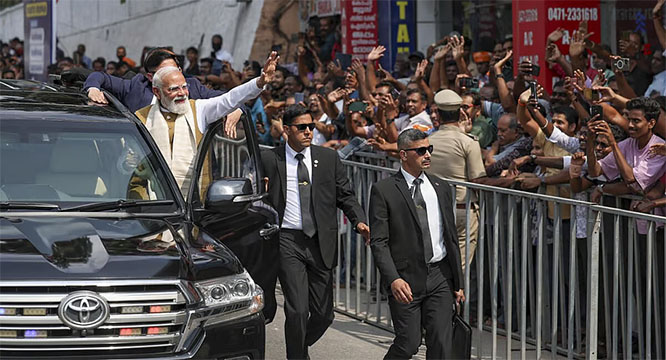
Prime Minister Narendra Modi, during his visit to Thiruvananthapuram on Friday, January 23, indicated that the Bharatiya Janata Party (BJP) is aiming to expand its political footprint in Kerala ahead of the Assembly elections scheduled in the coming months.

Speaking at a BJP-organised public meeting, Modi drew parallels between the party’s early electoral gains in Gujarat and its recent victory in the Thiruvananthapuram Municipal Corporation. The civic body win, which ended decades of Left control, was cited by the Prime Minister as a possible starting point for the party’s broader ambitions in the state.

Recalling BJP’s political trajectory in Gujarat, Modi said the party was largely insignificant before 1987 and received little media attention. He pointed out that the BJP’s first major breakthrough came with its victory in the Ahmedabad Municipal Corporation that year.

“Just as our journey in Gujarat began with one city, Kerala’s journey has also started with a single city,” Modi said, suggesting that the party’s municipal-level success could translate into wider electoral acceptance.

The Prime Minister alleged that successive governments led by the Left Democratic Front (LDF) and the United Democratic Front (UDF) had failed to adequately develop Thiruvananthapuram. He accused both fronts of corruption and neglect, claiming that basic infrastructure and facilities were denied to the capital city for decades.

According to Modi, the BJP’s control of the civic body represents a shift driven by public dissatisfaction with the existing political alternatives. He asserted that the BJP administration in Thiruvananthapuram had begun working towards development, though no specific details or timelines were outlined.

Addressing the gathering at Putharikandam Maidan, Modi said the BJP intended to project Thiruvananthapuram as a “model city,” reiterating his party’s commitment to governance-led change.

The Prime Minister’s visit to Kerala also included the inauguration of several development projects and the flagging off of new train services, as the BJP intensifies its political outreach in the poll-bound state.

Comments

Add new comment

  • Coastaldigest.com reserves the right to delete or block any comments.
  • Coastaldigset.com is not responsible for its readers’ comments.
  • Comments that are abusive, incendiary or irrelevant are strictly prohibited.
  • Please use a genuine email ID and provide your name to avoid reject.
News Network
February 1,2026

Bengaluru: Karnataka Deputy Chief Minister D K Shivakumar on Sunday criticised the Union Budget presented by Finance Minister Nirmala Sitharaman, claiming it offered no tangible benefit to the state.

Though he said he was yet to study the budget in detail, Shivakumar asserted that Karnataka had gained little from it. “There is no benefit for our state from the central budget. I was observing it. They have now named a programme after Mahatma Gandhi, after repealing the MGNREGA Act that was named after him,” he said.

Speaking to reporters here, the Deputy Chief Minister demanded the restoration of MGNREGA, and made it clear that the newly enacted rural employment scheme — VB-G RAM G — which proposes a 60:40 fund-sharing formula between the Centre and the states, would not be implemented in Karnataka.

“I don’t see any major share for our state in this budget,” he added.

Shivakumar, who also holds charge of Bengaluru development, said there were high expectations for the city from the Union Budget. “The Prime Minister calls Bengaluru a ‘global city’, but what has the Centre done for it?” he asked.

He also drew attention to the problems faced by sugar factories, particularly those in the cooperative sector, alleging a lack of timely decisions and support from the central government.

Noting that the Centre has the authority to fix the minimum support price (MSP) for agricultural produce, Shivakumar said the Union government must take concrete steps to protect farmers’ interests.

Comments

Add new comment

  • Coastaldigest.com reserves the right to delete or block any comments.
  • Coastaldigset.com is not responsible for its readers’ comments.
  • Comments that are abusive, incendiary or irrelevant are strictly prohibited.
  • Please use a genuine email ID and provide your name to avoid reject.
News Network
January 28,2026

ajit.jpg

Mumbai: The sudden death of Maharashtra Deputy Chief Minister Ajit Pawar in a plane crash in his hometown of Baramati has plunged the state into political uncertainty, raising a pressing question for both the Nationalist Congress Party (NCP) and its rival faction, the Nationalist Congress Party (Sharadchandra Pawar): what next?

For the two factions that emerged after the dramatic split of June–July 2023, the moment marks their gravest challenge yet. Many believe the answer now rests with party founder Sharad Pawar.

Sharad Pawar, who founded the NCP in 1999 after parting ways with the Congress over Sonia Gandhi’s foreign origin, has already indicated his intention to step away from electoral politics once his Rajya Sabha term ends in April 2026.

Speaking at a public event in Baramati ahead of his 85th birthday on December 12, 2025, Pawar said he would not contest any further elections. “I have contested 14 elections. The younger generation needs to be given an opportunity,” he said, adding that he would decide later whether to seek another Rajya Sabha term.

Often described as the Bhishma Pitamah of Indian politics, Pawar also spoke of his gradual withdrawal from active leadership. “For the first 30 years, I handled everything. For the next 25–30 years, Ajit Dada handled responsibilities. Now, arrangements must be made for new leadership,” he said.

Ajit Pawar’s death has dramatically altered that transition, especially as he was working towards reunifying the two NCP factions.

“After the developments of June–July 2023 and the 2024 Lok Sabha and Vidhan Sabha elections, there were deep changes within the family and the party. In the last six months, serious efforts were made to reunite. Even workers from both sides wanted unity. This is a massive blow,” a Pawar family insider told DH over phone from Baramati.

Electoral outcomes over the past year reflected the split. In the 2024 Lok Sabha elections, NCP (SP) recorded the best strike rate in Maharashtra, winning eight of the 10 seats it contested. The NCP, by contrast, won just one seat out of four.

However, the trend reversed in the subsequent Vidhan Sabha elections, where the NCP emerged stronger, securing 41 of the 288 seats, while NCP (SP) managed only 10.

Within NCP (SP), Sharad Pawar’s daughter Supriya Sule serves as Working President, followed by leaders such as Rohit Pawar, state president Shashikant Shinde and former state chief Jayant Patil.

In the NCP, Praful Patel is the Working President and Raigad MP Sunil Tatkare heads the state unit. Ajit Pawar’s wife, Sunetra Pawar, is a Rajya Sabha MP, while their sons Parth and Jay are not actively involved in day-to-day politics. Parth Pawar briefly entered electoral politics in 2019 but lost the Lok Sabha election from Maval. Jay Pawar’s political debut was under consideration.

With Ajit Pawar gone, speculation has intensified that a member of the family may be asked to assume a larger role. For now, Sunetra Pawar is expected to play a key coordinating role in party affairs, alongside Patel and Tatkare.

The NCP continues to have several heavyweight leaders, including Chhagan Bhujbal, Hasan Mushrif, Dattatreya Bharne, Manikrao Kokate and Dhananjay Munde.

Ajit Pawar had already begun steps towards reconciliation between the two factions. While they contested the Pune and Pimpri-Chinchwad municipal elections separately, they later decided to fight the zilla parishad elections together under the ‘clock’ symbol—seen as the first formal step towards reunification.

Nagpur meet and party roadmap

Both NCP factions claim adherence to the ideology of ‘Shiv–Shahu–Phule–Ambedkar’. At the Rashtravadi Chintan Shivir held in Nagpur on September 19, 2025, the NCP reaffirmed its commitment to sarva dharma sambhav and discussed strengthening ties with the BJP “for the welfare and development of Maharashtra”.

In recent days, reports had suggested Ajit Pawar might return to the Maha Vikas Aghadi following the party’s poor performance in Pune municipal elections, but these claims were denied.

Big question for Maha Yuti

Ajit Pawar’s death also presents an immediate challenge for the Devendra Fadnavis-led Maha Yuti government. Pawar held crucial portfolios, including Finance, Planning and Excise. With the Budget Session approaching, appointing a new Finance Minister has become urgent.

Beyond numbers and portfolios, Maha Yuti has lost a swift decision-maker known for his administrative grip and political finesse—leaving a vacuum that will not be easy to fill.

Comments

Add new comment

  • Coastaldigest.com reserves the right to delete or block any comments.
  • Coastaldigset.com is not responsible for its readers’ comments.
  • Comments that are abusive, incendiary or irrelevant are strictly prohibited.
  • Please use a genuine email ID and provide your name to avoid reject.