



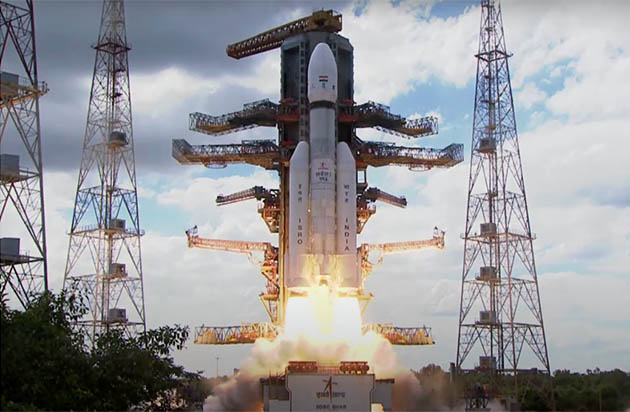
India’s Chandrayaan-3 blasts off to the moon from Sriharikota

News Network
July 14, 2023

chandrayan.jpg

New Delhi, July 14: India’s third unmanned lunar mission, Chandrayaan-3, aimed at exploring the south polar region of the moon, soared into the sky successfully at 2.35 pm on Friday as planned from the second launch pad of the Satish Dhawan Space Centre (SDSC) here. 
 
The precise goal is to make a soft and safe landing on the lunar surface, and if the mission is successful, India will only be the fourth country to have achieved the feat, joining the elite club of the US, Russia, and China. The south-polar region of the moon is of intense interest due to the presence of many permanently shadowed craters which could contain water ice and precious minerals. 
 
At the end of the 25-hour and 30-minute countdown, LVM3-M4, India’s largest and heaviest launch vehicle, LVM3-M4, lifted off at 2:35 pm with the 3,900-kg Chandrayaan-3 spacecraft, including the lander. Minutes later, it transferred the satellites into the Geo Transfer orbit as scientists, including ISRO Chairman S Somnath and his predecessors, were watching the launch from the Control Command Centre. 

Billed as a follow-up mission to Chandrayaan-2 which failed after the lander crash-landed on the moon 48 days later, Chandrayaan-3 will seek to demonstrate end-to-end landing and roving capabilities. The spacecraft will take about 40 days to make a soft landing on the lunar surface which is expected to be between August 23 and 24, eight days lesser than what the Chandrayaan-2 mission took. 
 
The success of Chandrayaan-3 will also help the ISRO fast-tracking its planned manned mission to the space, named Gaganyaan. 
 
The Chandrayaan-3 lander carrying a rover within it will be carried into an orbit around the moon by the propulsion module. A little later, the lander will separate from that module and will attempt to make a soft landing in the south polar region of the moon, which is of intense interest as it has many permanently shadowed craters which could contain water ice and precious minerals. 
 
India’s first unmanned mission, Chandrayaan-1, which took off on October 22, 2008, demonstrated the country’s ability to reach the surface of the moon and discover water on the lunar surface, while the Chandrayaan-2 mission’s aim was to make a soft landing on the moon. 
 
Learning lessons from the failure, the ISRO has made several significant modifications to Friday's mission with officials attributing the 2019 failure to malfunctioning of the onboard computer and propulsion system. 
 
This time around, the lander’s legs have been strengthened, a fifth engine has been removed to reduce the weight, and the landing area has been expanded from 500mx500m (in Chandrayaan-2) to 4kmx2.4 km area in Chandrayaan-3. Several special tests like Integrated Cold and Integrated Hot tests and Lander Leg mechanism performance tests have also been conducted to ensure the success of the mission, the officials added.
 
The Chandrayaan-3 mission is yet another attempt to achieve the goal with the help of a rover. The spacecraft, according to officials, will have four payloads which will study moon quakes, how the surface of the moon allows heat to flow through it, the plasma environment near the moon's surface, and enable scientists to measure the distance between Earth and moon “very accurately.”
 
The two rover payloads study composition of the moon’s surface using X-rays and LASER, while the propulsion module payload will explore the Spectro-polarimetric signatures of the habitable planet, Earth. The mission is divided into three phases -- Earth Centric, Lunar Transfer, and Moon Centric. 
 
The work on Chandrayaan-3 began just a few months after the failure of Chandrayaan-2, but the Covid-19 pandemic and the subsequent lockdown delayed ISRO’s plans. By demonstrating its capabilities to soft-land on the moon, the ISRO is also hoping to expand its business as it is already launching private satellites from Sriharikota.


Comments

Add new comment

  • Coastaldigest.com reserves the right to delete or block any comments.
  • Coastaldigset.com is not responsible for its readers’ comments.
  • Comments that are abusive, incendiary or irrelevant are strictly prohibited.
  • Please use a genuine email ID and provide your name to avoid reject.
News Network
February 4,2026

Mangaluru: Urban local bodies and gram panchayats should make the use of Kannada on signboards mandatory while issuing trade licences to commercial establishments, Dakshina Kannada Deputy Commissioner Darshan HV said. He also called for regular inspections to ensure compliance.

Presiding over the District Kannada Awareness Committee meeting at the deputy commissioner’s office, Darshan said the city corporation would be directed to ensure that shops operating in malls prominently display their names in Kannada. “All commercial establishments, including shops, companies, offices and hotels, must mandatorily display their names in Kannada on signboards,” he said.

The deputy commissioner added that the National Highways Authority of India (NHAI) would be instructed to include Kannada on signboards along national highways. Banks, he said, would be directed through committee meetings to provide application forms in Kannada.

“Even if English-medium schools and colleges impart education in English, their signboards must display the institution’s name in Kannada. Steps will also be taken to ensure that private buses display place names in Kannada,” Darshan said.

During the meeting, committee members raised concerns over the closure of Kannada-medium schools in rural areas due to a shortage of teachers and stressed the need for immediate corrective measures. They also pointed out that several industries employ workers from other states while overlooking local candidates.

Members further demanded that nationalised banks provide deposit and withdrawal slips in Kannada. It was brought to the deputy commissioner’s notice that the presence of staff without knowledge of Kannada in rural branches of nationalised banks is causing hardship to local customers.

Meanwhile, MP Srinath, president of the District Kannada Sahitya Parishat, urged the district administration to allot land for the construction of a district Kannada Bhavana in Mangaluru.

Comments

Add new comment

  • Coastaldigest.com reserves the right to delete or block any comments.
  • Coastaldigset.com is not responsible for its readers’ comments.
  • Comments that are abusive, incendiary or irrelevant are strictly prohibited.
  • Please use a genuine email ID and provide your name to avoid reject.
News Network
February 4,2026

gaming.jpg

Ghaziabad: In a tragic incident, three sisters aged 12, 14 and 16 died after jumping from the ninth floor of their apartment in Uttar Pradesh’s Ghaziabad in the early hours of Wednesday. The girls allegedly took the extreme step after becoming deeply obsessed with an online Korean task-based game.

The incident occurred around 2.15 am at a high-rise apartment complex in Bharat City. Before jumping, the sisters — Pakhi (12), Prachi (14) and Vishika (16) — left behind a handwritten note that read, “Sorry, Papa.”

According to police, the girls went to the balcony, bolted the door from inside and jumped one after another. Their screams and the sound alerted their parents, neighbours and security guards. By the time the parents broke open the balcony door, all three had died.

“When we reached the spot, we confirmed that three minor girls, daughters of Chetan Kumar, had died after jumping from the building,” said Assistant Commissioner of Police Atul Kumar Singh.

Visuals from the scene on Wednesday morning showed the bodies lying on the ground, their mother wailing in grief, and stunned neighbours gathering at the complex.

Police said the sisters were heavily influenced by Korean culture and were addicted to an online “Korean love game”, though no specific game has been identified so far. Investigators are examining an eight-page suicide note written in a pocket diary, detailing the girls’ mobile and gaming activities.

“Read everything written in this diary because all of it is true. I’m really sorry. Sorry, Papa,” the note said, accompanied by a hand-drawn crying emoji.

Their father, Chetan Kumar, told police that the girls had even adopted Korean names and had gradually withdrawn from school and daily activities. “They used to say, ‘Korea is our life, Korea is our biggest love. We cannot give it up,’” he said, breaking down.

Police said the parents had recently restricted the girls’ mobile phone usage, which may have triggered distress. “The investigation has not revealed the name of any particular game, but it is evident that the girls were deeply influenced by Korean culture, as mentioned in the suicide note,” said senior police officer Nimish Patel.

The sisters reportedly did everything together, including eating and bathing. Their gaming addiction is believed to have begun during the COVID-19 pandemic, after which they became irregular at school and eventually stopped attending altogether.

Police also revealed that Chetan Kumar is married to two sisters and lives with both wives and their children, all daughters. Two of the deceased girls were daughters of one wife, while the third was their half-sister.

Further investigation is underway.

Comments

Add new comment

  • Coastaldigest.com reserves the right to delete or block any comments.
  • Coastaldigset.com is not responsible for its readers’ comments.
  • Comments that are abusive, incendiary or irrelevant are strictly prohibited.
  • Please use a genuine email ID and provide your name to avoid reject.
News Network
February 1,2026

Bengaluru, Feb 1: For travelers landing at Kempegowda International Airport (KIA), the sleek, wood-paneled curves of Terminal 2 promise a world-class welcome. But the famed “Garden City” charm quickly withers at the curb. As India’s aviation sector swells to record numbers—handling over 43 million passengers in Bengaluru alone this past year—the “last mile” has turned into a marathon of frustration.

The Bengaluru Logjam: Rules vs Reality

While the city awaits the 2027 completion of the Namma Metro Blue Line, the interim has been chaotic. Recent “decongestion” rules at Terminal 1 have pushed app-based cab pickups to distant parking zones, forcing weary passengers into a 20-minute walk with luggage.

“I landed after ten months away and felt like a stranger in my own city,” says Ruchitha Jain, a Koramangala resident. “My driver couldn’t find me, staff couldn’t guide me, and the so-called ‘Premium’ lane is just a fancy tax on convenience.”

•    The Cost of Distance: A 40-km cab ride can now easily cross ₹1,500, driven by demand pricing and airport surcharges.

•    The Bus Gap: While Vayu Vajra remains a lifeline, its ₹300–₹400 fare is often cited as the most expensive airport bus service in the country.

A National Pattern of Disconnect

The struggle is not unique to Karnataka. From Chennai’s coast to Hyderabad’s plateau, India’s airports tell a familiar story: brilliant runways, broken exits.

City:    Primary Issue   |    Recent Development

Bengaluru:    Cab pickup restrictions & distance  |    App-based taxis shifted to far parking zones; long walks and fare spikes reported

Chennai:    Multi-Level Parking (MLCP) hike  |    Passengers report 40-minute walks to reach cab pickup points

Hyderabad:    “Taxi mafia” & touting  |    Over 440 touting cases reported; security presence intensified

Mumbai:    Fare scams  |     Tourists charged ₹18,000 for just 400 metres, triggering police action

In Hyderabad, travelers continue to battle entrenched local groups that intimidate Uber and Ola drivers, pushing passengers toward overpriced private taxis. Chennai flyers, meanwhile, complain that reaching the designated pickup zones now takes longer than short-haul flights from cities like Coimbatore.

The ‘Budget Day’ Hope

As Finance Minister Nirmala Sitharaman presents the Union Budget 2026 today, the aviation sector is watching closely. With the government’s renewed emphasis on multimodal integration, there is cautious hope for funding toward seamless airport-metro-bus hubs.

The vision is clear: a future where planes, trains, and metros speak the same language. Until then, passengers at KIA—and airports across India—will continue to discover that the hardest part of flying isn’t the thousands of kilometres in the air, but the last few on the ground.

Comments

Add new comment

  • Coastaldigest.com reserves the right to delete or block any comments.
  • Coastaldigset.com is not responsible for its readers’ comments.
  • Comments that are abusive, incendiary or irrelevant are strictly prohibited.
  • Please use a genuine email ID and provide your name to avoid reject.