



Key takeaways from Supreme Court verdict on Article 370 abrogation

News Network
December 11, 2023

court.jpg

The Supreme Court issued its decision on a slew of petitions challenging the abrogation of the Article 370 provisions on Monday (December 11, 2024).

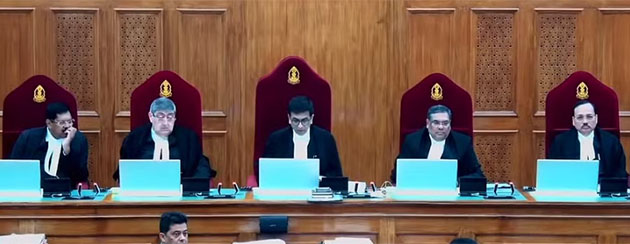
The Supreme Court upheld the Centre's decision to abrogate Article 370, saying it lacked "mala fide" intent. Chief Justice of India D Y Chandrachud announced the decision on behalf of Justices Gavai and Surya Kant as well, stating that Article 370 of the Constitution is a provision that is temporary and that the president has the authority to revoke it.

Chief Justice D Y Chandrachud led a five-judge Constitution bench that rendered the decision. Sanjay Kishan Kaul, Sanjiv Khanna, B R Gavai, and Surya Kant were the other members of the bench.

Following a 16-day hearing, the Supreme Court reserved its decision in the case on September 5.

Here are the major takeaways from the Supreme Court’s verdict:

- CJI D Y Chandrachud said that the five-judge bench made three judgements in the matter, and all were unanimous.

- Every decision taken by Union on behalf of the State is not subject to challenge, as this would eventually lead to chaos and uncertainty and would bring the administration of the State to a standstill, CJI said.

- The Supreme Court said the argument of petitioners that the Union government cannot take actions of irreversible consequences in the State during Presidential rule is not acceptable.

- The Supreme Court says it holds that Jammu and Kashmir did not retain an element of internal sovereignty after it acceded to India.

- SC held that Jammu and Kashmir became an integral part of India as evident from Articles 1 and 370 of the Constitution of India.

- Reading out the judgment CJI said, SC holds Article 370 was an interim arrangement due to war conditions in the State. Textual reading also indicates that Article 370 is a temporary provision.

- The Supreme Court held that the power of the President to issue a notification that Article 370 ceases to exist subsists even after the dissolution of the J&K Constituent Assembly.

- The Supreme Court said Article 370 was meant for the constitutional integration of Jammu and Kashmir with the Union and it was not for disintegration.

- J&K does not have internal sovereignty different from other states of the country, the CJI said.

- The Constituent Assembly of J&K was never intended to be a permanent body, the CJI also said.

- The Supreme Court said the concurrence of the State government was not required to apply all provisions of the Constitution using Article 370(1)(d). So, the President of India taking the concurrence of the Union government was not mala fide.

- The SC also said that the recommendation of Constituent Assembly of J&K was not binding on the President of India.

- The SC held the president seeking concurrence of union and not state as valid, and all provisions of the Indian constitution can be applied to J&K.

- The restoration of statehood in Union Territory of J&K shall be done at the earliest, said the CJI.

- The Supreme Court upheld the reorganisation of Ladakh as a Union Territory.

Comments

Add new comment

  • Coastaldigest.com reserves the right to delete or block any comments.
  • Coastaldigset.com is not responsible for its readers’ comments.
  • Comments that are abusive, incendiary or irrelevant are strictly prohibited.
  • Please use a genuine email ID and provide your name to avoid reject.
News Network
January 31,2026

Roy.jpg

Bengaluru: The shooting incident involving CJ Roy, founder of the Confident Group, has once again put the spotlight on a businessman whose life has swung between flamboyant global success and persistent controversy at home.

Though Roy’s business interests extended across continents, his roots lay firmly in Karnataka. An alumnus of Christ School in Bengaluru, he later moved to Tumakuru to pursue an engineering degree. Those familiar with his early years describe him as intensely ambitious, beginning his career as a salesman at a small electronics firm dealing in computers.

Roy’s entry into large-scale real estate came through the Crystal Group, where he worked closely with Latha Namboothiri and rose from manager to director. However, the launch of the Confident Group in 2005 was clouded by industry speculation. Insiders speak of a fallout involving alleged “benami” properties and claims of deception that ultimately led to his independent venture—an episode Roy spent years trying to distance himself from, according to associates.

A tale of two cities

Roy’s professional trajectory diverged sharply across geographies.

In Dubai, he built a reputation as a bold and efficient developer, completing massive luxury residential projects in record time—some reportedly within 11 months. His rapid project delivery and lavish lifestyle in the Emirates earned him admiration and visibility in the real estate sector.

In Bengaluru, however, his image remained far more fractured. Sources say Roy stayed away from the city for several years amid disputes over unpaid dues to vendors and suppliers. Several projects were allegedly stalled, with accusations of unfulfilled commitments to cement and steel suppliers continuing to follow him.

Roy’s return to Bengaluru’s business and social circles began around 2018, marked by a conscious attempt at rebranding. His appointment as Honorary Consul of the Slovak Republic added diplomatic legitimacy, which he complemented with visible CSR initiatives, including ambulance donations and high-profile charity events.

Heavy police presence in Langford Town

Following the incident, police personnel from the Central division were deployed outside the Confident Group building in Langford Town, which also houses the Slovak Honorary Consulate in Bengaluru.

The otherwise busy premises near Hosur Road wore a deserted look on Friday, reflecting the shock and uncertainty that followed the tragedy.

Comments

Add new comment

  • Coastaldigest.com reserves the right to delete or block any comments.
  • Coastaldigset.com is not responsible for its readers’ comments.
  • Comments that are abusive, incendiary or irrelevant are strictly prohibited.
  • Please use a genuine email ID and provide your name to avoid reject.
