No legal recognition for same-sex marriages, rules SC, leaves it to Parliament

News Network
October 17, 2023

bench.jpg

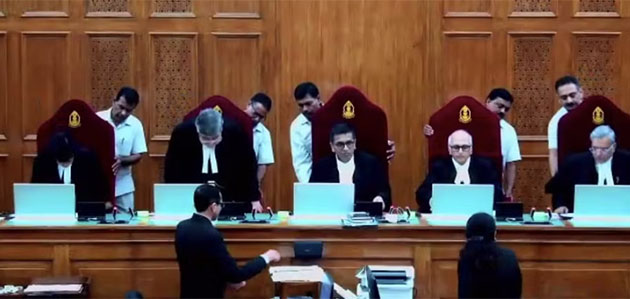
New Delhi, Oct 17: The Supreme Court on Tuesday passed judgement that it could not legally recognise same-sex marriages, after hearing a batch of pleas seeking legal sanction for the same. The apex court put the onus on the Parliament to frame the necessary laws.

The court ruled that the right to enter union cannot be restricted on the basis of sexual orientation.

"The Union Govt, State Govts and UTs shall not discriminate against the right of the queer community to enter into union", CJI D Y Chandrachud said.

"Failure of State to recognise the bouquet of rights flowing from a queer relationship amounts to discrimination", the court observed.

While adding "Transgender persons in heterosexual relationships have the right to marry under the existing laws including personal laws", the court continued that unmarried couples, including queer ones, can jointly adopt a child.

"This court cannot make law, it can only interpret it and give effect to it," the CJI said, while passing judgement. He had started by saying there were four judgements in the case, one from him, and the others from the Supreme Court bench hearing the matter.

"There is a degree of agreement and a degree of disagreement on how far we have to go", the CJI said.

He added, "Queerness can be regardless of one's caste or class or socio-economic status", leading up to the judgement.

The CJI continued that marriage as an institution has metamorphosed over time.

Chandrachud further said that if the apex court held "Section 4 of Special Marriage Act is unconstitutional because of being under-inclusive" it has to either strike it down or read it down.

The CJI noted "The right to enter into Union includes the right to choose one's partner and the right to recognition of that union", adding that "failure to recognize such associations will result in discrimination against queer couples."

The Solicitor General has already said that the Union would set out a committee to examine rights which can be conferred to such a couple.

The right to choose a partner goes to the very root of the right to life and liberty under Article 21, the CJI observed.

Stating that the gender of a person is the not the same as their sexuality, the CJI said "A transgender person is in a heterosexual relationship, such a marriage is recognised by the law. Since a transgender person can be in a heterosexual relationship, a union between a transman and a transwoman or vice versa can be registered under Special Marriage Act (SMA)."

The court also recognised that queer people cannot be discriminated against. The CJI said that material benefits and services that heterosexual couples get cannot be denied to queer couples, since that would be a violation of their fundamental rights.

Speaking on adoption rights, the CJI noted that neither can one assume unmarried couples are not serious about their relationship. He added, "There is no material on record to prove that only a married heterosexual couple can provide stability to a child."

Chandrachud also declared that stating only heterosexual couples can be good parents, is a violation of Article 15, since it is discriminatory.

"The CARA circular (which excludes queer couples from adoption) is violative of Article 15 of the Constitution", he said.

"CARA Regulation 5(3) indirectly discriminates against atypical unions. A queer person can adopt only in an individual capacity. This has the effect of reinforcing the discrimination against queer community", he added.

The CJI then directed the Union governments, state governments, and UTs to not discriminate against the queer community.

He also directed them to ensure no discrimination exists in access to goods and services.

Chandrachud added a few more directives including - sensitising public about queer rights, creating hotline for queer community, creating safe house for queer couples, ensuring inter-sex children are not forced to undergo operations, no person shall be forced to undergo hormonal therapy.

He also said queer community should not be harassed by being called to the police station to be asked about their sexual identity. The police cannot force queer couples to return to their natal families either, the CJI directed.

"Police should conduct a preliminary enquiry before registering an FIR against a queer couple over their relationship", he further said.

A five-judge bench including Justices Sanjay Kishan Kaul, S Ravindra Bhat, Hima Kohli, and PS Narasimha, and led by CJI D Y Chandrachud had begun hearing the matter from April 18.

The bench, after rigorous deliberation, reserved its judgement on May 11, 2023, setting the stage for a verdict that will greatly impact the LGBTQIA+ community in the world's largest democracy.

The apex court confined the case to the Special Marriage Act of 1954 and issued a clarification that it would not be dealing with personal laws or the Hindu Marriage Act. 

Comments

Add new comment

  • Coastaldigest.com reserves the right to delete or block any comments.
  • Coastaldigset.com is not responsible for its readers’ comments.
  • Comments that are abusive, incendiary or irrelevant are strictly prohibited.
  • Please use a genuine email ID and provide your name to avoid reject.
News Network
January 23,2026

modIKERALA.jpg

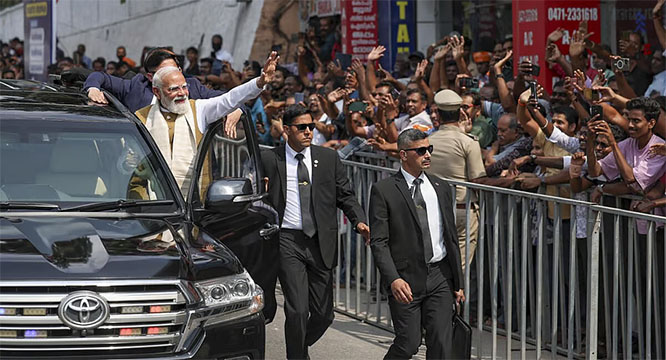
Prime Minister Narendra Modi, during his visit to Thiruvananthapuram on Friday, January 23, indicated that the Bharatiya Janata Party (BJP) is aiming to expand its political footprint in Kerala ahead of the Assembly elections scheduled in the coming months.

Speaking at a BJP-organised public meeting, Modi drew parallels between the party’s early electoral gains in Gujarat and its recent victory in the Thiruvananthapuram Municipal Corporation. The civic body win, which ended decades of Left control, was cited by the Prime Minister as a possible starting point for the party’s broader ambitions in the state.

Recalling BJP’s political trajectory in Gujarat, Modi said the party was largely insignificant before 1987 and received little media attention. He pointed out that the BJP’s first major breakthrough came with its victory in the Ahmedabad Municipal Corporation that year.

“Just as our journey in Gujarat began with one city, Kerala’s journey has also started with a single city,” Modi said, suggesting that the party’s municipal-level success could translate into wider electoral acceptance.

The Prime Minister alleged that successive governments led by the Left Democratic Front (LDF) and the United Democratic Front (UDF) had failed to adequately develop Thiruvananthapuram. He accused both fronts of corruption and neglect, claiming that basic infrastructure and facilities were denied to the capital city for decades.

According to Modi, the BJP’s control of the civic body represents a shift driven by public dissatisfaction with the existing political alternatives. He asserted that the BJP administration in Thiruvananthapuram had begun working towards development, though no specific details or timelines were outlined.

Addressing the gathering at Putharikandam Maidan, Modi said the BJP intended to project Thiruvananthapuram as a “model city,” reiterating his party’s commitment to governance-led change.

The Prime Minister’s visit to Kerala also included the inauguration of several development projects and the flagging off of new train services, as the BJP intensifies its political outreach in the poll-bound state.

Comments

Add new comment

  • Coastaldigest.com reserves the right to delete or block any comments.
  • Coastaldigset.com is not responsible for its readers’ comments.
  • Comments that are abusive, incendiary or irrelevant are strictly prohibited.
  • Please use a genuine email ID and provide your name to avoid reject.
News Network
January 23,2026

Karnataka Governor Thaawarchand Gehlot read only three lines from the 122-paragraph address prepared by the Congress-led state government while addressing the joint session of the Legislature on Thursday, effectively bypassing large sections critical of the BJP-led Union government.

The omitted portions of the customary Governor’s address outlined what the state government described as a “suppressive situation in economic and policy matters” under India’s federal framework. The speech also sharply criticised the Centre’s move to replace the Mahatma Gandhi National Rural Employment Guarantee Act (MGNREGA) with the Viksit Bharat–Guarantee for Rozgar and Ajeevika Mission (Gramin) Act, commonly referred to as the VB-GRAM (G) Act.

Governor Gehlot had earlier conveyed his objection to several paragraphs that were explicitly critical of the Union government. On Thursday, he confined himself to the opening lines — “I extend a warm welcome to all of you to the joint session of the State legislature. I am extremely pleased to address this august House” — before jumping directly to the concluding sentence of the final paragraph.

He ended the address by reading the last line of paragraph 122: “Overall, my government is firmly committed to doubling the pace of the State’s economic, social and physical development. Jai Hind — Jai Karnataka.”

According to the prepared speech, the Karnataka government demanded the scrapping of the VB-GRAM (G) Act, describing it as “contractor-centric” and detrimental to rural livelihoods, and called for the full restoration of MGNREGA. The state government argued that the new law undermines decentralisation, weakens labour protections, and centralises decision-making in violation of constitutional norms.

Key points from the unread sections of the speech:

•    Karnataka facing a “suppressive” economic and policy environment within the federal system

•    Repeal of MGNREGA described as a blow to rural livelihoods

•    VB-GRAM (G) Act accused of protecting corporate and contractor interests

•    New law alleged to weaken decentralised governance

•    Decision-making said to be imposed by the Centre without consulting states

•    Rights of Adivasis, women, backward classes and agrarian communities curtailed

•    Labourers allegedly placed under contractor control

•    States facing mounting fiscal stress due to central policies

•    VB-GRAM (G) Act accused of enabling large-scale corruption

Comments

Add new comment

  • Coastaldigest.com reserves the right to delete or block any comments.
  • Coastaldigset.com is not responsible for its readers’ comments.
  • Comments that are abusive, incendiary or irrelevant are strictly prohibited.
  • Please use a genuine email ID and provide your name to avoid reject.