



‘Ready to face siege-like situation’, say farmers as govt forces fire tear gas to stop them

News Network
February 13, 2024

farmerprotest.jpg

New Delhi, Feb 13: Tear gas has been fired at farmers massing at the Shambhu border point between Punjab and Haryana - a key meeting point for farmers from each state heading to Delhi as part of their 'Delhi Chalo' call - and many have been detained as they try to remove cement barriers obstructing their progress.

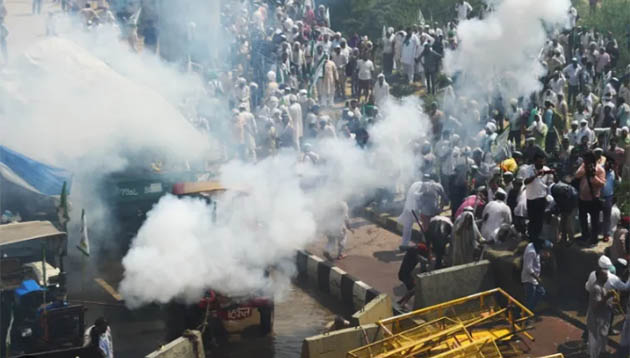
Visuals showed huge plumes of smoke - making visibility almost impossible - and hundreds of farmers, as well as media personnel, running helter-skelter to the sound of tear gas shells being fired. 

The shelling - the first signs of violence - broke as the clock struck noon and the farmers began their push to Delhi. An estimated two dozen shells were fired, despite no immediate signs of provocation.

Visuals from the Shambhu border - over 200 km from Delhi - also showed the police and security personnel - already outnumbered - dropping smoke bombs from drones to disperse the farmers.

Videos also showed farmers, with scarves wrapped around their faces, jumping concrete barriers to push aside metal barricades, and war zone-like scenes with green fields shrouded in smoke and gun fire (from tear gas guns) in the background. In one video farmers are throwing stones at the police.

Around 200 farmer unions - and an estimated one lakh farmers from neighbouring Haryana, Punjab, and Uttar Pradesh - began marching on the national capital Tuesday morning, in a worrying replay of the 2020/21 protests, in which dozens died and the city was blockaded and cut-off for months.

Police in each of those states have been prepping for this protest for the past few days, positioning concrete slabs and heavy metal barricades to block highways, and stop farmers and tractors pulling trolleys full of food and essential supplies - a signal of their intent to launch a second long-term protest.

Concrete blocks and nails have also been placed on key roads leading into Delhi to prevent tractors and trollies from entering the city, where orders banning large gatherings are in force till March 12.

Within Delhi, police have shut down key border crossings into each state, resulting in traffic jams at the Ghazipur and Chilla points, which connect the city with Ghaziabad and Noida in UP.

Other border points, including Singhu and Tikri, which were major protest sites four years ago, have also been fortified. These include setting up nail strips across roads to stop farmers' vehicles from forcing their way past check posts and placing metal barricades, including barbed wire fences.

The Singhu border - the main Delhi-Chandigarh road - has been blocked on both sides.

Also in Delhi, police are practising firing teargas shells; a video shows cops firing teargas shells in an open area in north Delhi, an exercise that left area residents in discomfort.

Congress leader Priyanka Gandhi Vadra has hit out at Prime Minister Narendra Modi's government over the anti-protest measures; "Is the laying nails in the path of farmers 'amritkaal' or 'anyaykaal'?" Ms Gandhi Vadra asked on X, attacking the ruling BJP for not fulfilling promises to farmers. "Mr Prime Minister! Why such behaviour with the country's farmers? Why don't you fulfil the promises..."

"We Have Everything We Need..."

Farmers marching on Delhi say they are coming prepared for another siege-like situation.

"From a needle to hammer, we have everything we need, including tools to break stones. We left our village with six months' ration with us. We have enough diesel, even for our brothers from Haryana," Harbhajan Singh, from Punjab's Gurdaspur, who was part of the 2020 protest too, said.

"We didn't budge through 13 months last time. We were promised our demands will be met, but the government didn't keep its promise. This time, we will leave only after all our demands are met."

Government Races To Contain Protests

The ruling Bharatiya Janata Party - aware of a potentially disastrous impact on its public image weeks before a general election - has already held one meeting with reps of protesting farmer unions.

Two union ministers, including junior Agriculture Minister Arjun Munda, met farmer leaders late Monday. Some progress was made - an agreement was struck on repealing the Electricity Act, 2020 and on providing compensation to farmers killed in UP's Lakhimpur Kheri.

However, there was no resolution of the farmers' primary concerns - a law to guarantee MSP, or minimum support price for all crops, loan waivers, and implementation of the Swaminathan Commission's recommendations - meaning the second "Delhi Chalo" protest began as scheduled.

Mr Munda said "some people want to create problems" and called on the farmers to have patience and trust the government. "The government is committed to the interests of farmers," he said.

"The talks did not lead to any result. We will start our march to Delhi... we will, however, discuss proposals given by the government. The government is at fault here," a farmer leader said.

Comments

Add new comment

  • Coastaldigest.com reserves the right to delete or block any comments.
  • Coastaldigset.com is not responsible for its readers’ comments.
  • Comments that are abusive, incendiary or irrelevant are strictly prohibited.
  • Please use a genuine email ID and provide your name to avoid reject.
News Network
February 1,2026

US President Donald Trump on Saturday claimed that the government of India led by Prime Minister Narendra Modi has made a deal to buy Venezuelan oil, as opposed to purchasing it from Iran.

"We've already made that deal, the concept of the deal," he told reporters on Air Force One.

Trump had imposed 25% tariffs on countries buying Venezuelan oil, including India, in March 2025. He had also hit India with tariffs for buying Russian oil, saying it was "funding" President Vladimir Putin's war against Ukraine.

Trump has said that the US has taken control of the oil-rich Venezuela after capturing former President Nicolas Maduro in January.

A fleet of 18 ships loaded with crude oil bound for refineries in Texas, Louisiana, and Mississippi in January, the most since December 2024, according to a report by the news agency Bloomberg.

Combined crude deliveries to the US will reach about 2,75,000 barrels a day, more than doubling volumes seen in December last year. Shipments to China, which averaged 4,00,000 barrels a day last year, fell to zero in January.

PM Modi, Venezuelan President Agree To Expand Ties

Prime Minister Narendra Modi and Venezuela's acting President Delcy Rodriguez spoke on Friday and agreed to take the bilateral relations to "new heights" in the years ahead.

It was the first phone call between the two leaders since the capture of Maduro and his wife by the US on January 3.

"Spoke with Acting President of Venezuela, Ms. Delcy Rodriguez. We agreed to further deepen and expand our bilateral partnership in all areas, with a shared vision of taking India-Venezuela relations to new heights in the years ahead," PM Modi said in a post on X.

A statement from Prime Minister Modi's office said the two leaders agreed to further expand and deepen the India-Venezuela partnership in all areas, including trade and investment, energy, digital technology, health, agriculture, and people-to-people ties.

They exchanged views on various regional and global issues of mutual interest and underscored the importance of their close cooperation for the Global South, the statement said.

Rodriguez also said that they discussed partnerships in the fields of agriculture, science and technology, mining, and tourism, as well as the pharmaceutical and automotive industries.

Comments

Add new comment

  • Coastaldigest.com reserves the right to delete or block any comments.
  • Coastaldigset.com is not responsible for its readers’ comments.
  • Comments that are abusive, incendiary or irrelevant are strictly prohibited.
  • Please use a genuine email ID and provide your name to avoid reject.
News Network
January 28,2026

ajit.jpg

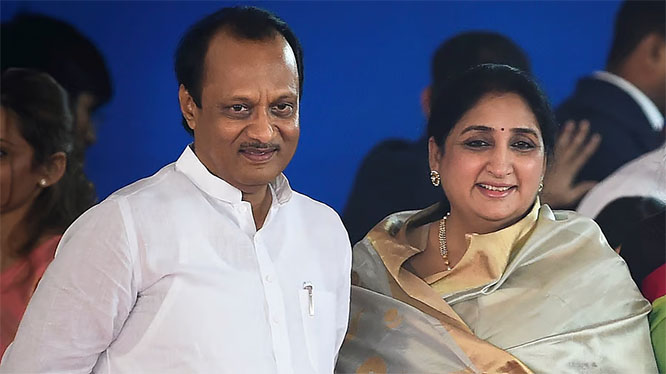
Mumbai: The sudden death of Maharashtra Deputy Chief Minister Ajit Pawar in a plane crash in his hometown of Baramati has plunged the state into political uncertainty, raising a pressing question for both the Nationalist Congress Party (NCP) and its rival faction, the Nationalist Congress Party (Sharadchandra Pawar): what next?

For the two factions that emerged after the dramatic split of June–July 2023, the moment marks their gravest challenge yet. Many believe the answer now rests with party founder Sharad Pawar.

Sharad Pawar, who founded the NCP in 1999 after parting ways with the Congress over Sonia Gandhi’s foreign origin, has already indicated his intention to step away from electoral politics once his Rajya Sabha term ends in April 2026.

Speaking at a public event in Baramati ahead of his 85th birthday on December 12, 2025, Pawar said he would not contest any further elections. “I have contested 14 elections. The younger generation needs to be given an opportunity,” he said, adding that he would decide later whether to seek another Rajya Sabha term.

Often described as the Bhishma Pitamah of Indian politics, Pawar also spoke of his gradual withdrawal from active leadership. “For the first 30 years, I handled everything. For the next 25–30 years, Ajit Dada handled responsibilities. Now, arrangements must be made for new leadership,” he said.

Ajit Pawar’s death has dramatically altered that transition, especially as he was working towards reunifying the two NCP factions.

“After the developments of June–July 2023 and the 2024 Lok Sabha and Vidhan Sabha elections, there were deep changes within the family and the party. In the last six months, serious efforts were made to reunite. Even workers from both sides wanted unity. This is a massive blow,” a Pawar family insider told DH over phone from Baramati.

Electoral outcomes over the past year reflected the split. In the 2024 Lok Sabha elections, NCP (SP) recorded the best strike rate in Maharashtra, winning eight of the 10 seats it contested. The NCP, by contrast, won just one seat out of four.

However, the trend reversed in the subsequent Vidhan Sabha elections, where the NCP emerged stronger, securing 41 of the 288 seats, while NCP (SP) managed only 10.

Within NCP (SP), Sharad Pawar’s daughter Supriya Sule serves as Working President, followed by leaders such as Rohit Pawar, state president Shashikant Shinde and former state chief Jayant Patil.

In the NCP, Praful Patel is the Working President and Raigad MP Sunil Tatkare heads the state unit. Ajit Pawar’s wife, Sunetra Pawar, is a Rajya Sabha MP, while their sons Parth and Jay are not actively involved in day-to-day politics. Parth Pawar briefly entered electoral politics in 2019 but lost the Lok Sabha election from Maval. Jay Pawar’s political debut was under consideration.

With Ajit Pawar gone, speculation has intensified that a member of the family may be asked to assume a larger role. For now, Sunetra Pawar is expected to play a key coordinating role in party affairs, alongside Patel and Tatkare.

The NCP continues to have several heavyweight leaders, including Chhagan Bhujbal, Hasan Mushrif, Dattatreya Bharne, Manikrao Kokate and Dhananjay Munde.

Ajit Pawar had already begun steps towards reconciliation between the two factions. While they contested the Pune and Pimpri-Chinchwad municipal elections separately, they later decided to fight the zilla parishad elections together under the ‘clock’ symbol—seen as the first formal step towards reunification.

Nagpur meet and party roadmap

Both NCP factions claim adherence to the ideology of ‘Shiv–Shahu–Phule–Ambedkar’. At the Rashtravadi Chintan Shivir held in Nagpur on September 19, 2025, the NCP reaffirmed its commitment to sarva dharma sambhav and discussed strengthening ties with the BJP “for the welfare and development of Maharashtra”.

In recent days, reports had suggested Ajit Pawar might return to the Maha Vikas Aghadi following the party’s poor performance in Pune municipal elections, but these claims were denied.

Big question for Maha Yuti

Ajit Pawar’s death also presents an immediate challenge for the Devendra Fadnavis-led Maha Yuti government. Pawar held crucial portfolios, including Finance, Planning and Excise. With the Budget Session approaching, appointing a new Finance Minister has become urgent.

Beyond numbers and portfolios, Maha Yuti has lost a swift decision-maker known for his administrative grip and political finesse—leaving a vacuum that will not be easy to fill.

Comments

Add new comment

  • Coastaldigest.com reserves the right to delete or block any comments.
  • Coastaldigset.com is not responsible for its readers’ comments.
  • Comments that are abusive, incendiary or irrelevant are strictly prohibited.
  • Please use a genuine email ID and provide your name to avoid reject.
News Network
January 23,2026

Mangaluru: The Karnataka Government Polytechnic (KPT), Mangaluru, has achieved autonomous status from the All India Council for Technical Education (AICTE), becoming the first government polytechnic in the country to receive such recognition in its 78-year history. The status was granted by AICTE, New Delhi, and subsequently approved by the Karnataka Board of Technical Education in October last year.

Officials said the autonomy was conferred a few months ago. Until recently, AICTE extended autonomous status only to engineering colleges, excluding diploma institutions. However, with a renewed national focus on skill development, several government polytechnics across India have now been granted autonomy.

KPT, the second-largest polytechnic in Karnataka, was established in 1946 with four branches and has since expanded to offer eight diploma programmes, including computer science and polymer technology. The institution is spread across a 19-acre campus.

Ravindra M Keni, the first dean of the institution, told The Times of India that AICTE had proposed autonomous status for polytechnic institutions that are over 25 years old. “Many colleges applied. In the first round, 100 institutions were shortlisted, which was further narrowed down to 15 in the second round. We have already completed one semester after becoming an autonomous institution,” he said. He added that nearly 500 students are admitted annually across eight three-year diploma courses.

Explaining the factors that helped KPT secure autonomy, Keni said the institution has consistently recorded 100 per cent admissions and placements for its graduates. He also noted its strong performance in sports, with the college emerging champions for 12 consecutive years, along with active student participation in NCC and NSS activities.

Autonomous status allows KPT to design industry-oriented curricula, conduct examinations, prepare question papers, and manage academic documentation independently. The institution can also directly collaborate with industries and receive priority funding from AICTE or the Ministry of Education. While academic autonomy has been granted, financial control will continue to rest with the state government.

“There will be separate committees for examinations, question paper setting, boards of studies, and boards of examiners. The institution will now have the freedom to conduct admissions without government notifications and issue its own marks cards,” Keni said, adding that new academic initiatives would be planned after a year of functioning under the autonomous framework.

Comments

Add new comment

  • Coastaldigest.com reserves the right to delete or block any comments.
  • Coastaldigset.com is not responsible for its readers’ comments.
  • Comments that are abusive, incendiary or irrelevant are strictly prohibited.
  • Please use a genuine email ID and provide your name to avoid reject.