



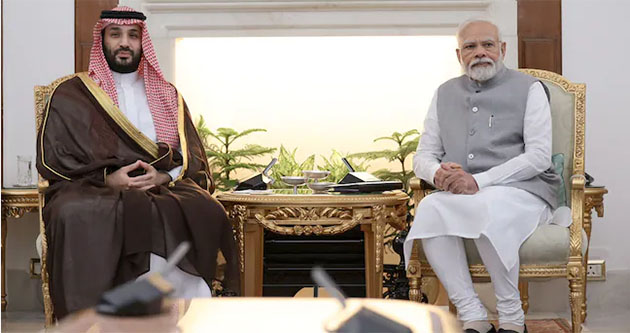
Saud Arabia is India’s closest partner; this bond is crucial for global stability: PM Modi

News Network
September 11, 2023

indoarab.jpg

New Delhi, Sept 11: Trade, economy, defence, and cultural cooperation were the main topics of discussion between Prime Minister Narendra Modi and Saudi Arabia's Crown Prince Mohammed bin Salman Al Saud during the latter's State visit today.

During the high-profile meeting today at Delhi's Hyderabad House, the two leaders co-chaired the first leaders' meeting of the Strategic Partnership Council, a bilateral agreement between India and Saudi Arabia signed by the two nations in Riyadh in 2019.

"For India, Saudi Arabia counts as one of its closest and biggest strategic partners," PM Modi said. "India-Saudi Arabia partnership crucial for stability, welfare of region and world."

"We are adding a new dimension to our ties in tune with changing times. We have identified several initiatives to take our close partnership to the next level," he added.

The leaders assessed the progress of the two ministerial committees of the Strategic Partnership Council, namely the Political, Security, Social and Cultural Cooperation Committee and the Economy and Investments Cooperation Committee. They also discussed all aspects of bilateral relations, including political, security, defence, trade, economy, culture, and people-to-people ties. Additionally, they discussed regional and international issues of mutual interest.

Prince Salman's 2nd State Visit

The Saudi Arabian Crown Prince was accorded a ceremonial reception at Rashtrapati Bhavan at 10 am, ahead of his meeting with PM Modi at 11 am.

"I am very glad to be here in India. I want to congratulate India for the G20 Summit," the Crown Prince said. 

After concluding his engagements with PM Modi and other dignitaries, Prince Salman will meet President Droupadi Murmu at Rashtrapati Bhavan at 6:30 PM before departing from New Delhi at 8:30 PM.

This is Prince Salman's second State visit to India.

During the two-day G20 Summit in New Delhi, Saudi Arabia was one of the signatories to the ambitious India-Middle East-Europe Economic Corridor.

The initiative, seen by many as a potential alternative to China's Belt and Road Initiative, was jointly announced by PM Modi and the leaders of the United States, Saudi Arabia, the United Arab Emirates, France, Germany, Italy, and the European Union on the sidelines of the G20 summit.

"Yesterday, we took a decision to start a historic economic corridor between India, West Asia and Europe. This corridor will not only connect two countries but also help in providing economic growth, and digital connectivity between Asia, West Asia and Europe," PM Modi said. 

Once completed, the project can serve as a modern-day Silk Road that functioned as the central trade route facilitating economic partnerships, political alliances, and cultural integration across continents. 

Prime Minister Modi also cited Saudi Arabia's 'Vision 2030' initiative, an all-encompassing nationwide reform programme launched in 2016 for the economic, cultural and architectural development of the Middle Eastern country.

"Under your leadership and Vision 2030, Saudi Arabia has seen tremendous economic growth and I congratulate you for that," PM Modi said. 

India-Saudi Arabia Ties

India and Saudi Arabia have a long history of cordial and cooperative relations, with extensive people-to-people ties. According to government data, bilateral trade between the two countries reached an all-time high of USD 52.75 billion in fiscal year 2022-23.

PM Modi during his 2019 visit to Riyadh had said that India and Saudi Arabia have a Joint Committee on Defence Cooperation (JCDC) that meets regularly and that the two countries have identified a number of areas of mutual interest and cooperation in the field of defence and security.

The two economic powerhouses are also major trading partners. India is Saudi Arabia's second-largest trading partner, while Saudi Arabia is India's fourth-largest. The two countries have a strong partnership in the energy sector, with India importing a significant amount of oil from Saudi Arabia.

Comments

Add new comment

  • Coastaldigest.com reserves the right to delete or block any comments.
  • Coastaldigset.com is not responsible for its readers’ comments.
  • Comments that are abusive, incendiary or irrelevant are strictly prohibited.
  • Please use a genuine email ID and provide your name to avoid reject.
News Network
February 1,2026

Bengaluru, Feb 1: For travelers landing at Kempegowda International Airport (KIA), the sleek, wood-paneled curves of Terminal 2 promise a world-class welcome. But the famed “Garden City” charm quickly withers at the curb. As India’s aviation sector swells to record numbers—handling over 43 million passengers in Bengaluru alone this past year—the “last mile” has turned into a marathon of frustration.

The Bengaluru Logjam: Rules vs Reality

While the city awaits the 2027 completion of the Namma Metro Blue Line, the interim has been chaotic. Recent “decongestion” rules at Terminal 1 have pushed app-based cab pickups to distant parking zones, forcing weary passengers into a 20-minute walk with luggage.

“I landed after ten months away and felt like a stranger in my own city,” says Ruchitha Jain, a Koramangala resident. “My driver couldn’t find me, staff couldn’t guide me, and the so-called ‘Premium’ lane is just a fancy tax on convenience.”

•    The Cost of Distance: A 40-km cab ride can now easily cross ₹1,500, driven by demand pricing and airport surcharges.

•    The Bus Gap: While Vayu Vajra remains a lifeline, its ₹300–₹400 fare is often cited as the most expensive airport bus service in the country.

A National Pattern of Disconnect

The struggle is not unique to Karnataka. From Chennai’s coast to Hyderabad’s plateau, India’s airports tell a familiar story: brilliant runways, broken exits.

City:    Primary Issue   |    Recent Development

Bengaluru:    Cab pickup restrictions & distance  |    App-based taxis shifted to far parking zones; long walks and fare spikes reported

Chennai:    Multi-Level Parking (MLCP) hike  |    Passengers report 40-minute walks to reach cab pickup points

Hyderabad:    “Taxi mafia” & touting  |    Over 440 touting cases reported; security presence intensified

Mumbai:    Fare scams  |     Tourists charged ₹18,000 for just 400 metres, triggering police action

In Hyderabad, travelers continue to battle entrenched local groups that intimidate Uber and Ola drivers, pushing passengers toward overpriced private taxis. Chennai flyers, meanwhile, complain that reaching the designated pickup zones now takes longer than short-haul flights from cities like Coimbatore.

The ‘Budget Day’ Hope

As Finance Minister Nirmala Sitharaman presents the Union Budget 2026 today, the aviation sector is watching closely. With the government’s renewed emphasis on multimodal integration, there is cautious hope for funding toward seamless airport-metro-bus hubs.

The vision is clear: a future where planes, trains, and metros speak the same language. Until then, passengers at KIA—and airports across India—will continue to discover that the hardest part of flying isn’t the thousands of kilometres in the air, but the last few on the ground.

Comments

Add new comment

  • Coastaldigest.com reserves the right to delete or block any comments.
  • Coastaldigset.com is not responsible for its readers’ comments.
  • Comments that are abusive, incendiary or irrelevant are strictly prohibited.
  • Please use a genuine email ID and provide your name to avoid reject.
News Network
February 4,2026

shettigar.jpg

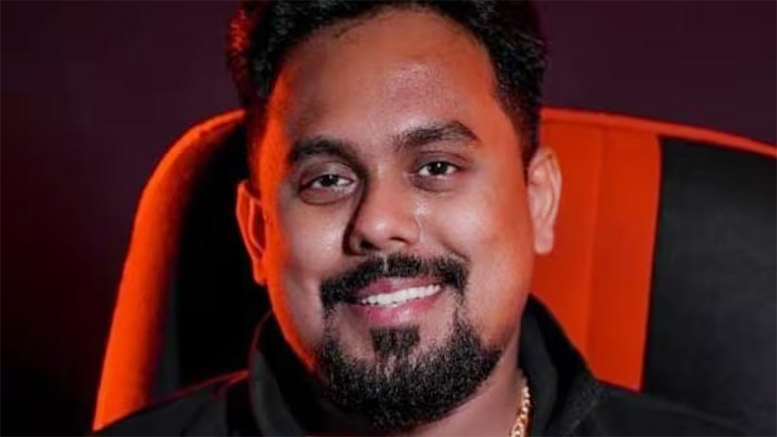
An Indian resident who won the Dh20 million (approximately Rs 50 crore) jackpot in Abu Dhabi's Big Ticket draw has told of his joy at sharing his life-changing fortune with a friend.

Shanthanu Shettigar, a shop manager in Muscat, regularly buys tickets for the monthly grand prize draw with one of his closest friends – and the pair won on February 3.

Mr Shettigar, 33, who is from Udyavar in Udupi district of the southern state of Karnataka and has lived in the Omani capital for eight years, said he was left speechless after learning of his success.

“When I first moved to Muscat, many of my colleagues were purchasing Big Ticket, which encouraged me to give it a try,” he said.

“I started buying tickets on my own, and later began sharing tickets with a close friend. The ticket that brought me this win was one we purchased together.”

“Like most people, I receive a lot of spam calls, and I was fully absorbed in my work as well. I knew the live draw was taking place tonight, but I never imagined my name would be announced,” he said.

“When I realised it was real and that I had won, I was honestly speechless. It still hasn’t fully sunk in, but I’m extremely happy.”

Mr Shettigar is not sure how he will spend his share of the money, but encouraged others to take part.

“This win was completely unexpected, so I want to take some time to think things through before deciding what to do next,” he said.

“I would definitely encourage others to participate with Big Ticket, whether with family or friends – you never know when your moment might come.”

The Big Ticket was established in 1992 with an initial first prize of Dh1 million. It is one of the most popular monthly raffles in the UAE.

It has transformed the lives of many people across the Emirates and beyond.

Entry to the Big Ticket Millionaire is Dh500. Tickets can be bought online or at counters at Zayed International Airport and Al Ain Airport.

Comments

Add new comment

  • Coastaldigest.com reserves the right to delete or block any comments.
  • Coastaldigset.com is not responsible for its readers’ comments.
  • Comments that are abusive, incendiary or irrelevant are strictly prohibited.
  • Please use a genuine email ID and provide your name to avoid reject.
News Network
February 1,2026

Bengaluru, Feb 1: For travelers landing at Kempegowda International Airport (KIA), the sleek, wood-paneled curves of Terminal 2 promise a world-class welcome. But the famed “Garden City” charm quickly withers at the curb. As India’s aviation sector swells to record numbers—handling over 43 million passengers in Bengaluru alone this past year—the “last mile” has turned into a marathon of frustration.

The Bengaluru Logjam: Rules vs Reality

While the city awaits the 2027 completion of the Namma Metro Blue Line, the interim has been chaotic. Recent “decongestion” rules at Terminal 1 have pushed app-based cab pickups to distant parking zones, forcing weary passengers into a 20-minute walk with luggage.

“I landed after ten months away and felt like a stranger in my own city,” says Ruchitha Jain, a Koramangala resident. “My driver couldn’t find me, staff couldn’t guide me, and the so-called ‘Premium’ lane is just a fancy tax on convenience.”

•    The Cost of Distance: A 40-km cab ride can now easily cross ₹1,500, driven by demand pricing and airport surcharges.

•    The Bus Gap: While Vayu Vajra remains a lifeline, its ₹300–₹400 fare is often cited as the most expensive airport bus service in the country.

A National Pattern of Disconnect

The struggle is not unique to Karnataka. From Chennai’s coast to Hyderabad’s plateau, India’s airports tell a familiar story: brilliant runways, broken exits.

City:    Primary Issue   |    Recent Development

Bengaluru:    Cab pickup restrictions & distance  |    App-based taxis shifted to far parking zones; long walks and fare spikes reported

Chennai:    Multi-Level Parking (MLCP) hike  |    Passengers report 40-minute walks to reach cab pickup points

Hyderabad:    “Taxi mafia” & touting  |    Over 440 touting cases reported; security presence intensified

Mumbai:    Fare scams  |     Tourists charged ₹18,000 for just 400 metres, triggering police action

In Hyderabad, travelers continue to battle entrenched local groups that intimidate Uber and Ola drivers, pushing passengers toward overpriced private taxis. Chennai flyers, meanwhile, complain that reaching the designated pickup zones now takes longer than short-haul flights from cities like Coimbatore.

The ‘Budget Day’ Hope

As Finance Minister Nirmala Sitharaman presents the Union Budget 2026 today, the aviation sector is watching closely. With the government’s renewed emphasis on multimodal integration, there is cautious hope for funding toward seamless airport-metro-bus hubs.

The vision is clear: a future where planes, trains, and metros speak the same language. Until then, passengers at KIA—and airports across India—will continue to discover that the hardest part of flying isn’t the thousands of kilometres in the air, but the last few on the ground.

Comments

Add new comment

  • Coastaldigest.com reserves the right to delete or block any comments.
  • Coastaldigset.com is not responsible for its readers’ comments.
  • Comments that are abusive, incendiary or irrelevant are strictly prohibited.
  • Please use a genuine email ID and provide your name to avoid reject.