



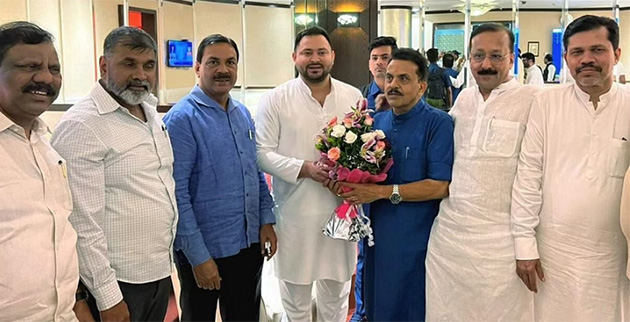
What's on the agenda of I.N.D.I.A bloc’s Mumbai meet

News Network
August 31, 2023

india.jpg

New Delhi, Aug 31: The third meeting of the opposition bloc I.N.D.I.A will begin here on Thursday to discuss its strategy to take on the Bharatiya Janata Party (BJP) in the Lok Sabha elections due next year and inclusion of new allies.

Along with talks on strategy and inclusion of new allies, unveiling of the I.N.D.I.A bloc logo and discussion on the common minimum programme (CMP) will be the highlight of the two-day deliberations.

As many as 63 representatives from 28 political parties will attend the meeting of the Indian National Developmental Inclusive Alliance (I.N.D.I.A) on Thursday and Friday at Grand Hyatt Hotel in Mumbai.

The third meeting of the opposition bloc is hosted by the Maha Vikas Aghadi (MVA), the three-party alliance of the Congress, the Shiv Sena (UBT) and the NCP led by Sharad Pawar.

The alliance leaders are getting together for the third round of the brainstorming session here, after Patna and Bengaluru, to chalk out their common campaign strategy to take on the NDA in the 2024 Lok Sabha elections.

The alliance would announce a coordination committee, which could be of 11 members from principal opposition parties.

The opposition alliance is also likely to hold discussions on whether to have a convenor or not and whether there will be some sub-groups to handle seat sharing, agitational joint programmes and communication strategy.

West Bengal Chief Minister Mamata Banerjee, former J&K CM Farooq Abdullah, former Bihar CM Lalu Prasad, Bihar Deputy Chief Minister Tejashwi Yadav and CPI general secretary D Raja have already arrived in Mumbai.

Congress president Mallikarjun Kharge, senior party leaders Sonia Gandhi and Rahul Gandhi, Bihar CM Nitish Kumar, Jharkhand CM Hemant Soren, Tamil Nadu Chief Minister M K Stalin, Delhi Chief Minister Arvind Kejriwal, Punjab CM Bhagwant Mann and Samajwadi Party chief Akhilesh Yadav will arrive on Thursday.

An informal meeting of all the leaders will take place followed by a dinner hosted by Shiv Sena (UBT) chief Uddhav Thackeray, where the visiting leaders will get to savour the traditional Maharashtrian food, including 'Puran Poli', and also a mix of North and South Indian dishes.

Senior Congress leader and former Maharashtra chief minister Ashok Chavan, who is heading the organising committee of the I.N.D.I.A alliance meet, on Wednesday said the meeting in Mumbai was significant as Maharashtra has shown the country a way forward in the independence movement, industrial and social revolutions.

He said the I.N.D.I.A alliance has developmental agenda and has taken on the challenge to stop fascist forces.

The opposition I.N.D.I.A bloc has exuded confidence that it would provide a formidable alternative to bring political change in the country and asserted that it has several prime ministerial faces against BJP's only one.

The opposition alliance has also expanded its ambit to 28 parties by including two regional outfits - the Peasants and Workers Party of India (PWP), a Marxist political party in Maharashtra, and another regional outfit.

Mamata Banerjee on her arrival in Mumbai tied Rakhi on Thackeray and Amitabh Bachchan on Wednesday.

To a query on who will be the I.N.D.I.A alliance PM candidate, Mamata Banerjee said, 'India will be our PM face. Our primary concern is to save the country,' she said.

Addressing a press conference here, NCP leader Sharad Pawar on Wednesday said he has confidence that the opposition alliance will provide a formidable alternative to bring about a political change in the country.

He said there has been no discussion on seat sharing within the I.N.D.I.A alliance.

Former chief minister and Shiv Sena (UBT) president Uddhav Thackeray on Wednesday said the alliance of opposition parties belonging to different ideologies has the common objective of protecting democracy and 'Bharat Mata'.

On the I.N.D.I.A alliance PM face, Thackeray said, 'We have a lot of choices, the question is what choice the BJP has.'

Comments

Add new comment

  • Coastaldigest.com reserves the right to delete or block any comments.
  • Coastaldigset.com is not responsible for its readers’ comments.
  • Comments that are abusive, incendiary or irrelevant are strictly prohibited.
  • Please use a genuine email ID and provide your name to avoid reject.
News Network
February 4,2026

gaming.jpg

Ghaziabad: In a tragic incident, three sisters aged 12, 14 and 16 died after jumping from the ninth floor of their apartment in Uttar Pradesh’s Ghaziabad in the early hours of Wednesday. The girls allegedly took the extreme step after becoming deeply obsessed with an online Korean task-based game.

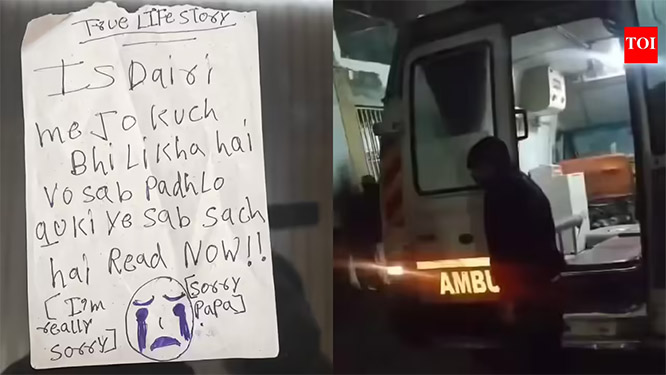
The incident occurred around 2.15 am at a high-rise apartment complex in Bharat City. Before jumping, the sisters — Pakhi (12), Prachi (14) and Vishika (16) — left behind a handwritten note that read, “Sorry, Papa.”

According to police, the girls went to the balcony, bolted the door from inside and jumped one after another. Their screams and the sound alerted their parents, neighbours and security guards. By the time the parents broke open the balcony door, all three had died.

“When we reached the spot, we confirmed that three minor girls, daughters of Chetan Kumar, had died after jumping from the building,” said Assistant Commissioner of Police Atul Kumar Singh.

Visuals from the scene on Wednesday morning showed the bodies lying on the ground, their mother wailing in grief, and stunned neighbours gathering at the complex.

Police said the sisters were heavily influenced by Korean culture and were addicted to an online “Korean love game”, though no specific game has been identified so far. Investigators are examining an eight-page suicide note written in a pocket diary, detailing the girls’ mobile and gaming activities.

“Read everything written in this diary because all of it is true. I’m really sorry. Sorry, Papa,” the note said, accompanied by a hand-drawn crying emoji.

Their father, Chetan Kumar, told police that the girls had even adopted Korean names and had gradually withdrawn from school and daily activities. “They used to say, ‘Korea is our life, Korea is our biggest love. We cannot give it up,’” he said, breaking down.

Police said the parents had recently restricted the girls’ mobile phone usage, which may have triggered distress. “The investigation has not revealed the name of any particular game, but it is evident that the girls were deeply influenced by Korean culture, as mentioned in the suicide note,” said senior police officer Nimish Patel.

The sisters reportedly did everything together, including eating and bathing. Their gaming addiction is believed to have begun during the COVID-19 pandemic, after which they became irregular at school and eventually stopped attending altogether.

Police also revealed that Chetan Kumar is married to two sisters and lives with both wives and their children, all daughters. Two of the deceased girls were daughters of one wife, while the third was their half-sister.

Further investigation is underway.

Comments

Add new comment

  • Coastaldigest.com reserves the right to delete or block any comments.
  • Coastaldigset.com is not responsible for its readers’ comments.
  • Comments that are abusive, incendiary or irrelevant are strictly prohibited.
  • Please use a genuine email ID and provide your name to avoid reject.
News Network
February 1,2026

Bengaluru, Feb 1: For travelers landing at Kempegowda International Airport (KIA), the sleek, wood-paneled curves of Terminal 2 promise a world-class welcome. But the famed “Garden City” charm quickly withers at the curb. As India’s aviation sector swells to record numbers—handling over 43 million passengers in Bengaluru alone this past year—the “last mile” has turned into a marathon of frustration.

The Bengaluru Logjam: Rules vs Reality

While the city awaits the 2027 completion of the Namma Metro Blue Line, the interim has been chaotic. Recent “decongestion” rules at Terminal 1 have pushed app-based cab pickups to distant parking zones, forcing weary passengers into a 20-minute walk with luggage.

“I landed after ten months away and felt like a stranger in my own city,” says Ruchitha Jain, a Koramangala resident. “My driver couldn’t find me, staff couldn’t guide me, and the so-called ‘Premium’ lane is just a fancy tax on convenience.”

•    The Cost of Distance: A 40-km cab ride can now easily cross ₹1,500, driven by demand pricing and airport surcharges.

•    The Bus Gap: While Vayu Vajra remains a lifeline, its ₹300–₹400 fare is often cited as the most expensive airport bus service in the country.

A National Pattern of Disconnect

The struggle is not unique to Karnataka. From Chennai’s coast to Hyderabad’s plateau, India’s airports tell a familiar story: brilliant runways, broken exits.

City:    Primary Issue   |    Recent Development

Bengaluru:    Cab pickup restrictions & distance  |    App-based taxis shifted to far parking zones; long walks and fare spikes reported

Chennai:    Multi-Level Parking (MLCP) hike  |    Passengers report 40-minute walks to reach cab pickup points

Hyderabad:    “Taxi mafia” & touting  |    Over 440 touting cases reported; security presence intensified

Mumbai:    Fare scams  |     Tourists charged ₹18,000 for just 400 metres, triggering police action

In Hyderabad, travelers continue to battle entrenched local groups that intimidate Uber and Ola drivers, pushing passengers toward overpriced private taxis. Chennai flyers, meanwhile, complain that reaching the designated pickup zones now takes longer than short-haul flights from cities like Coimbatore.

The ‘Budget Day’ Hope

As Finance Minister Nirmala Sitharaman presents the Union Budget 2026 today, the aviation sector is watching closely. With the government’s renewed emphasis on multimodal integration, there is cautious hope for funding toward seamless airport-metro-bus hubs.

The vision is clear: a future where planes, trains, and metros speak the same language. Until then, passengers at KIA—and airports across India—will continue to discover that the hardest part of flying isn’t the thousands of kilometres in the air, but the last few on the ground.

Comments

Add new comment

  • Coastaldigest.com reserves the right to delete or block any comments.
  • Coastaldigset.com is not responsible for its readers’ comments.
  • Comments that are abusive, incendiary or irrelevant are strictly prohibited.
  • Please use a genuine email ID and provide your name to avoid reject.
News Network
January 23,2026

Karnataka Governor Thaawarchand Gehlot read only three lines from the 122-paragraph address prepared by the Congress-led state government while addressing the joint session of the Legislature on Thursday, effectively bypassing large sections critical of the BJP-led Union government.

The omitted portions of the customary Governor’s address outlined what the state government described as a “suppressive situation in economic and policy matters” under India’s federal framework. The speech also sharply criticised the Centre’s move to replace the Mahatma Gandhi National Rural Employment Guarantee Act (MGNREGA) with the Viksit Bharat–Guarantee for Rozgar and Ajeevika Mission (Gramin) Act, commonly referred to as the VB-GRAM (G) Act.

Governor Gehlot had earlier conveyed his objection to several paragraphs that were explicitly critical of the Union government. On Thursday, he confined himself to the opening lines — “I extend a warm welcome to all of you to the joint session of the State legislature. I am extremely pleased to address this august House” — before jumping directly to the concluding sentence of the final paragraph.

He ended the address by reading the last line of paragraph 122: “Overall, my government is firmly committed to doubling the pace of the State’s economic, social and physical development. Jai Hind — Jai Karnataka.”

According to the prepared speech, the Karnataka government demanded the scrapping of the VB-GRAM (G) Act, describing it as “contractor-centric” and detrimental to rural livelihoods, and called for the full restoration of MGNREGA. The state government argued that the new law undermines decentralisation, weakens labour protections, and centralises decision-making in violation of constitutional norms.

Key points from the unread sections of the speech:

•    Karnataka facing a “suppressive” economic and policy environment within the federal system

•    Repeal of MGNREGA described as a blow to rural livelihoods

•    VB-GRAM (G) Act accused of protecting corporate and contractor interests

•    New law alleged to weaken decentralised governance

•    Decision-making said to be imposed by the Centre without consulting states

•    Rights of Adivasis, women, backward classes and agrarian communities curtailed

•    Labourers allegedly placed under contractor control

•    States facing mounting fiscal stress due to central policies

•    VB-GRAM (G) Act accused of enabling large-scale corruption

Comments

Add new comment

  • Coastaldigest.com reserves the right to delete or block any comments.
  • Coastaldigset.com is not responsible for its readers’ comments.
  • Comments that are abusive, incendiary or irrelevant are strictly prohibited.
  • Please use a genuine email ID and provide your name to avoid reject.