



Iran death toll rises as protests continue; hundreds arrested

Al Jazeera
January 2, 2018

Tehran, Jan 2: A number of Iranians have died  amid ongoing nationwide anti-government protests that began last week in various cities across Iran.

Nine Iranians were killed in Isfahan province alone during anti-government protests on Monday night.

State TV said on Tuesday that six people were killed in Isfahan's central town Qahderijan - during a raid on a police station - and one more in Khomeinishahr.

According to state media, the rioters were attempting to break into the station to obtain weapons.

An 11-year-old boy and a 20-year-old man were among those killed in Khomeinishahr.

In addition, Iran's semi-official Mehr news agency said a member of Basij militia and a police officer were killed in Najafabad, 350km south of the capital Tehran, on Monday.

According to reports, an Iranian Revolutionary Guard Corps (IRGC) soldier was shot by an assailant using a hunting rifle in Najafabad.

Al Jazeera could not independently verify whether the IRGC member was the same police officer who was reported as being shot.

Overall, at least 21 people have died in Iran during six days of protests, according to state media.

In the same period, at least 20 people have been killed and about 450 people n arrested, with the Tehran governor's deputy giving the following breakdown: 200 on Saturday; 150 on Sunday; and 100 on Monday.

The detention figures for other Iranian cities were not available.

Khamenei's comments

On Tuesday, Iran's top authority, Supreme Leader Ayatollah Ali Khamenei, accused "enemies" of the state of stirring unrest in the country.

He said that "enemies" of Iran have allied and used the various means they have available including "money, weapons, politics, and intelligence services" to stir unrest as nationwide anti-government rallies continue.

"The dignity, security, and progress of the Iranian nation is owed to the self-sacrifice of the martyrs. What prevents enemies from exerting their atrocities is the spirit of courage, sacrifice, and faith within the nation," he said in a statement posted on his official website.

"I have something to say on these events, and I will speak to the dear people when the time is right.

"The Iranian nation will forever owe the dear martyrs, who left behind their homes and families, to stand against the wicked enemies."

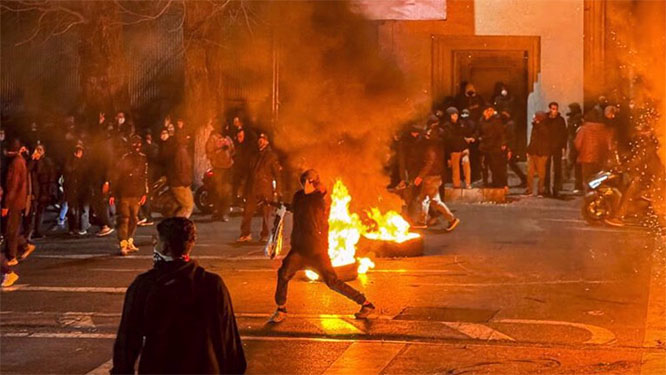
Despite threats by the IRGC to put down the demonstrations, protesters have continued taking to the streets in various parts of Iran, in what has been described as the biggest show of dissent in the country since huge rallies took place in 2009.

The rallies began on December 28 in the second-largest city of Mashhad, prompted by anger over rising cost of living and the state of the economy.

"We cannot predict a time when the protests will come to an end," said Sadegh Zibakalam, an author and academic.

"But the protests will shake the people in power who must give priority to the people's demands and needs."

On Sunday, President Hassan Rouhani said Iranians have the right to protest but not violently.

"People are free to express their criticism and to protest," he said in televised remarks, his first since the rallies began.

"However, we need to pay attention to the manner of that criticism and protest. It should be in such a way that it will lead to the improvement of the people and state," he added.

"People have the right to protest, but those demonstrations should not make the public feel concerned about their lives and security."

Why are there protests taking place in Iran?

In May 2017, Rouhani, who belongs to the reformist bloc of Iran's political spectrum, decisively won re-election after garnering 57 percent of the vote in the country's presidential election.

That poll was the first since Rouhani negotiated a historic deal with world powers in 2015 to curb Iran's nuclear programme in exchange for sanctions relief.

Many in Iran hoped that the deal, by lifting many international sanctions, would ease the country's financial struggles. Yet, the benefits do not seem to have trickled down.

Ali Vaez, the Iran project director at the International Crisis Group who worked with all sides during the negotiations for the nuclear deal, said the fact that the nuclear deal did not quite deliver the results people expected played a key part in what is happening currently in Iran.

"The government inflated public expectations a lot," Vaez told Al Jazeera, noting that factors such as falling oil prices and doubts over the US commitment to the deal were also adversely affecting the Iranian economy.

"The reality is, however, that President Rouhani failed to pave the ground for the potential the nuclear deal created, and that has led to a lot of frustration in Iran," he said.

"President Rouhani over-promised and under-delivered."

Mohammad Ali Shabani, an Iranian political analyst and scholar, agreed.

"The issue is elevated expectations, that's where the danger comes in," he told Al Jazeera.

"People have been expecting better lives, partly as a result of Rouhani's promises in connection with the nuclear deal.

"It's not a matter of absolute poverty driving people into the streets.

"It's mostly about people thinking that 'We need more than this, we were actually promised more than what's happening, and we don't have the jobs that we were anticipating'."

Comments

Add new comment

  • Coastaldigest.com reserves the right to delete or block any comments.
  • Coastaldigset.com is not responsible for its readers’ comments.
  • Comments that are abusive, incendiary or irrelevant are strictly prohibited.
  • Please use a genuine email ID and provide your name to avoid reject.
News Network
February 1,2026

Bengaluru: The Karnataka High Court has refused to quash an investigation against a WhatsApp group administrator accused of allowing the circulation of obscene and offensive images depicting Hindutva politicians and idols in 2021.

Justice M Nagaprasanna observed that, prima facie, the ingredients of the offence under Section 295A of the Indian Penal Code were made out. “The offence under Section 295A of the IPC is met to every word of its ingredient, albeit prima facie,” the judge said.

The petitioner, Sirajuddin, a resident of Belthangady taluk in Dakshina Kannada district, had challenged the FIR registered against him at the CEN (Cyber, Economics and Narcotics) police station, Mangaluru, for offences under Section 295A of the IPC and Section 67 of the Information Technology Act. Section 295A relates to punishment for deliberate and malicious acts intended to outrage the religious feelings of any class of citizens.

According to the complaint filed by K Jayaraj Salian, also a resident of Belthangady taluk, he received a WhatsApp group link from an unknown source and was added to the group after accessing it. The group reportedly had six administrators and around 250 participants, where obscene and offensive images depicting Hindu deities and certain political figures were allegedly circulated repeatedly.

Sirajuddin was arrested in connection with the case and later released on bail on February 16, 2021. He argued before the court that he was being selectively targeted, while other administrators—including the creator of the group—were neither arrested nor investigated. He also contended that the Magistrate could not have taken cognisance of the offence under Section 295A without prior sanction under Section 196(1) of the CrPC.

Rejecting the argument, Justice Nagaprasanna held that prior sanction is required only at the stage of taking cognisance, and not at the stage of registration of the crime or during investigation.

The judge noted that the State had produced the entire investigation material before the court. “A perusal of the material reveals depictions of Hindu deities in an extraordinarily obscene, demeaning and profane manner. The content is such that its reproduction in a judicial order would itself be inappropriate,” the court said, adding that the material, on its face, had the tendency to outrage religious feelings and disturb communal harmony.

Observing that the case was still at the investigation stage, the court said it could not interdict the probe at this juncture. However, it expressed concern that the investigating officer appeared to have not proceeded uniformly against all administrators. The court clarified that if the investigation revealed the active involvement of any member in permitting the circulation of such content, they must also be proceeded against.

“At this investigative stage, any further observation by this Court would be unnecessary,” the order concluded.

Comments

Add new comment

  • Coastaldigest.com reserves the right to delete or block any comments.
  • Coastaldigset.com is not responsible for its readers’ comments.
  • Comments that are abusive, incendiary or irrelevant are strictly prohibited.
  • Please use a genuine email ID and provide your name to avoid reject.
News Network
February 3,2026

Bengaluru: Following reports of fresh Nipah virus (NiV) cases in West Bengal and heightened vigilance across parts of Southeast Asia, the Karnataka Health Department has placed the state on high alert and activated emergency preparedness protocols.

Health officials said enhanced surveillance measures have been initiated after two healthcare workers in Barasat, West Bengal, tested positive for the virus earlier this month. While no cases have been reported in Karnataka so far, authorities said the state’s past exposure to Nipah outbreaks and high inter-state mobility warranted preventive action.

Officials have directed district health teams to intensify monitoring, particularly at hospitals and points of entry, and to ensure early detection and isolation of suspected cases.

High Mortality Virus with Multiple Transmission Routes

Nipah virus is a zoonotic disease that can spread from animals to humans and has a reported fatality rate ranging between 60 and 75 per cent. Fruit bats, also known as flying foxes, are the natural reservoirs of the virus and can transmit it by contaminating food sources with saliva or urine.

Known modes of transmission include:

•    Contaminated food: Consumption of fruits partially eaten by bats or raw date-palm sap
•    Animal contact: Exposure to infected pigs or other animals
•    Human-to-human transmission: Close contact with body fluids of infected persons, particularly in healthcare settings

Symptoms and Disease Progression

The incubation period typically ranges from 4 to 14 days, though delayed onset has also been reported. Early symptoms often resemble common viral infections, making prompt clinical suspicion critical.

•    Initial symptoms: Fever, headache, body aches, fatigue, sore throat
•    Progressive symptoms: Drowsiness, disorientation, altered mental state
•    Severe stage: Seizures, neck stiffness and acute encephalitis, which can rapidly progress to coma

Public Health Advisory

The Health Department has issued precautionary guidelines urging the public to adopt risk-avoidance practices to prevent any local spillover.

Do’s
•    Wash fruits thoroughly before consumption
•    Drink boiled and cooled water
•    Use protective equipment while handling livestock
•    Maintain strict hand hygiene

Don’ts
•    Avoid fruits found on the ground or showing bite marks
•    Do not consume beverages made from raw tree sap, including toddy
•    Avoid areas with dense bat populations
•    Do not handle sick or dead animals

Preparedness Measures

Officials confirmed that isolation wards are being readied in major government hospitals and that medical staff are being sensitised to identify early warning signs.

“There is no cause for panic, but there is a need for heightened vigilance,” a senior health official said, adding that there is currently no approved vaccine or specific antiviral treatment for Nipah, and care remains largely supportive.

Comments

Add new comment

  • Coastaldigest.com reserves the right to delete or block any comments.
  • Coastaldigset.com is not responsible for its readers’ comments.
  • Comments that are abusive, incendiary or irrelevant are strictly prohibited.
  • Please use a genuine email ID and provide your name to avoid reject.
News Network
January 20,2026

iran.jpg

Iranian security and intelligence forces have captured more than 470 individuals in three provinces, identified as key figures behind the recent wave of violent unrest and terrorist activities linked to foreign-backed networks.

The Intelligence Ministry's provincial office in Khorasan Razavi announced on Monday the arrest of 192 armed terrorists, identified as the main agents behind recent riots in the region. 

According to an official statement, the detainees were involved in the killing of several security personnel and civilians, setting fire to mosques, public service facilities, and buses, as well as attacks on military and law enforcement centers.

The seized items from the group include several bulletproof vests, Kalashnikov rifles, hunting weapons, Winchester rifles, and various cold weapons such as daggers, swords, brass knuckles, tactical knives, crossbows, and chains.

Evidence indicates that some of the individuals were tied to hostile movements and terrorist organizations, with links overseas. Others were identified as members of violent criminal gangs, actively taking part in the unrest alongside their associates.

Simultaneously, in the western province of Lorestan, the IRGC announced the arrest of 134 individuals as the main leaders and influential field agents of a US-Israeli terrorist network.

The IRGC statement stated that these individuals formed terrorist cells during the recent unrest, committing "Daesh-like" acts.

They wounded security forces with firearms and cold weapons, and burned and destroyed public and private properties, including mosques, shops, banks, and private and public vehicles.

In the northwestern province of Zanjan, the police reported detaining 150 people identified as principal leaders and agents behind recent riots.

Authorities noted that these individuals were responsible for destroying public and private property and intentionally setting fire to vehicles in the province's squares.

Their crimes include shedding the blood of innocent people, destroying public and private property, attempting to enter military sites, disrupting public order, and spreading terror among citizens.

A variety of cold weapons were reportedly seized from the detainees.

What began late last month as peaceful protests over economic hardship across Iran turned violent after public statements by US and Israeli regime figures encouraged vandalism and disorder.

During the unrest, foreign-backed mercenaries rampaged through cities, killing security forces and civilians and damaging public property.

Comments

Add new comment

  • Coastaldigest.com reserves the right to delete or block any comments.
  • Coastaldigset.com is not responsible for its readers’ comments.
  • Comments that are abusive, incendiary or irrelevant are strictly prohibited.
  • Please use a genuine email ID and provide your name to avoid reject.