



Israel adopts ‘racist’ Jewish nation-state law

Agencies
July 20, 2018

Jerusalem, Jul 20: Israel's parliament on Thursday adopted a law defining the country as the nation state of the Jewish people, provoking fears it could lead to blatant discrimination against Arab citizens.

Arab lawmakers and Palestinians called the law "racist" and said it legalised "apartheid" following a tumultuous debate in parliament.

Others said it neglects to specify equality and Israel's democratic character, implying that the country's Jewish nature comes first.

The legislation, adopted by 62 votes to 55, makes Hebrew the country's national language and defines the establishment of Jewish communities as being in the national interest.

Arabic, previously considered an official language, was granted only special status.

The law, passed in the early hours of Thursday, speaks of Israel as the historic homeland of the Jews and says they have a "unique" right to self-determination there, according to copies of the final text quoted by Israeli media.

However, a deeply controversial clause that had been seen as more specifically legalising the establishment of Jewish-only communities was changed after it drew criticism, including from Israeli President Reuven Rivlin.

The legislation becomes part of the country's basic laws, which serve as a de facto constitution.

"It is our state, the Jewish state, but in recent years some have tried to question that as well as the principles of our existence and our rights," Israeli Prime Minister Benjamin Netanyahu said after the vote on the legislation, backed by his right-wing government.

He called its approval a "decisive moment" in Israeli history.

- 'Death of democracy' -

A range of opposition politicians denounced the vote. The head of the mainly Arab Joint List alliance Ayman Odeh called it "the death of our democracy".

Arab parliament members who called the legislation "racist" ripped up copies of the bill in the chamber of the Knesset, Israel's parliament, after it was passed.

"This is a law that encourages not only discrimination, but racism as well," lawmaker Yousef Jabareen said.

Arab citizens account for some 17.5 percent of Israel's more than eight million population. They have long complained of discrimination.

Saeb Erekat, secretary-general of the Palestine Liberation Organisation, called the legislation a "dangerous and racist law" that "officially legalises apartheid and legally defines Israel as an apartheid system".

The sponsor of the law, Avi Dichter from Netanyahu's Likud party, has said it aims to defend Israel's "status as a Jewish and democratic state."

But others pointed out that references to "Jewish and democratic" in earlier versions of the law had been removed and that the law lacked references to equality as specified in the country's 1948 declaration of independence.

Shuki Friedman of the respected Israel Democracy Institute think tank said much of the law is symbolic, but it would force the courts to consider the country's Jewish nature and lead to a more "narrow interpretation of Arabs' rights".

By emphasising Israel's Jewish nature, it is "reducing, not directly but indirectly, its democratic nature," Friedman told AFP.

Various versions of the legislation have been debated for years.

Netanyahu's government, seen as the most right-wing in the country's history, had pushed for the law's approval before the parliament's summer session ends.

The legislation passed after the changing of a clause that would have allowed the state to "authorise a community composed of people having the same faith and nationality to maintain the exclusive character of that community".

Rivlin, whose role as president is mainly symbolic, had made a rare intervention in politics earlier this month to raise alarm over the clause.

The legislation "could harm the Jewish people worldwide and in Israel, and could even be used as a weapon by our enemies," he wrote in an open letter.

"Do we want to support the discrimination and exclusion of men and women based on their ethnic origin?"

Comments

Add new comment

  • Coastaldigest.com reserves the right to delete or block any comments.
  • Coastaldigset.com is not responsible for its readers’ comments.
  • Comments that are abusive, incendiary or irrelevant are strictly prohibited.
  • Please use a genuine email ID and provide your name to avoid reject.
News Network
February 1,2026

US President Donald Trump on Saturday claimed that the government of India led by Prime Minister Narendra Modi has made a deal to buy Venezuelan oil, as opposed to purchasing it from Iran.

"We've already made that deal, the concept of the deal," he told reporters on Air Force One.

Trump had imposed 25% tariffs on countries buying Venezuelan oil, including India, in March 2025. He had also hit India with tariffs for buying Russian oil, saying it was "funding" President Vladimir Putin's war against Ukraine.

Trump has said that the US has taken control of the oil-rich Venezuela after capturing former President Nicolas Maduro in January.

A fleet of 18 ships loaded with crude oil bound for refineries in Texas, Louisiana, and Mississippi in January, the most since December 2024, according to a report by the news agency Bloomberg.

Combined crude deliveries to the US will reach about 2,75,000 barrels a day, more than doubling volumes seen in December last year. Shipments to China, which averaged 4,00,000 barrels a day last year, fell to zero in January.

PM Modi, Venezuelan President Agree To Expand Ties

Prime Minister Narendra Modi and Venezuela's acting President Delcy Rodriguez spoke on Friday and agreed to take the bilateral relations to "new heights" in the years ahead.

It was the first phone call between the two leaders since the capture of Maduro and his wife by the US on January 3.

"Spoke with Acting President of Venezuela, Ms. Delcy Rodriguez. We agreed to further deepen and expand our bilateral partnership in all areas, with a shared vision of taking India-Venezuela relations to new heights in the years ahead," PM Modi said in a post on X.

A statement from Prime Minister Modi's office said the two leaders agreed to further expand and deepen the India-Venezuela partnership in all areas, including trade and investment, energy, digital technology, health, agriculture, and people-to-people ties.

They exchanged views on various regional and global issues of mutual interest and underscored the importance of their close cooperation for the Global South, the statement said.

Rodriguez also said that they discussed partnerships in the fields of agriculture, science and technology, mining, and tourism, as well as the pharmaceutical and automotive industries.

Comments

Add new comment

  • Coastaldigest.com reserves the right to delete or block any comments.
  • Coastaldigset.com is not responsible for its readers’ comments.
  • Comments that are abusive, incendiary or irrelevant are strictly prohibited.
  • Please use a genuine email ID and provide your name to avoid reject.
News Network
January 23,2026

modIKERALA.jpg

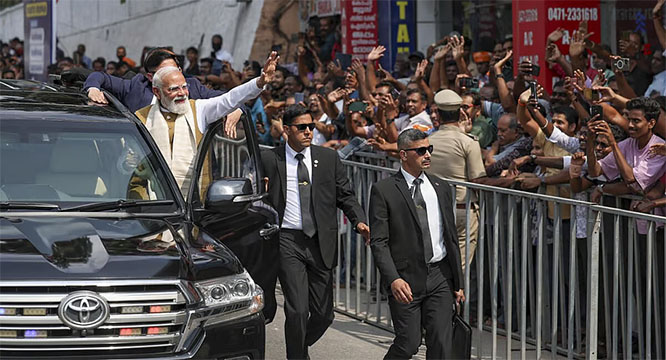
Prime Minister Narendra Modi, during his visit to Thiruvananthapuram on Friday, January 23, indicated that the Bharatiya Janata Party (BJP) is aiming to expand its political footprint in Kerala ahead of the Assembly elections scheduled in the coming months.

Speaking at a BJP-organised public meeting, Modi drew parallels between the party’s early electoral gains in Gujarat and its recent victory in the Thiruvananthapuram Municipal Corporation. The civic body win, which ended decades of Left control, was cited by the Prime Minister as a possible starting point for the party’s broader ambitions in the state.

Recalling BJP’s political trajectory in Gujarat, Modi said the party was largely insignificant before 1987 and received little media attention. He pointed out that the BJP’s first major breakthrough came with its victory in the Ahmedabad Municipal Corporation that year.

“Just as our journey in Gujarat began with one city, Kerala’s journey has also started with a single city,” Modi said, suggesting that the party’s municipal-level success could translate into wider electoral acceptance.

The Prime Minister alleged that successive governments led by the Left Democratic Front (LDF) and the United Democratic Front (UDF) had failed to adequately develop Thiruvananthapuram. He accused both fronts of corruption and neglect, claiming that basic infrastructure and facilities were denied to the capital city for decades.

According to Modi, the BJP’s control of the civic body represents a shift driven by public dissatisfaction with the existing political alternatives. He asserted that the BJP administration in Thiruvananthapuram had begun working towards development, though no specific details or timelines were outlined.

Addressing the gathering at Putharikandam Maidan, Modi said the BJP intended to project Thiruvananthapuram as a “model city,” reiterating his party’s commitment to governance-led change.

The Prime Minister’s visit to Kerala also included the inauguration of several development projects and the flagging off of new train services, as the BJP intensifies its political outreach in the poll-bound state.

Comments

Add new comment

  • Coastaldigest.com reserves the right to delete or block any comments.
  • Coastaldigset.com is not responsible for its readers’ comments.
  • Comments that are abusive, incendiary or irrelevant are strictly prohibited.
  • Please use a genuine email ID and provide your name to avoid reject.