



Maldives opposition leader Solih declares victory in presidential poll

Agencies
September 24, 2018

Colombo, Sept 24: Opposition leader Ibrahim Mohamed Solih won the Maldives' presidential election, results showed on Monday, a surprise defeat for President Abdulla Yameen following a campaign observers said was rigged in the strongman's favour.

Results released by the Elections Commission early Monday morning showed Solih had secured 58.3 percent of the popular vote.

India welcomes election results

India put out an early welcome of the presidential election results in Maldives, not waiting for official announcement. In a statement, the ministry of external affairs said, "We welcome the successful completion of the third Presidential election process in the Maldives which, according to preliminary information, Mr. Ibrahim Mohamed Solih has won. We heartily congratulate Ibrahim Mohamed Solih on his victory and hope that the Election Commission will officially confirm the result at the earliest.

This election marks not only the triumph of democratic forces in the Maldives, but also reflects the firm commitment to the values of democracy and the rule of law. In keeping with our 'Neighbourhood First' Policy, India looks forward to working closely with the Maldives in further deepening our partnership."

Celebrations brake out across the archipelago

Celebrations broke out across the tropical archipelago with opposition supporters carrying yellow flags of Solih's Maldivian Democratic Party (MDP) and dancing on the streets. There was no response from Yameen after results were announced.

Solih had the backing of a united opposition trying to oust Yameen but struggled for visibility with the electorate, with local media fearful of falling afoul of heavy-handed decrees and reporting restrictions.

There were also no other candidates at Sunday's election held with all key dissidents either in jail or exile.

Earlier in the night Solih had called on Yameen to concede defeat once the tally showed he had an unassailable lead.

"I call on Yameen to respect the will of the people and bring about a peaceful, smooth transfer of power," he said on television.

He also urged the incumbent to immediately release scores of political prisoners.

Yameen, who was widely tipped to retain power, had jailed or forced into exile almost all of his main rivals.

Before polls opened, police raided the campaign headquarters of the opposition Maldivian Democratic Party (MDP) and searched the building for several hours in a bid to stop what they called "illegal activities". There were no arrests.

Mohamed Nasheed, the head of the MDP, said the vote would "bring the country back to the democratic path".

Yameen would have no option but to concede defeat, said Nasheed, who was elected president of a newly-democratic Maldives in 2008 but currently lives in exile.

"He will not have people around him who will support him to fight on and stay," he told AFP.

The poll is being closely watched by regional rivals India and China, who are jostling to influence Indian Ocean nations. The European Union and United States, meanwhile, have threatened sanctions if the vote is not free and fair.

Many voters across the Indian Ocean archipelago said they stood in line for over five hours to cast their ballots, while expatriate Maldivians voted in neighbouring Sri Lanka and India.

The Election Commission said balloting was extended by three hours until 7:00 pm (1400 GMT) because of technical glitches suffered by tablet computers containing electoral rolls, with officials using manual systems to verify voters' identities.

An election official said the deadline was also extended due to heavy voter turnout, which was later declared at 88 percent.

Yameen voted minutes after polling booths opened in the capital Male, where opposition campaign efforts had been frustrated by a media crackdown and police harassment.

Some 262,000 people in the archipelago- famed for its white beaches and blue lagoons- were eligible to vote in an election from which independent international monitors were barred.

Only a handful of foreign media were allowed in to cover the poll.

The Asian Network for Free Elections, a foreign monitoring group that was denied access to the Maldives, said the campaign had been heavily tilted in favour of 59-year-old Yameen.

The government has used "vaguely worded laws to silence dissent and to intimidate and imprison critics", some of whom have been assaulted and even murdered, according to Human Rights Watch.

Before the election there were warnings that Yameen could try to hold on to power at all costs.

In February he declared a state of emergency, suspended the constitution and ordered troops to storm the Supreme Court and arrest judges and other rivals to stave off impeachment.

Yameen told supporters on the eve of the election he had overcome "huge obstacles" since controversially winning power in a contested run-off in 2013, but had handled the challenges "with resilience".

The crackdown attracted international censure and fears the Maldives was slipping back into one-man rule just a decade after transitioning to democracy.

Comments

Add new comment

  • Coastaldigest.com reserves the right to delete or block any comments.
  • Coastaldigset.com is not responsible for its readers’ comments.
  • Comments that are abusive, incendiary or irrelevant are strictly prohibited.
  • Please use a genuine email ID and provide your name to avoid reject.
News Network
January 23,2026

modIKERALA.jpg

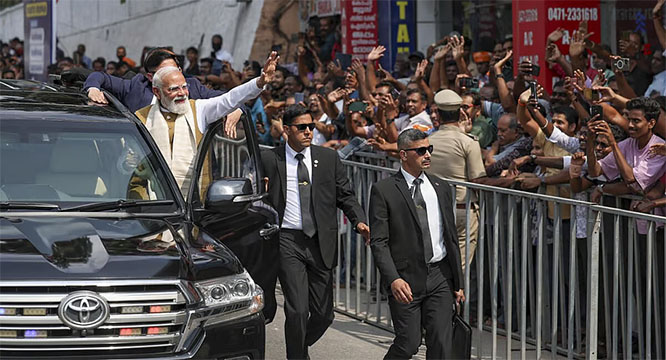
Prime Minister Narendra Modi, during his visit to Thiruvananthapuram on Friday, January 23, indicated that the Bharatiya Janata Party (BJP) is aiming to expand its political footprint in Kerala ahead of the Assembly elections scheduled in the coming months.

Speaking at a BJP-organised public meeting, Modi drew parallels between the party’s early electoral gains in Gujarat and its recent victory in the Thiruvananthapuram Municipal Corporation. The civic body win, which ended decades of Left control, was cited by the Prime Minister as a possible starting point for the party’s broader ambitions in the state.

Recalling BJP’s political trajectory in Gujarat, Modi said the party was largely insignificant before 1987 and received little media attention. He pointed out that the BJP’s first major breakthrough came with its victory in the Ahmedabad Municipal Corporation that year.

“Just as our journey in Gujarat began with one city, Kerala’s journey has also started with a single city,” Modi said, suggesting that the party’s municipal-level success could translate into wider electoral acceptance.

The Prime Minister alleged that successive governments led by the Left Democratic Front (LDF) and the United Democratic Front (UDF) had failed to adequately develop Thiruvananthapuram. He accused both fronts of corruption and neglect, claiming that basic infrastructure and facilities were denied to the capital city for decades.

According to Modi, the BJP’s control of the civic body represents a shift driven by public dissatisfaction with the existing political alternatives. He asserted that the BJP administration in Thiruvananthapuram had begun working towards development, though no specific details or timelines were outlined.

Addressing the gathering at Putharikandam Maidan, Modi said the BJP intended to project Thiruvananthapuram as a “model city,” reiterating his party’s commitment to governance-led change.

The Prime Minister’s visit to Kerala also included the inauguration of several development projects and the flagging off of new train services, as the BJP intensifies its political outreach in the poll-bound state.

Comments

Add new comment

  • Coastaldigest.com reserves the right to delete or block any comments.
  • Coastaldigset.com is not responsible for its readers’ comments.
  • Comments that are abusive, incendiary or irrelevant are strictly prohibited.
  • Please use a genuine email ID and provide your name to avoid reject.
News Network
February 4,2026

Mangaluru: Urban local bodies and gram panchayats should make the use of Kannada on signboards mandatory while issuing trade licences to commercial establishments, Dakshina Kannada Deputy Commissioner Darshan HV said. He also called for regular inspections to ensure compliance.

Presiding over the District Kannada Awareness Committee meeting at the deputy commissioner’s office, Darshan said the city corporation would be directed to ensure that shops operating in malls prominently display their names in Kannada. “All commercial establishments, including shops, companies, offices and hotels, must mandatorily display their names in Kannada on signboards,” he said.

The deputy commissioner added that the National Highways Authority of India (NHAI) would be instructed to include Kannada on signboards along national highways. Banks, he said, would be directed through committee meetings to provide application forms in Kannada.

“Even if English-medium schools and colleges impart education in English, their signboards must display the institution’s name in Kannada. Steps will also be taken to ensure that private buses display place names in Kannada,” Darshan said.

During the meeting, committee members raised concerns over the closure of Kannada-medium schools in rural areas due to a shortage of teachers and stressed the need for immediate corrective measures. They also pointed out that several industries employ workers from other states while overlooking local candidates.

Members further demanded that nationalised banks provide deposit and withdrawal slips in Kannada. It was brought to the deputy commissioner’s notice that the presence of staff without knowledge of Kannada in rural branches of nationalised banks is causing hardship to local customers.

Meanwhile, MP Srinath, president of the District Kannada Sahitya Parishat, urged the district administration to allot land for the construction of a district Kannada Bhavana in Mangaluru.

Comments

Add new comment

  • Coastaldigest.com reserves the right to delete or block any comments.
  • Coastaldigset.com is not responsible for its readers’ comments.
  • Comments that are abusive, incendiary or irrelevant are strictly prohibited.
  • Please use a genuine email ID and provide your name to avoid reject.
News Network
February 3,2026

Bengaluru: Following reports of fresh Nipah virus (NiV) cases in West Bengal and heightened vigilance across parts of Southeast Asia, the Karnataka Health Department has placed the state on high alert and activated emergency preparedness protocols.

Health officials said enhanced surveillance measures have been initiated after two healthcare workers in Barasat, West Bengal, tested positive for the virus earlier this month. While no cases have been reported in Karnataka so far, authorities said the state’s past exposure to Nipah outbreaks and high inter-state mobility warranted preventive action.

Officials have directed district health teams to intensify monitoring, particularly at hospitals and points of entry, and to ensure early detection and isolation of suspected cases.

High Mortality Virus with Multiple Transmission Routes

Nipah virus is a zoonotic disease that can spread from animals to humans and has a reported fatality rate ranging between 60 and 75 per cent. Fruit bats, also known as flying foxes, are the natural reservoirs of the virus and can transmit it by contaminating food sources with saliva or urine.

Known modes of transmission include:

•    Contaminated food: Consumption of fruits partially eaten by bats or raw date-palm sap
•    Animal contact: Exposure to infected pigs or other animals
•    Human-to-human transmission: Close contact with body fluids of infected persons, particularly in healthcare settings

Symptoms and Disease Progression

The incubation period typically ranges from 4 to 14 days, though delayed onset has also been reported. Early symptoms often resemble common viral infections, making prompt clinical suspicion critical.

•    Initial symptoms: Fever, headache, body aches, fatigue, sore throat
•    Progressive symptoms: Drowsiness, disorientation, altered mental state
•    Severe stage: Seizures, neck stiffness and acute encephalitis, which can rapidly progress to coma

Public Health Advisory

The Health Department has issued precautionary guidelines urging the public to adopt risk-avoidance practices to prevent any local spillover.

Do’s
•    Wash fruits thoroughly before consumption
•    Drink boiled and cooled water
•    Use protective equipment while handling livestock
•    Maintain strict hand hygiene

Don’ts
•    Avoid fruits found on the ground or showing bite marks
•    Do not consume beverages made from raw tree sap, including toddy
•    Avoid areas with dense bat populations
•    Do not handle sick or dead animals

Preparedness Measures

Officials confirmed that isolation wards are being readied in major government hospitals and that medical staff are being sensitised to identify early warning signs.

“There is no cause for panic, but there is a need for heightened vigilance,” a senior health official said, adding that there is currently no approved vaccine or specific antiviral treatment for Nipah, and care remains largely supportive.

Comments

Add new comment

  • Coastaldigest.com reserves the right to delete or block any comments.
  • Coastaldigset.com is not responsible for its readers’ comments.
  • Comments that are abusive, incendiary or irrelevant are strictly prohibited.
  • Please use a genuine email ID and provide your name to avoid reject.