



Makkah, Oct 2: As a child, Osama Al-Bar would walk from his home past Islam's holiest site, the Kaaba, to the market of spice and fabric merchants where his father owned a store. At that time, Makkah was so small, pilgrims could sit near the Kaaba and look out at the serene desert mountains where Prophet Muhammad (peace be upon him) once walked.
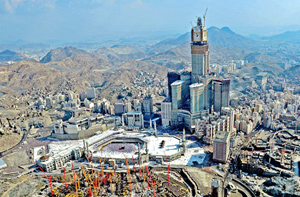
Now the market and the homes are gone. Monumental luxury hotel towers surround the Grand Mosque where the Kaaba is located. Steep rocky hills overlooking the mosque have been leveled and are now covered with cranes building more towers in row after row.
"My father and all the people who lived in Makkah wouldn't recognize it," said Al-Bar, who is now the city's mayor.
As Muslims from around the world stream into Makkah for the annual Haj pilgrimage this week, they come to a city undergoing the biggest transformation in its history.
Decades ago, this was a low-built city of centuries-old neighborhoods. Over the years, it saw piecemeal renewal projects. But in the mid-2000s, the Kingdom launched its most ambitious overhaul ever with a series of mega-projects that, though incomplete, have already reshaped Makkah. Old neighborhoods have been erased for hotel towers and malls built right up to the edge of the Grand Mosque. Next to the Kaaba soars the world's third tallest skyscraper, topped by a gigantic clock, which is splashed with colored lights at night.
The urban renewal is necessary, Saudi officials say, to accommodate Haj pilgrims whose numbers are expected to swell from around 3 million currently to nearly 7 million by 2040.
The $60-billion Grand Mosque expansion will almost double the area for pilgrims to pray at the Kaaba. Around half the cost went to buying about 5,800 homes that had to be razed for the expansion, said Al-Bar, the mayor. Domes and pillars dating back to rule by the Ottoman Empire are being pulled down to put up modern facilities.
Another mega project is Jabal Omar, a hill on the mosque's west side. The hill — a landmark in the city — was leveled and in its place, construction of around 40 towers is under way, mostly for luxury hotels providing some 11,000 rooms. The first of the Jabal Omar hotels, a Hilton Suites and the Anjum Hotel, just opened in the past few months.
On the mosque's south side stands the 1,972-foot (600-meter) clock-tower skyscraper, part of a completed seven-tower complex that was built after tearing down an Ottoman fort on the site.
Also under way is the Jabal Sharashif project, in which a slum that largely houses Burmese and African migrants is to be torn down to build a new neighborhood for Saudis, along with hotels. A four-line metro system is planned for the city along with a high-speed rail line to the port city of Jeddah, where the area's airport is located, and to Madinah.
The Grand Mosque's expansion is being headed by the Saudi Binladin Group, which also built the clock tower. The Binladin family runs major building projects around the country.
Speaking at a public forum in Jeddah in May, Nawaf Binladin, whose father is chairman of the conglomerate, said people are constantly asking if all this construction is needed.
"This can be answered in one moment in this image," he said, flashing a picture of tens of thousands of worshippers praying in the street because there was not enough room inside the Grand Mosque.
Essam Kalthoum, managing director of the government-owned Bawabat Makkah Company, which is involved in a number of projects around the city, said the main goal is to increase space for pilgrims.
Kalthoum showed a gift from a Turkish foundation he had just received: a photo of Makkah from the late 1800s.
"This is painful," he said. "For those of us who witnessed some of this (past), it brings back memories."
But he pointed to the Kaaba in the photograph. "Because of this place," he said, the old markets and buildings had to go.
Comments
Add new comment