



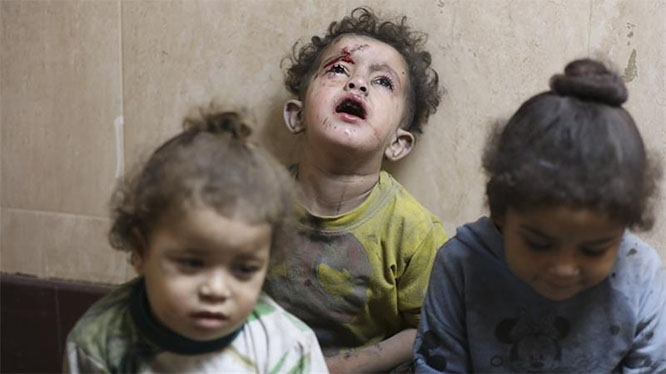
Gaza carnage: 6 months into ruthless Israel’s bloody war on Palestinians

News Network
April 7, 2024

gazachildren.jpg

Israel's relentless aggression against the Gaza Strip has now stretched over six months, and shows no sign of abating despite international calls for a ceasefire.

Israel launched the war on Gaza on October 7 after the Palestinian resistance movement Hamas waged the surprise Operation Al-Aqsa Storm against the occupying entity in response to the Israeli regime's decades-long campaign of violence against Palestinians.

At that time, the Israeli regime said attacking Gaza had two goals: eliminating Hamas and bringing back the hostages taken by the resistance group to Gaza. None of them have been achieved so far.

About 130 of the 250 Israeli captives taken during Operation Al-Aqsa Storm are still in Gaza after a provisional truce deal in December saw the exchange of a number of prisoners between the two sides.

Death toll

The conflict in Gaza has taken a devastating toll on Palestinians, with over 33,200 people, including 13,800 children, having lost their lives in 180 days of war, according to the Gaza Ministry of Health.

On top of that, around 76,000 people have been wounded – about four out of every 100 people in Gaza. The Palestine Red Crescent Society said this week some 1,000 children in Gaza have lost one or both of their legs.

A record-breaking 176 UN staff members and seven foreign aid workers have been killed in Gaza since October 7.

The Israeli army has killed the largest number of journalists of any modern conflict and detained more than 24. More than 140 journalists have been killed during the six months of war in the Israeli military's raids, bombardments and missile attacks across the Gaza Strip.

The humanitarian situation in Gaza has worsened day by day as the Israeli army continues to prevent aid from reaching the region, resulting in starvation being utilized as a tactic of warfare as over a million are at risk of starvation, with international groups warning of an “imminent” famine.

At least 27 Palestinians have already died from malnutrition and dehydration, according to international NGOs.

Displacement

More than 80 percent of Gaza’s population (Over 1.9 million Palestinians) have been intentionally displaced as the Israeli military ordered Palestinians to “go south” from the start of the war.

Some 1.4 million people are believed to be sheltering in Rafah, a small city on Gaza’s southern border with Egypt which is being bombarded by the Israeli forces every day as they have left no safe zone for the Palestinians to live.

Infrastructure damage

The estimated $18.5 billion in damage has affected public service infrastructure, resulting in 26 million tons of debris and rubble.

Over 290,000 housing units, equivalent to 62 percent of all homes in Gaza, have been damaged or destroyed by the war, leaving more than a million people homeless.

Only a fraction of hospitals, 10 out of 36, are operational following severe damage, leading to overwhelming strain on their limited resources.

Al-Shifa Hospital, the largest medical facility in Gaza, has been left severely damaged and burned after enduring a relentless two-week-long siege. The compound, which witnessed the loss of at least 400 lives and the arrest of hundreds, now faces a dire situation.

With an acute shortage of medicine and healthcare professionals on the brink of exhaustion and starvation, the majority of patients in Gaza are unable to receive the treatment they desperately need.

The scarcity of resources has forced medical teams to carry out operations and amputations without the availability of anesthetic, further exacerbating the already dire circumstances.

Political resolutions

On March 6, South Africa filed an “urgent request” with the International Court of Justice (ICJ) and requested for additional provisional measures issued on January 26.

In January, the ICJ ordered Israel to refrain from any acts that could fall under the Genocide Convention and ensure its troops commit no genocidal acts against Palestinians in Gaza. Israel described the genocide allegation as baseless.

On Friday, the United Nations Human Rights Council adopted a resolution, calling for a halt to all arms sales to Israel, and for the regime to be held accountable for possible war crimes in the Gaza Strip.

Moreover, the UN Security Council adopted a resolution last month, demanding an “immediate ceasefire” for the Muslim holy month of Ramadan. The resolution is the first to be approved by the council after three previous attempts during the past five months of war were vetoed by the US.

Meanwhile, during the months of war, protests around the world have been held in support of Palestine, calling for an immediate ceasefire and halt to arms sales to Israel.

Comments

Add new comment

  • Coastaldigest.com reserves the right to delete or block any comments.
  • Coastaldigset.com is not responsible for its readers’ comments.
  • Comments that are abusive, incendiary or irrelevant are strictly prohibited.
  • Please use a genuine email ID and provide your name to avoid reject.
News Network
January 23,2026

Mangaluru: The Karnataka Government Polytechnic (KPT), Mangaluru, has achieved autonomous status from the All India Council for Technical Education (AICTE), becoming the first government polytechnic in the country to receive such recognition in its 78-year history. The status was granted by AICTE, New Delhi, and subsequently approved by the Karnataka Board of Technical Education in October last year.

Officials said the autonomy was conferred a few months ago. Until recently, AICTE extended autonomous status only to engineering colleges, excluding diploma institutions. However, with a renewed national focus on skill development, several government polytechnics across India have now been granted autonomy.

KPT, the second-largest polytechnic in Karnataka, was established in 1946 with four branches and has since expanded to offer eight diploma programmes, including computer science and polymer technology. The institution is spread across a 19-acre campus.

Ravindra M Keni, the first dean of the institution, told The Times of India that AICTE had proposed autonomous status for polytechnic institutions that are over 25 years old. “Many colleges applied. In the first round, 100 institutions were shortlisted, which was further narrowed down to 15 in the second round. We have already completed one semester after becoming an autonomous institution,” he said. He added that nearly 500 students are admitted annually across eight three-year diploma courses.

Explaining the factors that helped KPT secure autonomy, Keni said the institution has consistently recorded 100 per cent admissions and placements for its graduates. He also noted its strong performance in sports, with the college emerging champions for 12 consecutive years, along with active student participation in NCC and NSS activities.

Autonomous status allows KPT to design industry-oriented curricula, conduct examinations, prepare question papers, and manage academic documentation independently. The institution can also directly collaborate with industries and receive priority funding from AICTE or the Ministry of Education. While academic autonomy has been granted, financial control will continue to rest with the state government.

“There will be separate committees for examinations, question paper setting, boards of studies, and boards of examiners. The institution will now have the freedom to conduct admissions without government notifications and issue its own marks cards,” Keni said, adding that new academic initiatives would be planned after a year of functioning under the autonomous framework.

Comments

Add new comment

  • Coastaldigest.com reserves the right to delete or block any comments.
  • Coastaldigset.com is not responsible for its readers’ comments.
  • Comments that are abusive, incendiary or irrelevant are strictly prohibited.
  • Please use a genuine email ID and provide your name to avoid reject.
News Network
February 3,2026

Bengaluru: Following reports of fresh Nipah virus (NiV) cases in West Bengal and heightened vigilance across parts of Southeast Asia, the Karnataka Health Department has placed the state on high alert and activated emergency preparedness protocols.

Health officials said enhanced surveillance measures have been initiated after two healthcare workers in Barasat, West Bengal, tested positive for the virus earlier this month. While no cases have been reported in Karnataka so far, authorities said the state’s past exposure to Nipah outbreaks and high inter-state mobility warranted preventive action.

Officials have directed district health teams to intensify monitoring, particularly at hospitals and points of entry, and to ensure early detection and isolation of suspected cases.

High Mortality Virus with Multiple Transmission Routes

Nipah virus is a zoonotic disease that can spread from animals to humans and has a reported fatality rate ranging between 60 and 75 per cent. Fruit bats, also known as flying foxes, are the natural reservoirs of the virus and can transmit it by contaminating food sources with saliva or urine.

Known modes of transmission include:

•    Contaminated food: Consumption of fruits partially eaten by bats or raw date-palm sap
•    Animal contact: Exposure to infected pigs or other animals
•    Human-to-human transmission: Close contact with body fluids of infected persons, particularly in healthcare settings

Symptoms and Disease Progression

The incubation period typically ranges from 4 to 14 days, though delayed onset has also been reported. Early symptoms often resemble common viral infections, making prompt clinical suspicion critical.

•    Initial symptoms: Fever, headache, body aches, fatigue, sore throat
•    Progressive symptoms: Drowsiness, disorientation, altered mental state
•    Severe stage: Seizures, neck stiffness and acute encephalitis, which can rapidly progress to coma

Public Health Advisory

The Health Department has issued precautionary guidelines urging the public to adopt risk-avoidance practices to prevent any local spillover.

Do’s
•    Wash fruits thoroughly before consumption
•    Drink boiled and cooled water
•    Use protective equipment while handling livestock
•    Maintain strict hand hygiene

Don’ts
•    Avoid fruits found on the ground or showing bite marks
•    Do not consume beverages made from raw tree sap, including toddy
•    Avoid areas with dense bat populations
•    Do not handle sick or dead animals

Preparedness Measures

Officials confirmed that isolation wards are being readied in major government hospitals and that medical staff are being sensitised to identify early warning signs.

“There is no cause for panic, but there is a need for heightened vigilance,” a senior health official said, adding that there is currently no approved vaccine or specific antiviral treatment for Nipah, and care remains largely supportive.

Comments

Add new comment

  • Coastaldigest.com reserves the right to delete or block any comments.
  • Coastaldigset.com is not responsible for its readers’ comments.
  • Comments that are abusive, incendiary or irrelevant are strictly prohibited.
  • Please use a genuine email ID and provide your name to avoid reject.
News Network
January 23,2026

Karnataka Governor Thaawarchand Gehlot read only three lines from the 122-paragraph address prepared by the Congress-led state government while addressing the joint session of the Legislature on Thursday, effectively bypassing large sections critical of the BJP-led Union government.

The omitted portions of the customary Governor’s address outlined what the state government described as a “suppressive situation in economic and policy matters” under India’s federal framework. The speech also sharply criticised the Centre’s move to replace the Mahatma Gandhi National Rural Employment Guarantee Act (MGNREGA) with the Viksit Bharat–Guarantee for Rozgar and Ajeevika Mission (Gramin) Act, commonly referred to as the VB-GRAM (G) Act.

Governor Gehlot had earlier conveyed his objection to several paragraphs that were explicitly critical of the Union government. On Thursday, he confined himself to the opening lines — “I extend a warm welcome to all of you to the joint session of the State legislature. I am extremely pleased to address this august House” — before jumping directly to the concluding sentence of the final paragraph.

He ended the address by reading the last line of paragraph 122: “Overall, my government is firmly committed to doubling the pace of the State’s economic, social and physical development. Jai Hind — Jai Karnataka.”

According to the prepared speech, the Karnataka government demanded the scrapping of the VB-GRAM (G) Act, describing it as “contractor-centric” and detrimental to rural livelihoods, and called for the full restoration of MGNREGA. The state government argued that the new law undermines decentralisation, weakens labour protections, and centralises decision-making in violation of constitutional norms.

Key points from the unread sections of the speech:

•    Karnataka facing a “suppressive” economic and policy environment within the federal system

•    Repeal of MGNREGA described as a blow to rural livelihoods

•    VB-GRAM (G) Act accused of protecting corporate and contractor interests

•    New law alleged to weaken decentralised governance

•    Decision-making said to be imposed by the Centre without consulting states

•    Rights of Adivasis, women, backward classes and agrarian communities curtailed

•    Labourers allegedly placed under contractor control

•    States facing mounting fiscal stress due to central policies

•    VB-GRAM (G) Act accused of enabling large-scale corruption

Comments

Add new comment

  • Coastaldigest.com reserves the right to delete or block any comments.
  • Coastaldigset.com is not responsible for its readers’ comments.
  • Comments that are abusive, incendiary or irrelevant are strictly prohibited.
  • Please use a genuine email ID and provide your name to avoid reject.