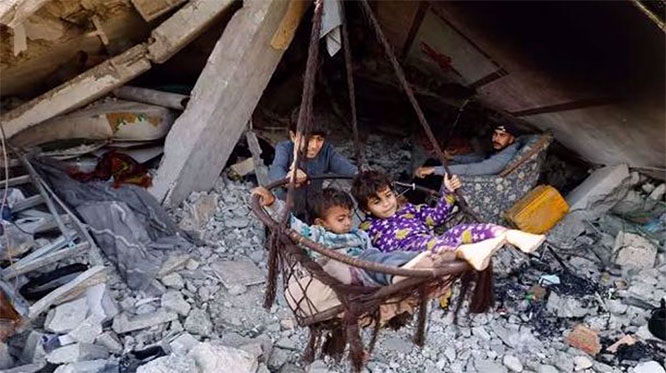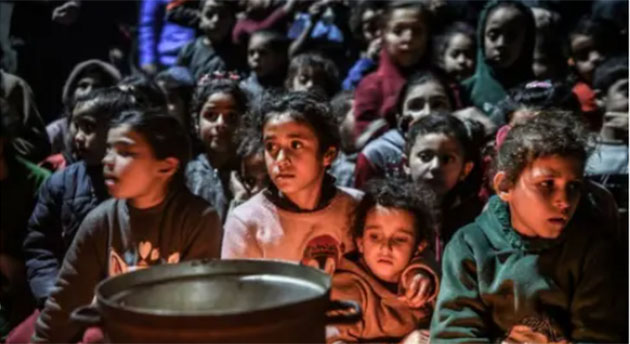
Gaza children, who survived off animal feed, going without food for days as inhuman Israel blocks aid convoys

News Network
February 10, 2024

gaza.jpg

People living in the isolated north of Gaza have revealed that children are going without food for days, as aid convoys are increasingly denied permits to enter thanks to Israeli army’s inhuman blockade. Some residents have resorted to grinding animal feed into flour to survive, but even stocks of those grains are now dwindling, they say.

People have also described digging down into the soil to access water pipes, for drinking and washing.

The UN has warned that acute malnutrition among young children in the north has risen sharply, and is now above the critical threshold of 15%.

The UN's humanitarian coordination agency, Ocha, says more than half the aid missions to the north of Gaza were denied access last month, and that there is increasing interference from Israeli forces in how and where aid is delivered.

It says 300,000 people estimated to be living in northern areas are largely cut off from assistance, and face a growing risk of famine.

A spokesman for the Israeli military agency tasked with coordinating aid access in Gaza said in a briefing last month that there was "no starvation in Gaza. Period." The agency, Cogat, has repeatedly said it does not limit the amount of humanitarian aid sent to Gaza.

The BBC spoke to three people living in Gaza City and Beit Lahia, and viewed footage and interviews filmed by local journalists in Jabalia.

Mahmoud Shalabi, a local medical aid worker in Beit Lahia, said people had been grinding grains used for animal feed into flour, but that even that was now running out.

"People are not finding it in the market," he said. "It's unavailable nowadays in the north of Gaza, and Gaza City."

He also said stocks of tinned food were disappearing.

"What we had was actually from the six or seven days of truce [in November], and whatever aid was allowed into the north of Gaza has actually been consumed by now. What people are eating right now is basically rice, and only rice."

The World Food Programme (WFP) told the BBC this week that four out of the last five aid convoys into the north had been stopped by Israeli forces, meaning a gap of two weeks between deliveries to Gaza City.

'Serious risk of famine'

"We know there is a very serious risk of famine in Gaza if we don't provide very significant volumes of food assistance on a regular basis," said the WFP regional chief, Matt Hollingworth.

The UN Office for the Coordination of Humanitarian Affairs (Ocha) said there had been a sharp increase in the number of aid missions denied access to northern Gaza: with 56% of deliveries denied access in January, up from 14% in October to December.

It also said the Israeli military "at times required justifications" for quantities of fuel destined for health facilities, and "imposed reductions on the volume of assistance, such as the quantity of food".

A famine risk assessment, carried out by several UN agencies, estimated that almost a third of residents in northern areas could now be facing a "catastrophic" lack of food, though restrictions on accessing the area make real-time measurements very difficult.

Families in northern areas are also struggling to find reliable water supplies.

"Many of us are now drinking unpotable water. There are no pipes; we have to dig for water," explained Mahmoud Salah in Beit Lahia.

Video filmed in the Jabalia neighbourhood north of Gaza City shows residents sitting among the rubble of bombed out streets, digging down into the earth to tap large underground water pipes.

"We get water here once every 15 days," Yusuf al-Ayoti said. "The water is dirty. Our children are inflamed and their teeth are eroded from the dirty water. There is sand in it, and it's very salty."

After four months of war, the makeshift solutions for bridging the hunger gaps are wearing thin. And there are few ways to restock Gaza's larder.

The territory was reliant on food aid before the war; now much of its agricultural industry has been ruined or abandoned.

Comments

Add new comment

  • Coastaldigest.com reserves the right to delete or block any comments.
  • Coastaldigset.com is not responsible for its readers’ comments.
  • Comments that are abusive, incendiary or irrelevant are strictly prohibited.
  • Please use a genuine email ID and provide your name to avoid reject.
News Network
November 26,2025

students.jpg

Bengaluru, Nov 26: Karnataka is taking its first concrete steps towards lifting a three-decade-old ban on student elections in colleges and universities. Deputy Chief Minister D.K. Shivakumar announced Wednesday that the state government will form a small committee to study the reintroduction of campus polls, a practice halted in 1989 following incidents of violence.

Speaking at a 'Constitution Day' event organised by the Karnataka Congress, Mr. Shivakumar underscored the move's aim: nurturing new political leadership from the grassroots.

"Recently, (Leader of the Opposition in Lok Sabha) Rahul Gandhi wrote a letter to me and Chief Minister (Siddaramaiah) asking us to think about restarting student elections," Shivakumar stated. "I'm announcing today that we'll form a small committee and seek a report on this."

Student elections were banned in Karnataka in 1989, largely due to concerns over violence and the infiltration of political party affiliates into campus life. The ban effectively extinguished vibrant student bodies and the pipeline of young leaders they often produced.

Mr. Shivakumar, who also serves as the Karnataka Congress president, said that former student leaders will be consulted to "study the pros and cons" of the re-introduction.

Acknowledging the history of the ban, he added, "There were many criminal activities taking place back then. We’ll see how we can conduct (student) elections by regulating such criminal activities."

The Deputy CM reminisced about his own journey, which began on campus. He recalled his political activism at Sri Jagadguru Renukacharya College leading to his first Assembly ticket in 1985 at the age of 23. "That's how student leadership was at the time. Such leadership has gone today. College elections have stopped," he lamented, adding that for many, college elections were "like a big movement" where leaders were forged.

The move, driven by the Congress high command's push to cultivate young talent, will face scrutiny from academics and university authorities who have, in the past, expressed concern that the return of polls could disrupt the peaceful academic environment and turn campuses into political battlegrounds.

Comments

Add new comment

  • Coastaldigest.com reserves the right to delete or block any comments.
  • Coastaldigset.com is not responsible for its readers’ comments.
  • Comments that are abusive, incendiary or irrelevant are strictly prohibited.
  • Please use a genuine email ID and provide your name to avoid reject.
News Network
November 22,2025

gaza.jpg

The Israeli regime’s forces have killed two Palestinian children in the Gaza Strip every day since the ceasefire began in early October, UNICEF has warned.

The UN children’s agency said on Friday that Israeli forces continue to attack Palestinians in Gaza even though the agreement was meant to stop the killing.

“Since 11 October, while the ceasefire has been in effect, at least 67 children have been killed in conflict-related incidents in the Gaza Strip. Dozens more have been injured. That is an average of almost two children killed every day since the ceasefire took effect,” UNICEF spokesperson Ricardo Pires said in Geneva, reminding that each number in the statistics represents a child whose life had ended violently.

“These are not statistics,” he said. “Each child had a story, a family, and a future that was stolen from them.”

Data from Palestinian factions, human rights groups, and government bodies recorded since the US-brokered ceasefire deal went into effect on October 10 show that Israeli forces have carried out numerous attacks, each constituting a separate ceasefire violation.

UNICEF teams say they repeatedly continue to witness heart-wrenching scenes of fearful Palestinian children sleeping outdoors with amputated limbs, while others live as orphans in flooded, makeshift shelters.

“I saw this myself in August. There is no safe place for them. The world cannot normalize their suffering,” Pires said, lamenting that the UN could “do a lot more if the aid that is really needed was entering faster.”

The UNICEF spokesperson warned that with the advent of winter, the risks for hundreds of thousands of displaced children will increase.

He warned, “The stakes are incredibly high” for children as winter acts as a threat multiplier, where children have no heating, no insulation, and few blankets. He said respiratory infections rise.

“Too many children have already paid the highest price,” Pires said. “Too many are still paying it, even under a ceasefire. The world promised them it would stop and that we would protect them.”

“Now we must act like it,” the UNICEF spokesperson added.

Since the Israeli regime launched its genocidal war against Palestinians in Gaza in October 2023, it has killed nearly 70,000 people in the territory, most of them women and children, and injured over 170,000 more, while reducing most of the structures in the enclave to rubble.

Comments

Add new comment

  • Coastaldigest.com reserves the right to delete or block any comments.
  • Coastaldigset.com is not responsible for its readers’ comments.
  • Comments that are abusive, incendiary or irrelevant are strictly prohibited.
  • Please use a genuine email ID and provide your name to avoid reject.
coastaldigest.com news network
November 28,2025

roadshow.jpg

Udupi district transformed into a sea of saffron and celebration on Friday, November 28, as Prime Minister Narendra Modi’s roadshow swept through the coastal temple town. Thousands of residents lined the streets, turning the event into a vibrant public spectacle filled with cheers, flags, and festive energy.

The procession route—from the helipad to the historic Sri Krishna Math—was decked with buntings, saffron flags, and multilayered security barricades. One of the district’s largest-ever security deployments was put in place for the high-profile visit, with over 3,000 police personnel on duty. The arrangement included ten SPs, 27 DSPs, 49 inspectors, 127 sub-inspectors, 232 assistant sub-inspectors, 1,608 constables, and 39 women staff.

Six platoons of the Karnataka State Reserve Police, six Quick Response Teams, bomb detection units, and dog squads were stationed across Udupi. Enhanced surveillance covered Adi Udupi, Bannanje bus stand, and the Sri Krishna Math parking zone, with combing operations carried out along the roadshow corridor.

At the 800-year-old Sri Krishna Math, preparations reached a ceremonial peak. Paryaya Puttige Math seer Sugunendra Teertha Swamiji said the Prime Minister would take part in the Laksha Kantha Geetha Parayana, a mass chanting of the Bhagavad Gita by one lakh devotees, and inaugurate the new Suvarna Teertha Mantapa.

“He will first offer floral tributes to saint-poet Kanakadasa and then unveil the golden covering over the Kanakana Kindi,” the seer said.

The Prime Minister will also receive a Poorna Kumbha welcome and have darshan of Lord Sri Krishna, Mukhyaprana Devaru, and the Suvarna Paduke. Union Minister Pralhad Joshi, Karnataka Governor Thaawarchand Gehlot, Minister Bairathi Suresh, Dharmadhikari D. Veerendra Heggade, and seers from the Ashta Maths are expected to join the ceremony.

Ahead of his arrival, the Prime Minister posted on X that he felt “honoured” to attend the spiritually significant gathering. “This is a special occasion that brings together people from different sections of society for a recital of the Gita. This Matha has a very special significance in our cultural life,” he wrote, noting the institution’s long-standing legacy rooted in the teachings of Sri Madhvacharya.

roadshow2.jpg

Comments

Add new comment

  • Coastaldigest.com reserves the right to delete or block any comments.
  • Coastaldigset.com is not responsible for its readers’ comments.
  • Comments that are abusive, incendiary or irrelevant are strictly prohibited.
  • Please use a genuine email ID and provide your name to avoid reject.