



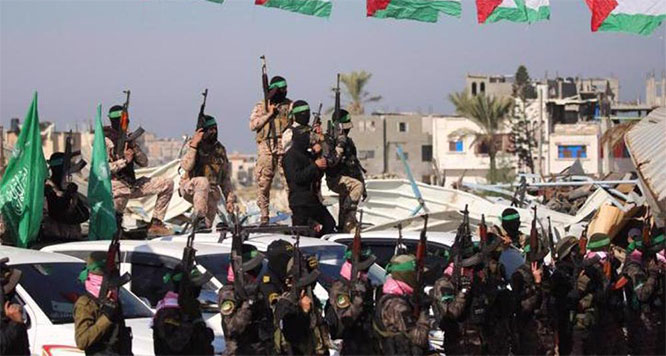
Hamas hands over bodies of 4 Israeli captives killed in Israeli strikes to Red Cross

Agencies
February 20, 2025

hamasisrael.jpg

The Palestinian Hamas resistance movement hands over the bodies of four Israeli captives, killed in the regime's strikes on the besieged Gaza Strip to the International Committee of the Red Cross.

The handover, part of the ceasefire agreement between Hamas and the Tel Aviv regime, was carried out in Khan Yunis on Thursday, with Hamas saying that the move reflects its commitment to consolidate the ceasefire for long-term peace in the war-ravaged Palestinian territory.

According to the movement, all four captives, a mother and her two children and an elderly journalist, were killed in the Israeli airstrikes during the 15-month genocide war that killed at least 48,284 Palestinians, mostly women and children, in the small coastal territory.

"To the families of Bibas and Lifshitz: We would have preferred your sons to return to you alive, but your army and government leaders chose to kill them instead of bringing them back," Hamas said in a statement.

"They killed with them: 17,881 Palestinian children, in their criminal bombardment of the Gaza Strip, and we know that you know who is truly responsible for their departure. You were the victim of a leadership that does not care about its children."

Hamas said the Israeli army killed the captives by bombing their detention centers, and that the regime of prime minister Benjamin Netanyahu bears full responsibility after repeatedly obstructing the exchange agreement. 

"The criminal Netanyahu is crying today over the bodies of his prisoners who returned to him in coffins, in a blatant attempt to evade responsibility for their killing in front of his audience."

Hamas said it did everything in its power to protect the prisoners and preserve their lives, "but the barbaric and continuous bombing by the occupation prevented them from being able to save all the prisoners".

On Saturday, Hamas said it would also release six more live captives in return for hundreds of Palestinian prisoners that include half of the women and children abducted by the occupying regime during the genocide.

The handover came just a day after the resistance movement announced that it is ready to release all Israeli captives in a single swap during the second phase of the Gaza truce deal.

"We emphasize that the exchange is the only way to return the prisoners alive to their families, and any attempt to bring them back by military force or return to war will only result in more losses among the prisoners," Hamas said in its Thursday statement. 

Israel and Hamas are currently in the process of implementing the first phase of the truce, which began on January 19. Since then, 19 Israeli captives have been released in exchange for more than 1,100 Palestinians.

After the completion of the first phase, 58 captives will remain in Gaza. The Israeli military says 34 of the remaining captives are dead.

Prior to Al-Aqsa Flood operation in October 2023, approximately 5,200 Palestinians were held in Israeli prisons. According to Palestinian officials, that number has since increased to over 10,000.

The occupying entity failed to achieve its declared objectives of freeing captives and eliminating Hamas despite killing at least 48,284 Palestinians, mostly women and children, in Gaza.

The ceasefire is divided into three phases, each lasting 42 days. In the first phase, which is currently underway, 33 Israeli captives will be freed in exchange for approximately 2,000 Palestinian detainees held in the regime’s prisons.

Despite Hamas fully committing to the ceasefire deal, Israel has restricted the delivery of humanitarian aid, including shelters, and blocked the entry of heavy machinery into the besieged strip, hindering the clearance of rubble from destroyed infrastructure.

Comments

Add new comment

  • Coastaldigest.com reserves the right to delete or block any comments.
  • Coastaldigset.com is not responsible for its readers’ comments.
  • Comments that are abusive, incendiary or irrelevant are strictly prohibited.
  • Please use a genuine email ID and provide your name to avoid reject.
News Network
January 23,2026

Mangaluru: The Karnataka Government Polytechnic (KPT), Mangaluru, has achieved autonomous status from the All India Council for Technical Education (AICTE), becoming the first government polytechnic in the country to receive such recognition in its 78-year history. The status was granted by AICTE, New Delhi, and subsequently approved by the Karnataka Board of Technical Education in October last year.

Officials said the autonomy was conferred a few months ago. Until recently, AICTE extended autonomous status only to engineering colleges, excluding diploma institutions. However, with a renewed national focus on skill development, several government polytechnics across India have now been granted autonomy.

KPT, the second-largest polytechnic in Karnataka, was established in 1946 with four branches and has since expanded to offer eight diploma programmes, including computer science and polymer technology. The institution is spread across a 19-acre campus.

Ravindra M Keni, the first dean of the institution, told The Times of India that AICTE had proposed autonomous status for polytechnic institutions that are over 25 years old. “Many colleges applied. In the first round, 100 institutions were shortlisted, which was further narrowed down to 15 in the second round. We have already completed one semester after becoming an autonomous institution,” he said. He added that nearly 500 students are admitted annually across eight three-year diploma courses.

Explaining the factors that helped KPT secure autonomy, Keni said the institution has consistently recorded 100 per cent admissions and placements for its graduates. He also noted its strong performance in sports, with the college emerging champions for 12 consecutive years, along with active student participation in NCC and NSS activities.

Autonomous status allows KPT to design industry-oriented curricula, conduct examinations, prepare question papers, and manage academic documentation independently. The institution can also directly collaborate with industries and receive priority funding from AICTE or the Ministry of Education. While academic autonomy has been granted, financial control will continue to rest with the state government.

“There will be separate committees for examinations, question paper setting, boards of studies, and boards of examiners. The institution will now have the freedom to conduct admissions without government notifications and issue its own marks cards,” Keni said, adding that new academic initiatives would be planned after a year of functioning under the autonomous framework.

Comments

Add new comment

  • Coastaldigest.com reserves the right to delete or block any comments.
  • Coastaldigset.com is not responsible for its readers’ comments.
  • Comments that are abusive, incendiary or irrelevant are strictly prohibited.
  • Please use a genuine email ID and provide your name to avoid reject.
News Network
February 1,2026

Bengaluru: Karnataka Deputy Chief Minister D K Shivakumar on Sunday criticised the Union Budget presented by Finance Minister Nirmala Sitharaman, claiming it offered no tangible benefit to the state.

Though he said he was yet to study the budget in detail, Shivakumar asserted that Karnataka had gained little from it. “There is no benefit for our state from the central budget. I was observing it. They have now named a programme after Mahatma Gandhi, after repealing the MGNREGA Act that was named after him,” he said.

Speaking to reporters here, the Deputy Chief Minister demanded the restoration of MGNREGA, and made it clear that the newly enacted rural employment scheme — VB-G RAM G — which proposes a 60:40 fund-sharing formula between the Centre and the states, would not be implemented in Karnataka.

“I don’t see any major share for our state in this budget,” he added.

Shivakumar, who also holds charge of Bengaluru development, said there were high expectations for the city from the Union Budget. “The Prime Minister calls Bengaluru a ‘global city’, but what has the Centre done for it?” he asked.

He also drew attention to the problems faced by sugar factories, particularly those in the cooperative sector, alleging a lack of timely decisions and support from the central government.

Noting that the Centre has the authority to fix the minimum support price (MSP) for agricultural produce, Shivakumar said the Union government must take concrete steps to protect farmers’ interests.

Comments

Add new comment

  • Coastaldigest.com reserves the right to delete or block any comments.
  • Coastaldigset.com is not responsible for its readers’ comments.
  • Comments that are abusive, incendiary or irrelevant are strictly prohibited.
  • Please use a genuine email ID and provide your name to avoid reject.
News Network
February 1,2026

US President Donald Trump on Saturday claimed that the government of India led by Prime Minister Narendra Modi has made a deal to buy Venezuelan oil, as opposed to purchasing it from Iran.

"We've already made that deal, the concept of the deal," he told reporters on Air Force One.

Trump had imposed 25% tariffs on countries buying Venezuelan oil, including India, in March 2025. He had also hit India with tariffs for buying Russian oil, saying it was "funding" President Vladimir Putin's war against Ukraine.

Trump has said that the US has taken control of the oil-rich Venezuela after capturing former President Nicolas Maduro in January.

A fleet of 18 ships loaded with crude oil bound for refineries in Texas, Louisiana, and Mississippi in January, the most since December 2024, according to a report by the news agency Bloomberg.

Combined crude deliveries to the US will reach about 2,75,000 barrels a day, more than doubling volumes seen in December last year. Shipments to China, which averaged 4,00,000 barrels a day last year, fell to zero in January.

PM Modi, Venezuelan President Agree To Expand Ties

Prime Minister Narendra Modi and Venezuela's acting President Delcy Rodriguez spoke on Friday and agreed to take the bilateral relations to "new heights" in the years ahead.

It was the first phone call between the two leaders since the capture of Maduro and his wife by the US on January 3.

"Spoke with Acting President of Venezuela, Ms. Delcy Rodriguez. We agreed to further deepen and expand our bilateral partnership in all areas, with a shared vision of taking India-Venezuela relations to new heights in the years ahead," PM Modi said in a post on X.

A statement from Prime Minister Modi's office said the two leaders agreed to further expand and deepen the India-Venezuela partnership in all areas, including trade and investment, energy, digital technology, health, agriculture, and people-to-people ties.

They exchanged views on various regional and global issues of mutual interest and underscored the importance of their close cooperation for the Global South, the statement said.

Rodriguez also said that they discussed partnerships in the fields of agriculture, science and technology, mining, and tourism, as well as the pharmaceutical and automotive industries.

Comments

Add new comment

  • Coastaldigest.com reserves the right to delete or block any comments.
  • Coastaldigset.com is not responsible for its readers’ comments.
  • Comments that are abusive, incendiary or irrelevant are strictly prohibited.
  • Please use a genuine email ID and provide your name to avoid reject.