High ranking Iranian nuclear scientist assassinated

Agencies
November 28, 2020

assasination.JPG

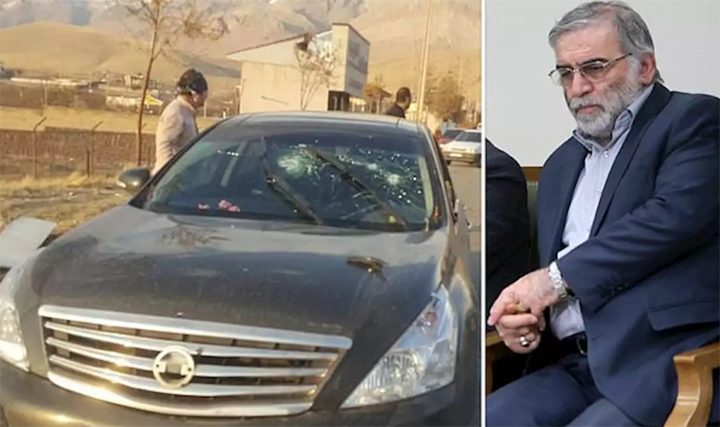
High-ranking Iranian nuclear physicist Mohsen Fakhrizadeh, named by the West as leading the Islamic Republic’s military nuclear programme until its disbanding in the early 2000s, has been assassinated in an ambush near Tehran.

Fakhrizadeh was shot “by terrorists” in his vehicle in Absard, a suburb in eastern Tehran, and he later succumbed to his injuries in what amounted to a “martyr’s death”, Iran’s Foreign Ministry said on Friday.

Local authorities had confirmed Fakhrizadeh’s death several hours earlier and also said that several attackers were killed.

Fakhrizadeh served as the head of the Research and Innovation Organisation of the defence ministry at the time of his death.

Iran’s foreign minister alleged the killing of Mohsen Fakhrizadeh bore “serious indications” of an Israeli role, but did not elaborate.

Israel declined to immediately comment on the killing of Fakhrizadeh, whom Israeli Prime Minister Benjamin Netanyahu once called out in a news conference saying: “Remember that name.”

Israel has long been suspected of carrying out a series of targeted killings of Iranian nuclear scientists nearly 10 years ago.

Photos and video shared online showed a Nissan sedan with bullet holes through windshield and blood pooled on the road.

The semiofficial Fars News Agency said witnesses heard the sound of an explosion and then machine gun fire. The attack targeted the car Fakhrizadeh was travelling in, the agency said.

Those wounded, including Fakhrizadeh’s bodyguards, were taken to a local hospital, the agency said.

No group immediately claimed responsibility for the attack.

Al Jazeera’s Assed Baig, reporting from Tehran, said that according to Fars News Agency, Fakhrizadeh “came under attack by three-four unknown assailants”.

“They also say three-four people were killed in that incident,” Baig said.

“We have had the head of the Revolutionary Guard say that assassinating nuclear scientists is an attempt by hegemonic powers to stop Iran from gaining new sciences.”

‘Serious indications’ of Israeli role

Iran’s foreign minister called on the international community to condemn “this act of state terror”.

“Terrorists murdered an eminent Iranian scientist today. This cowardice – with serious indications of Israeli role – shows desperate warmongering of perpetrators,” Mohammad Javad Zarif wrote on Twitter on Friday.

In a letter to UN Secretary-General Antonio Guterres and the UN Security Council on Friday, Iran also said there are “serious indications of Israeli responsibility” in the attack and said it reserves the right to defend itself.

“Warning against any adventuristic measures by the United States and Israel against my country, particularly during the remaining period of the current administration of the United States in office, the Islamic Republic of Iran reserves its rights to take all necessary measures to defend its people and secure its interests,” Iran’s UN envoy, Majid Takht Ravanchi, wrote in the letter, which was seen by Reuters news agency.

Fakhrizadeh, 63, had been a member of Iran’s Revolutionary Guard and was an expert in missile production. Fars said that is why Israeli secret services had long sought to eliminate him for many years.

A military adviser to Iranian Supreme Leader Ayatollah Ali Khamenei accused Israel of killing Fakhrizadeh to try to provoke a war.

“In the last days of the political life of their … ally [US President Donald Trump], the Zionists (Israel) seek to intensify pressure on Iran and create a full-blown war,” commander Hossein Dehghan tweeted.

He said Fakhrizadeh’s work will continue to be a “nightmare” for Iran’s enemies.

Fakhrizadeh was one of “the people who are fighting without any claims behind the scenes of political battles and achieved martyrdom in this path”, Dehghan tweeted.

The US Pentagon declined to comment on reports of the attack.

‘More detrimental to Iran’s antagonists’

Mohammad Marandi, a professor at the University of Tehran, told Al Jazeera that the assassination “is going to make Iranians more assertive when it comes to dealing with its antagonists” and that it was too late for hostile entities to do anything about Iran’s nuclear programme.

“Fifty years ago, if they carried out this attack it would’ve had an impact. But now Iran’s nuclear programme is developed, it’s highly diverse. It has many young scientists and these murders will be more detrimental to Iran’s antagonists, I believe, than Iran,” Marandi said.

“[Fakharizadeh] was one of the first generation of people in Iran who helped develop nuclear technology.”

Fakhrizadeh led Iran’s so-called Amad (Hope) programme. Israel and the West have alleged it was a military operation looking at the feasibility of building a nuclear weapon in Iran. Tehran has long maintained its nuclear programme is peaceful.

The International Atomic Energy Agency says the Amad programme ended in the early 2000s. Its inspectors now monitor Iranian nuclear sites.

The assassination comes as Trump, who has been fervently backed by Israel in his “maximum pressure” campaign on Iran, is slated to leave office in less than two months after losing the presidential election to Democrat Joe Biden.

In recent weeks, multiple reports by American media have said, citing unnamed sources, that Trump has been seriously considering a military attack on Iran, even on its main nuclear site in Natanz.

In May 2018, Trump unilaterally withdrew from Iran’s 2015 nuclear deal with world powers and imposed harsh economic sanctions that have only escalated since.

In the first European reaction to Fakhrizadeh’s assassination, Carl Bildt, co-chair of the European Council on Foreign Relations, said the attack may be related to Biden’s promise to return to the nuclear deal.

“It’s not unlikely that this targeted killing was part of efforts to prevent the Biden administration from reviving diplomacy with Iran and going back to the nuclear agreement,” he tweeted.

In the past year, the Trump administration has also tried to make it harder for a Biden administration to come back to the nuclear accord through retargeting Iranian entities and individuals that were already sanctioned with new terrorism-related designations.

Friday’s assassination marks the second high-profile targeted killing of a top Iranian official after IRGC Quds Force chief General Qassem Soleimani’s killing in a US air strike in January this year.

Hillary Mann Leverett, founder of political consultancy group Stratega, said while the killing was not as “shocking” as that of Soleimani’s assassination, it was still “very disturbing”.

“It is certainly one of the most high-level assassinations we have seen in the past year,” she told Al Jazeera over Skype from Mclean, Virginia.

“I think it is intended to stoke tensions particularly in this interim period between the current administration and the Biden administration.”

“The Trump administration have openly said that they will exert what they call ‘maximum pressure’ in its most maximum essence between now and when they have to leave office on January 20,” Leverett said.

Iran has previously called the Trump administration’s “maximum pressure” strategy an instance of “economic and medical terrorism”.


Comments

Mohammad Sagar
 - 
Thursday, 10 Dec 2020

I want to go back uae how I gate apporwal

Add new comment

  • Coastaldigest.com reserves the right to delete or block any comments.
  • Coastaldigset.com is not responsible for its readers’ comments.
  • Comments that are abusive, incendiary or irrelevant are strictly prohibited.
  • Please use a genuine email ID and provide your name to avoid reject.
News Network
November 24,2025

Mangaluru, Nov 24: The original departure time of 11.10 pm was a distant memory for scores of Dammam-bound passengers at Mangaluru International Airport last Friday night, as their Air India Express flight was abruptly cancelled at the eleventh hour, sparking hours of frustration and chaos.

The flight, IX 885, initially scheduled to depart at 11.10 pm on November 22, was subject to two back-to-back reschedules—first pushed to 11.45 pm and then significantly postponed to 1.40 am—before the final, crushing announcement of cancellation was made. For the travellers, many of whom are likely expatriate workers with tight schedules, the last-minute change marked the beginning of a distressing ordeal.

"There was no drinking water, no food, and absolutely no proper guidance. We were left stranded like refugees," complained a stranded passenger.

According to multiple passenger accounts, the airline's ground staff failed to provide adequate support or essential amenities following the cancellation. Complaints poured in about the total absence of drinking water, food provisions, and any reliable guidance from the carrier's representatives. Travellers alleged they were left stranded for a considerable period, with no immediate arrangements or clear communication offered regarding accommodation or alternative travel to send them back home.

The incident has highlighted serious concerns over the carrier's contingency planning and customer service protocols during flight disruptions at one of India's key international gateways. The airline is yet to issue a comprehensive statement addressing the alleged lapse in passenger care.
 

Comments

Add new comment

  • Coastaldigest.com reserves the right to delete or block any comments.
  • Coastaldigset.com is not responsible for its readers’ comments.
  • Comments that are abusive, incendiary or irrelevant are strictly prohibited.
  • Please use a genuine email ID and provide your name to avoid reject.
coastaldigest.com news network
November 28,2025

roadshow.jpg

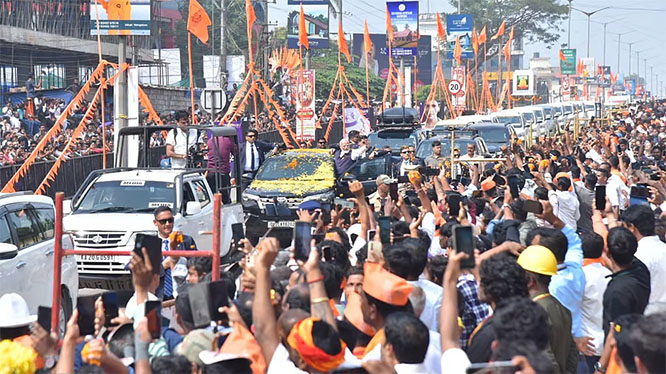
Udupi district transformed into a sea of saffron and celebration on Friday, November 28, as Prime Minister Narendra Modi’s roadshow swept through the coastal temple town. Thousands of residents lined the streets, turning the event into a vibrant public spectacle filled with cheers, flags, and festive energy.

The procession route—from the helipad to the historic Sri Krishna Math—was decked with buntings, saffron flags, and multilayered security barricades. One of the district’s largest-ever security deployments was put in place for the high-profile visit, with over 3,000 police personnel on duty. The arrangement included ten SPs, 27 DSPs, 49 inspectors, 127 sub-inspectors, 232 assistant sub-inspectors, 1,608 constables, and 39 women staff.

Six platoons of the Karnataka State Reserve Police, six Quick Response Teams, bomb detection units, and dog squads were stationed across Udupi. Enhanced surveillance covered Adi Udupi, Bannanje bus stand, and the Sri Krishna Math parking zone, with combing operations carried out along the roadshow corridor.

At the 800-year-old Sri Krishna Math, preparations reached a ceremonial peak. Paryaya Puttige Math seer Sugunendra Teertha Swamiji said the Prime Minister would take part in the Laksha Kantha Geetha Parayana, a mass chanting of the Bhagavad Gita by one lakh devotees, and inaugurate the new Suvarna Teertha Mantapa.

“He will first offer floral tributes to saint-poet Kanakadasa and then unveil the golden covering over the Kanakana Kindi,” the seer said.

The Prime Minister will also receive a Poorna Kumbha welcome and have darshan of Lord Sri Krishna, Mukhyaprana Devaru, and the Suvarna Paduke. Union Minister Pralhad Joshi, Karnataka Governor Thaawarchand Gehlot, Minister Bairathi Suresh, Dharmadhikari D. Veerendra Heggade, and seers from the Ashta Maths are expected to join the ceremony.

Ahead of his arrival, the Prime Minister posted on X that he felt “honoured” to attend the spiritually significant gathering. “This is a special occasion that brings together people from different sections of society for a recital of the Gita. This Matha has a very special significance in our cultural life,” he wrote, noting the institution’s long-standing legacy rooted in the teachings of Sri Madhvacharya.

roadshow2.jpg

Comments

Add new comment

  • Coastaldigest.com reserves the right to delete or block any comments.
  • Coastaldigset.com is not responsible for its readers’ comments.
  • Comments that are abusive, incendiary or irrelevant are strictly prohibited.
  • Please use a genuine email ID and provide your name to avoid reject.
News Network
November 21,2025

Bengaluru, Nov 21: The Karnataka government is facing pressure to overhaul its employment system after a high-level Cabinet sub-committee recommended the complete phase-out of job outsourcing in government offices, boards, and corporations by March 2028. The move is aimed at tackling a systemic issue that has led to the potential violation of constitutional reservation policies and the exploitation of workers.

The Call for Systemic Change

With over three lakh vacant posts currently being filled through private agencies on an outsource, insource, or daily wage basis, the sub-committee highlighted a significant lapse. "As a result, reservations are not being followed as per the Constitution and state laws. It’s an urgent need to take serious steps to change the system. It has been recommended to completely stop the system of outsourcing by March 2028," the panel stated in a document.

The practice of outsourcing involves private companies hiring workers to perform duties for a government agency. Critics argue this model results in lesser salaries, a lack of social security benefits (otherwise available to permanent government employees), and a failure to adhere to the provisions of Articles 14 and 15 of the Constitution, which guarantee equality before the law and prohibit discrimination.

The 'Bidar Model' as a Stop-Gap Solution

To regulate the current mode of employment and reduce worker exploitation until the 2028 deadline, the government plans to establish workers’ services multi-purpose cooperative societies across all districts, following the successful "Bidar Model."

The Bidar District Services of Labour Multi-purpose Cooperative Society Ltd., which operates under the District Commissioner, is cited as a successful example of providing a measure of social security to outsourced staff. Labour Department officials argue this society ensures workers receive their due wages and statutory facilities like ESI (Employees' State Insurance) and PF (Provident Fund), in exchange for a 1% service fee collected from the employees.

legislative push and Priority Insourcing

The recommendations, led by the sub-committee headed by Law and Parliamentary Affairs Minister H K Patil, are set to be discussed at the next Cabinet meeting. The committee has proposed the introduction of the Karnataka Outsourced Employees (Regulation, Placement and Welfare) Bill 2025.

In a move addressing immediate concerns, Labour Minister Santosh Lad, a member of the sub-committee, has reportedly assured that steps will be taken over the next 2-3 years to insource workers in "life-threatening services" on a priority basis. This includes essential personnel like pourakarmikas (sanitation workers), drivers, electrical staff in the Energy Department, and Health Department staff handling contagious diseases. The transition aims to grant these workers the long-term security and benefits they currently lack under the outsourcing system. 

Comments

Add new comment

  • Coastaldigest.com reserves the right to delete or block any comments.
  • Coastaldigset.com is not responsible for its readers’ comments.
  • Comments that are abusive, incendiary or irrelevant are strictly prohibited.
  • Please use a genuine email ID and provide your name to avoid reject.