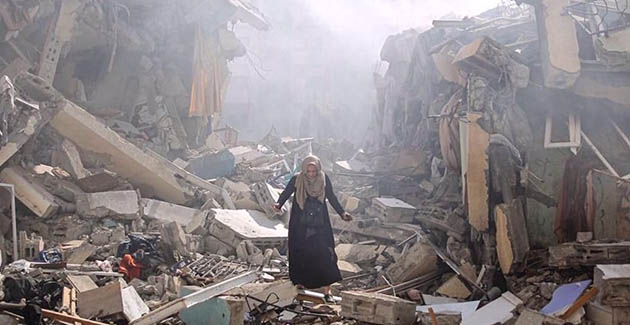
Israel blocking delivery of medicines, lifesaving supplies to northern Gaza: UN

News Network
January 16, 2024

gazacatastrophe.jpg

The United Nations Office for the Coordination of Humanitarian Affairs (OCHA) says the Israeli regime is denying access to aid missions delivering medicine and fuel to the northern part of the Gaza Strip, amid a deepening humanitarian disaster in the besieged enclave.

OCHA reported that in the first two weeks of January, only 24 percent of planned aid missions to deliver food, medicine, water, and other lifesaving supplies have successfully reached their destinations north of Gaza.

“Around 95 percent of missions involving the allocation of fuel and medicines to water reservoirs, water wells, and health facilities in the north of Gaza have been denied access by Israeli authorities,” the report said.

“Lack of fuel for water, sanitation, and hygiene increases risks of health and environmental hazards,” it added, stressing that “lack of medicine has debilitated the functionality of the six partially functioning hospitals in the blockaded territory.”

OCHA also added that the aid missions that could not proceed include five planned missions to the Central Drug Store, four planned missions to Jabalia Medical Center, and eight planned missions to four critical reservoirs and water and waste pumps. 

The UN agency further stated that since the start of the war, humanitarian missions have reported two instances where Israeli forces were detaining convoy members, as well as two instances of attacks on convoys.

“Reluctance by the regime to open main supply routes and facilitate timely crossing through the Israeli military-controlled checkpoint has exposed humanitarian actors to security risks,” it said.

According to the OCHA restrictions applied by the Israeli regime on the import of critical humanitarian equipment have heavily compromised the capacity of humanitarian agencies to operate safely and effectively.

Several UN agencies have also appealed for “faster” and “safer” aid access to Gaza as the population faces famine and the spread of disease.

In a joint statement, the World Food Programme (WFP), the United Nations Children’s Fund (UNICEF), and the World Health Organization (WHO) urged the opening of new entry routes, easing restrictions on the movement of humanitarian workers and guaranteeing the safety of people accessing and distributing aid.

The Rafah and Kerem Shalom border crossings are the only lifelines for Gaza’s 2.3 million people, who have been deprived of food, water, medicine, and fuel due to the Israeli blockade.

The Israeli regime waged the war on Gaza on October 7 after the Palestinian resistance movement Hamas carried out the surprise Operation Al-Aqsa Storm against the occupying entity in response to the Israeli regime’s atrocities against Palestinians.

Since the start of the aggression, Israel has killed more than 24,000 Palestinians, mostly women and children.

The Tel Aviv regime has also imposed a “complete siege” on the territory, cutting off fuel, electricity, food, and water to the more than two million Palestinians living there.


Comments

Add new comment

  • Coastaldigest.com reserves the right to delete or block any comments.
  • Coastaldigset.com is not responsible for its readers’ comments.
  • Comments that are abusive, incendiary or irrelevant are strictly prohibited.
  • Please use a genuine email ID and provide your name to avoid reject.
News Network
November 21,2025

Tejas.jpg

An Indian Air Force (IAF) Tejas fighter jet crashed on Friday, November 21, afternoon during its aerial demonstration at the Dubai Air Show, plunging to the ground at around 2:10 pm local time while performing a manoeuvre before thousands of spectators.

The IAF confirmed the incident, stating that a Tejas aircraft participating in the show had crashed and that further details were being gathered. An Air Force spokesperson said more information would be shared after initial assessments.

The crash sent thick black smoke billowing into the sky near the airport, causing panic among visitors, including families and children who had gathered to watch the display. Authorities have not yet confirmed whether the pilot managed to eject before the aircraft went down. Emergency response teams rushed to the scene, and officials have not released information on casualties or damage so far.

The Tejas is a 4.5-generation, multi-role fighter aircraft developed indigenously by Hindustan Aeronautics Limited (HAL). Designed for versatility, it is capable of offensive air support, close combat, ground attack missions and maritime operations. The aircraft family includes single-seat fighters and twin-seat trainers for both the Air Force and Navy.

HAL describes the latest version, the LCA Mk1A, as the most advanced in the series, featuring an AESA radar, an upgraded electronic warfare suite with radar-warning and self-protection jamming, smart multifunction displays, a digital map generator, a combined interrogator–transponder system and a modern radio altimeter. These enhancements significantly improve the aircraft’s combat capability and survivability.

Further updates from IAF and UAE authorities are awaited.

Comments

Add new comment

  • Coastaldigest.com reserves the right to delete or block any comments.
  • Coastaldigset.com is not responsible for its readers’ comments.
  • Comments that are abusive, incendiary or irrelevant are strictly prohibited.
  • Please use a genuine email ID and provide your name to avoid reject.
News Network
November 24,2025

israelsyra.jpg

Israeli forces have pushed over the Syrian frontier, erecting a checkpoint and stopping vehicles in the southwestern city of Quneitra, in yet another breach of the Arab country’s sovereignty.

The violation took place on Sunday, when the troops made their way across the border, setting up the outpost near the Ain al-Bayda junction in northern Quneitra, Syrian outlets reported.

According to the al-Ikhbariya paper, an Israeli detachment positioned itself at the junction, halting cars and conducting searches.

The Syrian Arab News Agency (SANA) reported that three Israeli military vehicles then moved further into the northern countryside, deploying between the town of Jubata al-Khashab and the villages of Ofaniya and Ain al-Bayda. The agency added that a separate Israeli unit mounted a new incursion in the central region, approaching the villages of Umm Batina and al-Ajraf.

Residents said such activities have surged in recent months, pointing to Israeli advances onto farmland, leveling of extensive forested areas, arrests, and spread of mobile checkpoints.

The Israeli regime began markedly increasing its military aggression against Syria last year.

The escalation coincided with increasingly ferocious onslaughts throughout the country by the so-called Hay'at Tahrir al-Sham (HTS) Takfiri terrorist group, which the government of President Bashar al-Assad had confined to northwestern Syria. The HTS, however, managed to overthrow the government as the Israeli attacks would pummel the country’s civilian and defensive infrastructure.

Various reports have shown that, during the escalation, the regime conducted more than 1,000 airstrikes on the Syrian territory and over 400 ground raids into the south.

Following the collapse of the Assad government, Tel Aviv also widened its grip over the occupied Golan Heights by taking control of a demilitarized buffer zone, in defiance of a 1974 Disengagement Agreement. Earlier this month, senior Israeli officials, including Prime Minister Benjamin Netanyahu, visited the buffer zone, prompting expressions of alarm on the part of the United Nations.

The United States, the regime’s biggest ally, has, meanwhile, been fraternizing the HTS head Abu Mohammed al-Jolani amid the widely reported prospect of rapprochement with Tel Aviv.

Comments

Add new comment

  • Coastaldigest.com reserves the right to delete or block any comments.
  • Coastaldigset.com is not responsible for its readers’ comments.
  • Comments that are abusive, incendiary or irrelevant are strictly prohibited.
  • Please use a genuine email ID and provide your name to avoid reject.
News Network
December 4,2025

indigocrisis.jpg

Angry outbursts, long queues, and desperate appeals filled airports across India today as IndiGo grappled with a severe operational breakdown. Hundreds of flights have been cancelled or delayed, leaving thousands of passengers stranded through the night and forcing many to spend long hours at helpdesks.

Social media was flooded with videos of fliers pleading for assistance, accusing the airline of misleading updates, and demanding accommodation after being stuck for 10 to 12 hours at airports such as Hyderabad and Bengaluru.

What Triggered the Meltdown?

IndiGo has attributed the widespread disruption to “a multitude of unforeseen operational challenges.” These include:

•    Minor technology glitches
•    Winter-season schedule adjustments
•    Bad weather
•    Congestion in the aviation network
•    New crew rostering rules (Flight Duty Time Limitations or FDTL)

Among these, the most disruptive has been the implementation of the updated FDTL norms introduced by the Directorate General of Civil Aviation (DGCA) in January 2024.

These rules were designed to reduce pilot fatigue and improve passenger safety. Key changes include:

•    Longer weekly rest periods for flight crew
•    A revised definition of “night,” extending it by an extra hour
•    Tighter caps on flight duty timing and night landings
•    Cutting night shifts for pilots and crew from six per roster cycle to just two

Once these norms became fully enforceable, airlines were required to overhaul rosters well in advance. For IndiGo, this triggered a sudden shortage of crew available for duty, leading to cascading delays and cancellations.

Why IndiGo Was Hit the Hardest

IndiGo is India’s largest airline by a wide margin, operating over 2,200 flights daily. That’s roughly double the number operated by Air India.

When an airline of this size experiences even a 10–20% disruption, it translates to 200–400 flights being delayed or grounded — producing massive spillover effects across the country.

IndiGo also relies heavily on high-frequency overnight operations, a model typical of low-cost carriers that aim to maximise aircraft utilisation and reduce downtime. The stricter FDTL norms clash with these overnight-heavy schedules, forcing the airline to pull back services.

Aviation bodies have also criticised IndiGo’s preparedness. The Airline Pilots' Association of India (ALPA) said airlines were given a two-year window to plan for the new rules but “started preparing rather late.” IndiGo, it said, failed to rebuild crew rosters 15 days in advance as required.

The Federation of Indian Pilots (FIP) went further, calling the crisis the result of IndiGo’s “prolonged and unorthodox lean manpower strategy,” and alleging that the airline adopted a hiring freeze even as it knew the new rules would require more careful staffing.

How Many Flights Are Affected?

In the past 48 hours, over 300 flights have been cancelled. At least 100 more are expected to be cancelled today.

City-wise impact:

•    Hyderabad: 33 expected cancellations; several fliers stranded overnight
•    Bengaluru: over 70 expected cancellations
•    Delhi, Mumbai, Chennai, Kolkata: widespread delays and missed connections

Passengers shared distressing accounts online.

One customer at Hyderabad airport said they waited from 6 PM to 9 AM with “no action taken” regarding their delayed Pune flight. Another said IndiGo repeatedly told them the crew was “arriving soon,” only for the delay to stretch over 12 hours.

IndiGo has apologised for the disruption and promised that operations will stabilise within 48 hours, adding that “calibrated adjustments” are being made to contain the chaos.

What Should Passengers Do Now?

For those flying in the next few days, especially with IndiGo, here are key precautions:

1. Keep Checking Flight Status
Monitor your flight closely before leaving for the airport, as delays may be announced last-minute.

2. Arrive Early
Expect long queues at counters and security due to crowding and rescheduling.

3. Carry Essentials
Pack snacks, water, basic medicines, chargers, and items for children or senior citizens. Extended waiting times should be anticipated.

4. Use Flexible Booking Options
If you booked tickets with a free-date-change or cancellation option, consider using them.
If you haven’t booked yet, prefer refundable or flexible fares, or even consider alternate airlines.

5. Follow IndiGo’s Updates
Keep an eye on IndiGo’s official social media channels and contact customer support for rebooking and refund queries.

What Needs to Change?

Pilot groups have raised concerns not just about staffing but also the planning practices behind it.
The Federation of Indian Pilots accused IndiGo of:

•    Imposing an unexplained hiring freeze despite knowing the FDTL changes were coming
•    Entering non-poaching agreements that limited talent movement
•    Keeping pilot pay frozen
•    Underestimating the need to restructure operations in advance

They have urged DGCA to approve seasonal schedules only after airlines prove they have adequate pilot strength under the new norms.

ALPA also warned that some airlines might be using the delays as an “immature pressure tactic” to push DGCA for relaxations in the new rules — which, if granted, could compromise the very safety standards the norms were meant to protect.

Both pilot bodies stressed that no exemption should dilute safety, and any deviations should be based solely on scientific risk assessment.

Is a Solution in Sight?

While IndiGo says normalcy will return within two days, aviation experts believe that fully stabilising operations could take longer, depending on how quickly the airline can:
•    Re-align rosters
•    Mobilise rested crew
•    Boost staffing
•    Adjust its winter schedule to match regulatory requirements
Passengers are advised to remain prepared for continued delays over the next few days as the airline works through its backlog. 

Comments

Add new comment

  • Coastaldigest.com reserves the right to delete or block any comments.
  • Coastaldigset.com is not responsible for its readers’ comments.
  • Comments that are abusive, incendiary or irrelevant are strictly prohibited.
  • Please use a genuine email ID and provide your name to avoid reject.