Israel broadens airstrikes in Lebanon, killing displaced families without warning

News Network
November 13, 2024

lebenonstrikes.jpg

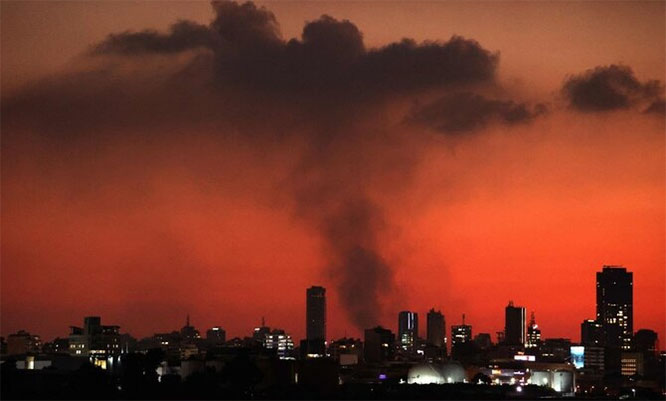
Beirut: The Israeli army on Tuesday continued to launch attacks against civilians in Lebanon, targeting them in several areas without prior evacuation warnings.

However, 13 airstrikes on Beirut’s southern suburbs in the space of only three hours were preceded by evacuation warnings.

The attacks caused no injuries but resulted in widespread destruction of residential buildings and commercial, medical and educational centers.

The airstrikes in southern Lebanon and Bekaa region, reaching Akkar in Lebanon’s far north, erased any hope of a near-term ceasefire settlement.

The strikes were accompanied by an announcement on Israel’s Channel 14 that “the Israeli army has expanded its operations in southern Lebanon to areas it had not reached since the beginning of the ground operation.”

About 50 days have passed since Israel intensified its hostile operations in Lebanon targeting Hezbollah. The death toll from these confrontations and attacks has passed 3,200, with more than 14,000 wounded.

For the first time, an airstrike targeted a mountainous area between Baalchmay and Aabadiyeh on the road leading to Aley, destroying a building housing displaced people.

The mayor of Baalchmay, Adham Al-Danaf, confirmed that “the airstrike targeted a residential building in the Dhour Aabadiyeh area.”

The initial toll from the Ministry of Health showed “five people killed and two injured.”

The raids that targeted Beirut’s southern suburbs for the first time in the morning, unlike nightly raids before, caused huge destruction. Those who evacuated their homes after Israeli warnings, used their phones to record the collapse of empty buildings in Sfeir, Haret Hreik, Bir Al-Abed, Mrayjeh, Laylaki and Hadath.

Israeli warplanes also targeted Tyre, where a strike on a building killed three people and injured many others, while a raid on Tefahta killed a man identified as Kifah Khalil and his family.

Attacks were widespread, with Yater and Zebqine subject to artillery shelling, a civilian being killed in Hermel, and further attacks on Bouday and an area between the towns of Srifa and Arsoun.

A raid on the town of Siddiqin killed two people and injured several others, while an attack on the Mechref farm led to one fatality and multiple injuries.

The search for those missing after an Israeli raid on the town of Ain Yaacoub in Akkar, in the northernmost part of Lebanon, continued until dawn.

During the operation, 14 bodies were retrieved, identified as those of residents displaced from the town of Arabsalim in the Iqlim Al-Tuffah area of the south, along with members of a Syrian family, a mother and three of her children. Additionally, there were 10 people in critical condition.

The targeted residence belongs to a Lebanese citizen, Hussein Hashim, who is reported to be a member of the Syrian Social Nationalist Party.

An airstrike on the town of Saksakiyeh in the Sidon region on Monday night resulted in yet another tragedy.

It appeared that the intended target was the Shoumer family, who just days before lost Hussein Amin Shoumer and his two sisters in a drone strike near Al-Awali River.

Israeli army spokesperson Avichay Adraee issued additional evacuation warnings for towns in the southern region along the Litani River, which, according to estimates from the mayors, are currently 90 percent uninhabited.

In the meantime, Hezbollah announced its continued efforts to “combat the intrusions of Israeli forces and to strike military installations and towns in the north.”

Hezbollah said in a statement that it confronted “an Israeli Hermes 450 drone in the airspace of Nabatieh and forced it to leave Lebanese airspace.”

The party also announced that it targeted “Kfar Blum settlement with a rocket salvo.”

On the Israeli side, air raid sirens sounded in areas of Upper and Western Galilee and in the town of Kiryat Shmona and its surroundings.

The Israeli army confirmed that “a drone exploded in Nesher, east of Haifa, without activating the air raid sirens,” and that “a drone launched from Lebanon crashed into a school in Gesher HaZiv, north of Nahariya.”

Israel’s Channel 13 reported the Israeli military’s assessment regarding Hezbollah’s military strength, claiming that the group currently possesses approximately 100 precision missiles, thousands of artillery shells, and hundreds of rockets. Additionally, it was highlighted that “there are around 200 Lebanese towns that remain unvisited.”

Comments

Add new comment

  • Coastaldigest.com reserves the right to delete or block any comments.
  • Coastaldigset.com is not responsible for its readers’ comments.
  • Comments that are abusive, incendiary or irrelevant are strictly prohibited.
  • Please use a genuine email ID and provide your name to avoid reject.
News Network
January 20,2026

iran.jpg

Iranian security and intelligence forces have captured more than 470 individuals in three provinces, identified as key figures behind the recent wave of violent unrest and terrorist activities linked to foreign-backed networks.

The Intelligence Ministry's provincial office in Khorasan Razavi announced on Monday the arrest of 192 armed terrorists, identified as the main agents behind recent riots in the region. 

According to an official statement, the detainees were involved in the killing of several security personnel and civilians, setting fire to mosques, public service facilities, and buses, as well as attacks on military and law enforcement centers.

The seized items from the group include several bulletproof vests, Kalashnikov rifles, hunting weapons, Winchester rifles, and various cold weapons such as daggers, swords, brass knuckles, tactical knives, crossbows, and chains.

Evidence indicates that some of the individuals were tied to hostile movements and terrorist organizations, with links overseas. Others were identified as members of violent criminal gangs, actively taking part in the unrest alongside their associates.

Simultaneously, in the western province of Lorestan, the IRGC announced the arrest of 134 individuals as the main leaders and influential field agents of a US-Israeli terrorist network.

The IRGC statement stated that these individuals formed terrorist cells during the recent unrest, committing "Daesh-like" acts.

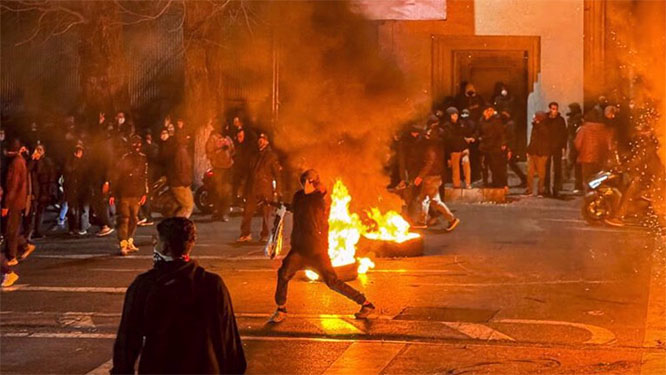
They wounded security forces with firearms and cold weapons, and burned and destroyed public and private properties, including mosques, shops, banks, and private and public vehicles.

In the northwestern province of Zanjan, the police reported detaining 150 people identified as principal leaders and agents behind recent riots.

Authorities noted that these individuals were responsible for destroying public and private property and intentionally setting fire to vehicles in the province's squares.

Their crimes include shedding the blood of innocent people, destroying public and private property, attempting to enter military sites, disrupting public order, and spreading terror among citizens.

A variety of cold weapons were reportedly seized from the detainees.

What began late last month as peaceful protests over economic hardship across Iran turned violent after public statements by US and Israeli regime figures encouraged vandalism and disorder.

During the unrest, foreign-backed mercenaries rampaged through cities, killing security forces and civilians and damaging public property.

Comments

Add new comment

  • Coastaldigest.com reserves the right to delete or block any comments.
  • Coastaldigset.com is not responsible for its readers’ comments.
  • Comments that are abusive, incendiary or irrelevant are strictly prohibited.
  • Please use a genuine email ID and provide your name to avoid reject.
News Network
January 28,2026

ajit.jpg

Mumbai: The sudden death of Maharashtra Deputy Chief Minister Ajit Pawar in a plane crash in his hometown of Baramati has plunged the state into political uncertainty, raising a pressing question for both the Nationalist Congress Party (NCP) and its rival faction, the Nationalist Congress Party (Sharadchandra Pawar): what next?

For the two factions that emerged after the dramatic split of June–July 2023, the moment marks their gravest challenge yet. Many believe the answer now rests with party founder Sharad Pawar.

Sharad Pawar, who founded the NCP in 1999 after parting ways with the Congress over Sonia Gandhi’s foreign origin, has already indicated his intention to step away from electoral politics once his Rajya Sabha term ends in April 2026.

Speaking at a public event in Baramati ahead of his 85th birthday on December 12, 2025, Pawar said he would not contest any further elections. “I have contested 14 elections. The younger generation needs to be given an opportunity,” he said, adding that he would decide later whether to seek another Rajya Sabha term.

Often described as the Bhishma Pitamah of Indian politics, Pawar also spoke of his gradual withdrawal from active leadership. “For the first 30 years, I handled everything. For the next 25–30 years, Ajit Dada handled responsibilities. Now, arrangements must be made for new leadership,” he said.

Ajit Pawar’s death has dramatically altered that transition, especially as he was working towards reunifying the two NCP factions.

“After the developments of June–July 2023 and the 2024 Lok Sabha and Vidhan Sabha elections, there were deep changes within the family and the party. In the last six months, serious efforts were made to reunite. Even workers from both sides wanted unity. This is a massive blow,” a Pawar family insider told DH over phone from Baramati.

Electoral outcomes over the past year reflected the split. In the 2024 Lok Sabha elections, NCP (SP) recorded the best strike rate in Maharashtra, winning eight of the 10 seats it contested. The NCP, by contrast, won just one seat out of four.

However, the trend reversed in the subsequent Vidhan Sabha elections, where the NCP emerged stronger, securing 41 of the 288 seats, while NCP (SP) managed only 10.

Within NCP (SP), Sharad Pawar’s daughter Supriya Sule serves as Working President, followed by leaders such as Rohit Pawar, state president Shashikant Shinde and former state chief Jayant Patil.

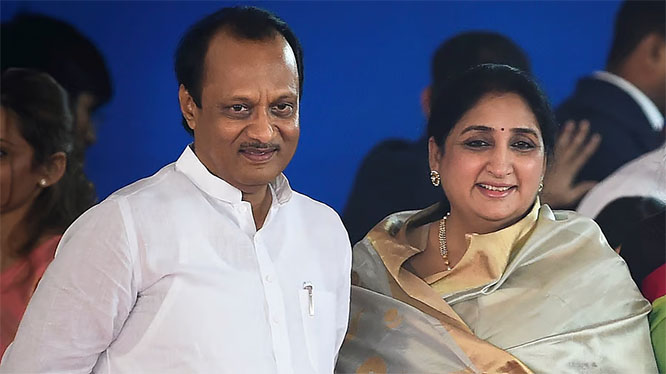
In the NCP, Praful Patel is the Working President and Raigad MP Sunil Tatkare heads the state unit. Ajit Pawar’s wife, Sunetra Pawar, is a Rajya Sabha MP, while their sons Parth and Jay are not actively involved in day-to-day politics. Parth Pawar briefly entered electoral politics in 2019 but lost the Lok Sabha election from Maval. Jay Pawar’s political debut was under consideration.

With Ajit Pawar gone, speculation has intensified that a member of the family may be asked to assume a larger role. For now, Sunetra Pawar is expected to play a key coordinating role in party affairs, alongside Patel and Tatkare.

The NCP continues to have several heavyweight leaders, including Chhagan Bhujbal, Hasan Mushrif, Dattatreya Bharne, Manikrao Kokate and Dhananjay Munde.

Ajit Pawar had already begun steps towards reconciliation between the two factions. While they contested the Pune and Pimpri-Chinchwad municipal elections separately, they later decided to fight the zilla parishad elections together under the ‘clock’ symbol—seen as the first formal step towards reunification.

Nagpur meet and party roadmap

Both NCP factions claim adherence to the ideology of ‘Shiv–Shahu–Phule–Ambedkar’. At the Rashtravadi Chintan Shivir held in Nagpur on September 19, 2025, the NCP reaffirmed its commitment to sarva dharma sambhav and discussed strengthening ties with the BJP “for the welfare and development of Maharashtra”.

In recent days, reports had suggested Ajit Pawar might return to the Maha Vikas Aghadi following the party’s poor performance in Pune municipal elections, but these claims were denied.

Big question for Maha Yuti

Ajit Pawar’s death also presents an immediate challenge for the Devendra Fadnavis-led Maha Yuti government. Pawar held crucial portfolios, including Finance, Planning and Excise. With the Budget Session approaching, appointing a new Finance Minister has become urgent.

Beyond numbers and portfolios, Maha Yuti has lost a swift decision-maker known for his administrative grip and political finesse—leaving a vacuum that will not be easy to fill.

Comments

Add new comment

  • Coastaldigest.com reserves the right to delete or block any comments.
  • Coastaldigset.com is not responsible for its readers’ comments.
  • Comments that are abusive, incendiary or irrelevant are strictly prohibited.
  • Please use a genuine email ID and provide your name to avoid reject.
News Network
January 23,2026

Mangaluru: The Karnataka Government Polytechnic (KPT), Mangaluru, has achieved autonomous status from the All India Council for Technical Education (AICTE), becoming the first government polytechnic in the country to receive such recognition in its 78-year history. The status was granted by AICTE, New Delhi, and subsequently approved by the Karnataka Board of Technical Education in October last year.

Officials said the autonomy was conferred a few months ago. Until recently, AICTE extended autonomous status only to engineering colleges, excluding diploma institutions. However, with a renewed national focus on skill development, several government polytechnics across India have now been granted autonomy.

KPT, the second-largest polytechnic in Karnataka, was established in 1946 with four branches and has since expanded to offer eight diploma programmes, including computer science and polymer technology. The institution is spread across a 19-acre campus.

Ravindra M Keni, the first dean of the institution, told The Times of India that AICTE had proposed autonomous status for polytechnic institutions that are over 25 years old. “Many colleges applied. In the first round, 100 institutions were shortlisted, which was further narrowed down to 15 in the second round. We have already completed one semester after becoming an autonomous institution,” he said. He added that nearly 500 students are admitted annually across eight three-year diploma courses.

Explaining the factors that helped KPT secure autonomy, Keni said the institution has consistently recorded 100 per cent admissions and placements for its graduates. He also noted its strong performance in sports, with the college emerging champions for 12 consecutive years, along with active student participation in NCC and NSS activities.

Autonomous status allows KPT to design industry-oriented curricula, conduct examinations, prepare question papers, and manage academic documentation independently. The institution can also directly collaborate with industries and receive priority funding from AICTE or the Ministry of Education. While academic autonomy has been granted, financial control will continue to rest with the state government.

“There will be separate committees for examinations, question paper setting, boards of studies, and boards of examiners. The institution will now have the freedom to conduct admissions without government notifications and issue its own marks cards,” Keni said, adding that new academic initiatives would be planned after a year of functioning under the autonomous framework.

Comments

Add new comment

  • Coastaldigest.com reserves the right to delete or block any comments.
  • Coastaldigset.com is not responsible for its readers’ comments.
  • Comments that are abusive, incendiary or irrelevant are strictly prohibited.
  • Please use a genuine email ID and provide your name to avoid reject.