



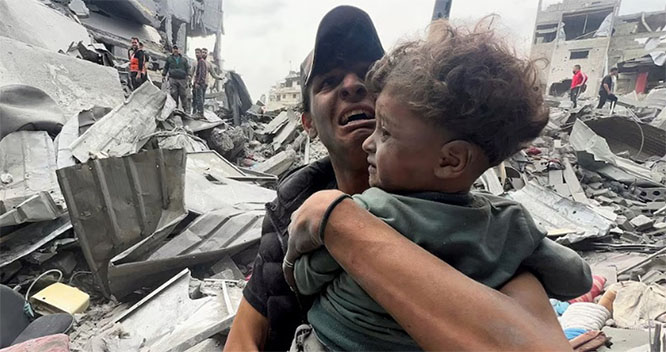
Mostly children and women killed as Israel expands Gaza onslaught

News Network
April 11, 2025

gazawar.jpg

New Israeli strikes have killed over a dozen people, including seven children, in the besieged territory as the regime is pressing ahead with its bloody military onslaught against Palestinians.

Gaza's civil defense agency said the bodies of 10 people, including seven children, were brought to the hospital following an Israeli airstrike that targeted the al-Farra family home in central Khan Younis.

Witnesses reported continuous and intensive Israeli tank fire in the city. 

Moreover, one Palestinian was killed and four others were wounded following an aerial attack on a group of civilians in Rafah.

In central Gaza, Israeli drones struck a group of civilians in Deir el-Balah, following which a number of casualties were transferred to the al-Aqsa Hospital.

Two more people killed in an Israeli strike that targeted a group of civilians in the al-Atatra area in the northern city of Beit Lahia.

On Friday morning, the Israeli military released an “urgent and serious” evacuation notice for residents living in various neighborhoods east of Gaza City.

The United Nations on Friday said its analysis of 36 recent Israeli strikes in Gaza showed only women and children were killed and decried the human cost of the war.

Spokeswoman Ravina Shamdasani cited an April 6 strike on a residential building of the Abu Issa family in Deir al-Balah, which reportedly killed one girl, four women, and one four-year-old boy.

Even the areas where Palestinians were being instructed to go in the expanding number of Israeli "evacuation orders" were also being subjected to attacks, she said.

Israel has said its troops are seizing "large areas" in Gaza and incorporating them into buffer zones cleared of their inhabitants.

The UN rights office warned that expanding Israeli evacuation orders are resulting in the "forcible transfer" of people into ever-shrinking spaces in the war-ravaged Palestinian territory.

"Let us be clear, these so-called evacuation orders are actually displacement orders, leading to displacement of the population of Gaza into ever shrinking spaces," Shamdasani said.

"The permanently displacing the civilian population within occupied territories amounts to forcible transfer, which is a grave breach of the Fourth Geneva Convention, and it is a crime against humanity."

Speaking to reporters in Geneva, Shamsadani said between March 18 and April 9, there were some 224 incidents of Israeli strikes on residential buildings and tents for internally displaced people.

"In some 36 strikes about which the UN Human Rights Office corroborated information, the fatalities recorded so far were only women and children," she said.

"Overall, a large percentage of fatalities are children and women, according to information recorded by our Office," she added.

Comments

Add new comment

  • Coastaldigest.com reserves the right to delete or block any comments.
  • Coastaldigset.com is not responsible for its readers’ comments.
  • Comments that are abusive, incendiary or irrelevant are strictly prohibited.
  • Please use a genuine email ID and provide your name to avoid reject.
News Network
February 1,2026

Bengaluru, Feb 1: For travelers landing at Kempegowda International Airport (KIA), the sleek, wood-paneled curves of Terminal 2 promise a world-class welcome. But the famed “Garden City” charm quickly withers at the curb. As India’s aviation sector swells to record numbers—handling over 43 million passengers in Bengaluru alone this past year—the “last mile” has turned into a marathon of frustration.

The Bengaluru Logjam: Rules vs Reality

While the city awaits the 2027 completion of the Namma Metro Blue Line, the interim has been chaotic. Recent “decongestion” rules at Terminal 1 have pushed app-based cab pickups to distant parking zones, forcing weary passengers into a 20-minute walk with luggage.

“I landed after ten months away and felt like a stranger in my own city,” says Ruchitha Jain, a Koramangala resident. “My driver couldn’t find me, staff couldn’t guide me, and the so-called ‘Premium’ lane is just a fancy tax on convenience.”

•    The Cost of Distance: A 40-km cab ride can now easily cross ₹1,500, driven by demand pricing and airport surcharges.

•    The Bus Gap: While Vayu Vajra remains a lifeline, its ₹300–₹400 fare is often cited as the most expensive airport bus service in the country.

A National Pattern of Disconnect

The struggle is not unique to Karnataka. From Chennai’s coast to Hyderabad’s plateau, India’s airports tell a familiar story: brilliant runways, broken exits.

City:    Primary Issue   |    Recent Development

Bengaluru:    Cab pickup restrictions & distance  |    App-based taxis shifted to far parking zones; long walks and fare spikes reported

Chennai:    Multi-Level Parking (MLCP) hike  |    Passengers report 40-minute walks to reach cab pickup points

Hyderabad:    “Taxi mafia” & touting  |    Over 440 touting cases reported; security presence intensified

Mumbai:    Fare scams  |     Tourists charged ₹18,000 for just 400 metres, triggering police action

In Hyderabad, travelers continue to battle entrenched local groups that intimidate Uber and Ola drivers, pushing passengers toward overpriced private taxis. Chennai flyers, meanwhile, complain that reaching the designated pickup zones now takes longer than short-haul flights from cities like Coimbatore.

The ‘Budget Day’ Hope

As Finance Minister Nirmala Sitharaman presents the Union Budget 2026 today, the aviation sector is watching closely. With the government’s renewed emphasis on multimodal integration, there is cautious hope for funding toward seamless airport-metro-bus hubs.

The vision is clear: a future where planes, trains, and metros speak the same language. Until then, passengers at KIA—and airports across India—will continue to discover that the hardest part of flying isn’t the thousands of kilometres in the air, but the last few on the ground.

Comments

Add new comment

  • Coastaldigest.com reserves the right to delete or block any comments.
  • Coastaldigset.com is not responsible for its readers’ comments.
  • Comments that are abusive, incendiary or irrelevant are strictly prohibited.
  • Please use a genuine email ID and provide your name to avoid reject.
News Network
January 20,2026

Mangaluru: In a major step towards strengthening rural innovation, the Office of the Principal Scientific Adviser (PSA) to the Government of India is supporting the establishment of RuTAGe Smart Village Centres (RSVCs) across the country through collaborations with academic institutions, civil society organisations and philanthropic partners.

As part of this national initiative, Nitte (Deemed to be University) will set up the first RSVCs in the region at Nitte GP in Udupi district and at the Nitte Health Centre, Sevanjali Trust, Farangipete, in Dakshina Kannada district. The centres will be inaugurated on January 21. In South India, the programme is being implemented by the Section Infin-8 Foundation (SI-8).

Speaking to reporters on Monday, SI-8 founder-director Vishwas US said experts from Nitte University and SI-8 would work closely with farmers, students, youth and local entrepreneurs to adapt and deploy technologies tailored to local needs.

Project head Prof Iddya Karunasagar, representing Nitte DU, said the RSVCs at Nitte and Farangipete would serve as demonstration hubs for a wide range of agriculture, energy, skill-development and assistive technologies. These include solar dryers for fruits, vegetables and crops; soil-testing solutions; power weeders and women-friendly farm tools; wind-powered devices for rural artisans; grain storage systems; grass-cutting and tree-climbing equipment; and liquid fertiliser production using cowshed waste.

SI-8 CEO Aravind C Kumar said the centres would also provide access to digital and knowledge-based platforms such as ISRO applications, government scheme portals, market linkage tools and gamified learning resources, along with assistive technologies for persons with visual impairments.

Highlighting the broader impact of the initiative, Principal Scientific Adviser Prof Ajay Kumar Sood said it demonstrated how applied research could bridge the rural–urban divide and help create self-reliant, technology-enabled villages.

The initiative has been made possible through philanthropic support from Dr NC Murthy of ACM Business Solutions, LLC, USA. Dr Sapna Poti, Director (Strategic Alliances) at the Office of the Principal Scientific Adviser, said the long-term objective is to build self-sufficient, technology-driven communities capable of generating sustainable livelihoods on their own.

Comments

Add new comment

  • Coastaldigest.com reserves the right to delete or block any comments.
  • Coastaldigset.com is not responsible for its readers’ comments.
  • Comments that are abusive, incendiary or irrelevant are strictly prohibited.
  • Please use a genuine email ID and provide your name to avoid reject.
News Network
February 1,2026

US President Donald Trump on Saturday claimed that the government of India led by Prime Minister Narendra Modi has made a deal to buy Venezuelan oil, as opposed to purchasing it from Iran.

"We've already made that deal, the concept of the deal," he told reporters on Air Force One.

Trump had imposed 25% tariffs on countries buying Venezuelan oil, including India, in March 2025. He had also hit India with tariffs for buying Russian oil, saying it was "funding" President Vladimir Putin's war against Ukraine.

Trump has said that the US has taken control of the oil-rich Venezuela after capturing former President Nicolas Maduro in January.

A fleet of 18 ships loaded with crude oil bound for refineries in Texas, Louisiana, and Mississippi in January, the most since December 2024, according to a report by the news agency Bloomberg.

Combined crude deliveries to the US will reach about 2,75,000 barrels a day, more than doubling volumes seen in December last year. Shipments to China, which averaged 4,00,000 barrels a day last year, fell to zero in January.

PM Modi, Venezuelan President Agree To Expand Ties

Prime Minister Narendra Modi and Venezuela's acting President Delcy Rodriguez spoke on Friday and agreed to take the bilateral relations to "new heights" in the years ahead.

It was the first phone call between the two leaders since the capture of Maduro and his wife by the US on January 3.

"Spoke with Acting President of Venezuela, Ms. Delcy Rodriguez. We agreed to further deepen and expand our bilateral partnership in all areas, with a shared vision of taking India-Venezuela relations to new heights in the years ahead," PM Modi said in a post on X.

A statement from Prime Minister Modi's office said the two leaders agreed to further expand and deepen the India-Venezuela partnership in all areas, including trade and investment, energy, digital technology, health, agriculture, and people-to-people ties.

They exchanged views on various regional and global issues of mutual interest and underscored the importance of their close cooperation for the Global South, the statement said.

Rodriguez also said that they discussed partnerships in the fields of agriculture, science and technology, mining, and tourism, as well as the pharmaceutical and automotive industries.

Comments

Add new comment

  • Coastaldigest.com reserves the right to delete or block any comments.
  • Coastaldigset.com is not responsible for its readers’ comments.
  • Comments that are abusive, incendiary or irrelevant are strictly prohibited.
  • Please use a genuine email ID and provide your name to avoid reject.