



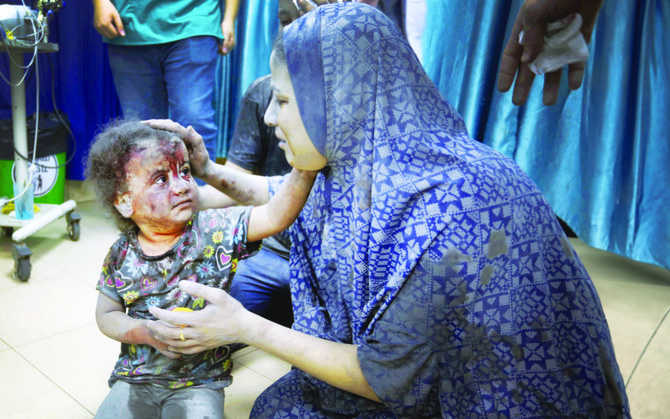
London: What should have been a time of great joy and excitement has become a living nightmare for thousands of new and expectant mothers living under siege and constant Israeli bombardment in the Gaza Strip.
For Layla, 28, whose name has been changed for her safety, bringing a new life into the world at a time of so much death and destruction fills her with dread. “What worries me most is falling in love with life, amid all the death, once I hold my baby,” she said.
Like 5,500 other pregnant women in the Gaza Strip, Layla is due to give birth very soon amid an inhuman Israeli aggression that has devastated healthcare infrastructure and deprived the population of access to nutritious food, clean water and public sanitation.
The closure of hospitals and clinics under the intense bombardment and chronic shortages of electricity, fuel and medicine are among the biggest challenges faced by the roughly 50,000 pregnant women in Gaza.
As of Nov. 10, some 18 hospitals and 51 primary care centers across the embattled enclave are no longer operational, meaning fewer than 60 percent of hospitals and 30 percent of public health centers are operating to some degree.
Fikr Shalltoot, Gaza director for Medical Aid for Palestinians, or MAP, a British charity operating in the Palestinian enclave, said that pregnant women in Gaza “face a dire reality, with limited access to essential health services amid a near-total humanitarian disaster.”
“With over 180 births daily and a staggering 235 attacks on healthcare infrastructure since Oct. 7, the situation is critical,” Shalltoot told Arab News. This leaves women deprived of emergency obstetric services and forces many to give birth in unsafe conditions.
“Closed hospitals force births in shelters, homes and streets amid rubble, raising infection risks,” she said. “Maternity hospitals, like Al-Hilo, face attacks.”
Hospitals in Gaza have been on the frontline of the conflict, overwhelmed by wounded civilians since the start of Israel’s genocide campaign.
Some 135 health facilities across Gaza have been damaged or destroyed. Although these facilities are protected under international humanitarian law, Israel claims Hamas has been using hospitals, particularly Gaza’s largest, Al-Shifa, to host underground command centers.
Hamas and medical staff deny these facilities are being used to store weaponry, conceal hostages, or move fighters along a sophisticated network of tunnels. Israeli forces who took control of Al-Shifa on Wednesday failed to provide evidence to support their claim.
There are at least 650 patients, including 22 in intensive care and 36 premature babies, at Al-Shifa, according to local media, in addition to some 400 medical staff. More than 2,000 Gazans have also taken refuge within the facility.
Amid the destruction and shortages, made worse by Israel’s restrictions on the entry of humanitarian aid into Gaza via the Rafah border crossing with Egypt, physicians have been forced to take extreme measures, such as performing cesareans without anesthetic or pain relief.
“Some women face complications while giving birth, and to stop the problem and because there are no (capabilities), tools, (or) time, (physicians) are faced with the extreme option to take out the uterus,” Soraida Hussein-Sabbah, gender and advocacy specialist at ActionAid Spain, said.
At Al-Awda Hospital, the only provider of maternity services in northern Gaza, doctors performed 16 cesarean C-sections last weekend under extremely challenging circumstances, according to local media.
Hussein-Sabbah said that although there are many trained and specialized obstetrics physicians and nurses in the Gaza Strip, as well as private and public maternity hospitals, “these cannot operate normally right now.”
Despite this, “any specialized person found in a shelter, or any place… will continue serving as much as possible,” she added.
Elaborating on the dangers of conducting cesareans under such extreme circumstances, Zaher Sahloul, head of MedGlobal, a US-based medical NGO, said that while “doctors typically try to deliver as fast as possible,” performing such surgery requires them to “cut through multiple layers” and then “suture multiple layers.”
Performing such an operation without anesthetic, or even a partial dosage of pain relief, would be agonizing.
“It is, as you can imagine, an extremely traumatic experience, something that would be associated with PTSD,” Sahloul told Arab News. Medical professionals are also forced to discharge new mothers within three hours, which poses additional risks.
New mothers are typically monitored for a minimum of 24 hours because the postpartum period is associated with various complications, including hemorrhage. Even before the latest outbreak of violence in Gaza, “the two biggest causes of (maternal) deaths were bleeding and sepsis,” said Sahloul.
“The lack of water and sanitation puts them at an even higher risk of infection and sepsis. (Hospitals) do not (even) have any blood to transfuse these patients if they start to have complications.”
Even if they survive the ordeal of childbirth in these conditions, mother and baby are not out of danger. The lack of hygiene facilities, nutritious food, clean drinking water, safe sleeping spaces, and other basic comforts and necessities threaten health and development.
Fatty acid and vitamin deficiencies in lactating mothers can compromise newborns’ immune systems, putting them at risk of communicable diseases as well as cognitive development challenges, said Sahloul.
Fatema, another woman trapped inside Gaza, has resorted to using clean clothes to manage discharge as she lacks access to sanitary towels. Embarrassed, and with limited privacy, she has then buried those clothes, she told ActionAid.
More than 1.4 million Palestinians have been displaced since Oct. 7, according to the UN’s humanitarian office, OCHA. Many have set up makeshift tents outside hospitals, while others have squeezed into the corridors of schools or have slept out in the open.
MedGlobal’s Sahloul warned that with limited access to food and water, malnourished women face the risk of “preterm delivery,” which is also associated with fetal and neonatal morbidity and mortality.
Shalltoot of MAP, meanwhile, cautioned that as access to obstetrics services becomes increasingly difficult, “maternal deaths will rise, stress-induced complications soar, and malnutrition worsen, affecting childhood survival.” Moreover, “without fuel, premature babies relying on neonatal care face a life-threatening crisis.”
She added: “Maternity care at Al-Awda Hospital hangs in the balance. Doctors report a surge in premature births due to the bombing of homes, a heartbreaking crisis where premature deliveries are performed while mothers lay dying.”
Three premature babies at Al-Shifa died on Tuesday after the hospital’s neonatal intensive care unit was knocked out of operation. The lives of at least 36 others are in danger amid a lack of electricity and fuel for incubators, according to the facility’s director.
With women and children making up more than 70 percent of the casualties — one in four of them women of reproductive age — access to maternal health services is critical, said Shalltoot.
“Gaza is in urgent need of support to protect the lives of mothers and newborns,” she said, adding that “a ceasefire is imperative for pregnant women and infants.”
She said: “Without immediate access to fuel, aid, and medical experts, we face the looming threat of infectious diseases. Mass starvation, treatable deaths and a healthcare system in ruins are imminent unless swift action is taken.
“Opening multiple crossings is crucial to prevent a humanitarian freefall. Our plea is clear — act now to avert a catastrophic crisis.”
MAP has delivered a range of items, including medications and medical disposables that can be used to support delivery and the treatment of women and babies. “With our partner in Gaza, Ard El Insan, we have released all of our medications and food items for malnourished children and their families,” Shalltoot added.
Save the Children and ActionAid have also called for an immediate ceasefire and the opening of a humanitarian aid corridor.
“For this to happen, there is a need for a unified and coordinated call and pressure for the Rafah crossing to open, and the Israeli occupation forces to comply with international humanitarian law and allow for aid to come and civilians to be saved,” said ActionAid’s Hussein-Sabbah.
As of Nov. 17, over 12,000 people, including 5,000 children, according to officials in Gaza. There are also more than 30,000 injuries, 75 percent of which are women and children.
There are 3,750 missing persons, including 1,800 children who are still under the rubble, it said as the official death toll in Gaza had not been updated for days due to the collapse of the its health system.
Earlier this month, Antonio Guterres, the UN secretary-general, described Gaza as “a graveyard for children” and “a crisis of humanity.”
In a statement, Save the Children said: “During this humanitarian catastrophe, civilians, especially children, continue to pay the heaviest price for the ongoing violence.
“Children are being killed at a devastating rate, whole families are being wiped from the registry, and a growing number of people, including children, are being left with no surviving family members.”
Attacks on schools and hospitals are considered “a grave violation against children by the UN and may amount to violations of international humanitarian law.”
Calling for an end to “the continued, systematic assaults,” the NGO said that “hospitals and schools cannot be battlegrounds, and children cannot be targets. Yet in Gaza, all three are attacked on a daily basis.
“Even during wartime, basic elements of humanity must prevail.”


Comments
Add new comment