



Saudi Arabia is biggest success story of 21st century, says Crown Prince

News Network
September 21, 2023

Saudi.jpg

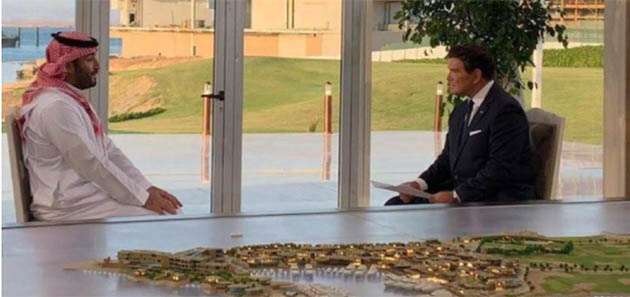
NEOM: Crown Prince and Prime Minister Mohammed bin Salman said that Saudi Arabia is the biggest success story of the 21st century.

In an interview with Bret Baier, chief political anchor of Fox News, at NEOM, the Crown Prince said the Palestinian issue is crucial to normalizing ties with Israel as he wanted to see a good life for the Palestinians. In the interview on “Special Report with Bret Baier” that was aired on Thursday morning, he reiterated that if Iran possessed a nuclear weapon, Saudi Arabia would do the same “for security reasons and the balance of power.”

Saudi Arabia had achieved the fastest growth in gross domestic product (GDP) among the G20 countries for two consecutive years, the Crown Prince said while pointing out about the bid to join G7. “We tried to join the G7, but some countries wanted to dictate their conditions to us,” he said.

In his first interview with a major American news network since 2019, the Crown Prince addressed a wide range of domestic, regional and international issues. Prince Mohammed bin Salman highlighted the robust growth and comprehensive social and economic reforms that Saudi Arabia is witnessing under its Vision 2030. “Saudi Arabia is so big, so I'm quite sure most people in the world, directly or indirectly, have something to do with Saudi Arabia. Our vision is great and we are surprised every day when achieving our goals quickly as our non-oil growth this year will be among the fastest in the G20 countries,” he said.

When asked about efforts to normalize relations with Israel, the Crown Prince emphasized that the Kingdom has no relationship with Israel at present. “Every day we get closer, it seems it's for the first time real one serious. We get to see how it goes," he said. The Crown Prince insisted his country could work with Israel, no matter who is in charge, calling the deal "the biggest historical deal since the end of the Cold War," which he stated would rest upon agreements related to the treatment of the Palestinians. "If we have a breakthrough of reaching a deal that gives the Palestinians their needs and makes the region calm, we're going to work with whoever is there," he said, while reiterating that he wanted to see "a good life for the Palestinians."

When asked about the potential for Iran to obtain a nuclear weapon and what it means for Saudi Arabia, the Crown Prince clearly stated that should Iran ever obtain such a weapon Saudi Arabia would "have to get one, for security reasons, for balancing power." "We are concerned if any country gets a nuclear weapon: That's a bad, that's a bad move," he said. "They don't need to get nuclear weapons because you cannot use them. Any country using a nuclear weapon that means they are having a war with the rest of the world," he said while reiterating the position of Saudi Arabia that the region must be stable for Saudi Arabia to achieve its goals. "The world cannot see another Hiroshima. If the world sees 100,000 people dead that means you are in a war with the rest of the world. So to use this effort to reach a nuclear weapon because you cannot use it if you use it, you got to have a big fight with the rest of the world."

The Crown Prince also spoke about relations with the United States, saying: “We have important security ties with Washington. We have a special relationship with President Joe Biden, and he is very focused and prepares himself well,” he said while adding that Saudi Arabia wants American and foreign companies to come and invest in a safe environment in the Middle East. "We are one of the five largest buyers of American weapons, and our move to buy weapons from countries other than the United States is not in their interest."

He also highlighted the various attacks Osama bin Laden planned and executed against Saudi Arabia in the 1990s. Bin Laden was able to recruit Saudis to help his cause but that it "doesn’t make any sense" for the country itself to help a man actively hurting it. "After that, killing Saudis and foreign people at that time in Saudi Arabia, he's our enemy and he's the American enemy," the Crown Prince said.

Referring to the Khashoggi issue, the Crown Prince said that Saudi Arabia prosecuted those involved in Khashoggi’s killing and made reforms to prevent such things happening again. “Anyone involved in Khashoggi’s killing is serving time in prison and must face the law. We take all the legal measurements that any country took ... We did that in Saudi Arabia and the case was closed," he said. "Also, we try to reform the security system to be sure that these kinds of mistakes do not happen again, and we can see in the past five years nothing of those things happened. It's not part of what Saudi Arabia does." He noted that the country is working to reform some laws and the government does not interfere in the work of the judiciary.

The Crown Prince also touched on economic files, stressing that the Kingdom monitors supply and demand in the oil market and takes the necessary measures to stabilize the energy market. “Our role in OPEC + is to bridge the gap between supply and demand. We are keen on the stability of energy markets and we are doing what is necessary in this regard.”

Referring to the recent deal signed with regard to establishing India – Middle East – Europe Economic Corridor during the G20 Summit, the Crown Prince said that the Economic Corridor that will connect the Middle East with Europe will save time and money and will shorten the distance to Europe to 3-6 days.

Regarding the BRICS group of countries, Prince Mohammed bin Salman said that this group “is not against the United States, as evidenced by the presence of Washington’s allies within it.” The Crown Prince stressed that the BRICS group, which includes Brazil, Russia, India, China and South Africa, is not a political alliance.

The Crown Prince also explained about the measures being taken to make the Kingdom a major global tourism destination. He said that attracting tourism is linked to developing other major sectors, including sports, entertainment and culture. “We do not mind developing the sports sector as it has become effective in economic returns. We are working to ensure that sports contribute 1.5 percent of the gross domestic product (GDP) soon,” he added.

Comments

Add new comment

  • Coastaldigest.com reserves the right to delete or block any comments.
  • Coastaldigset.com is not responsible for its readers’ comments.
  • Comments that are abusive, incendiary or irrelevant are strictly prohibited.
  • Please use a genuine email ID and provide your name to avoid reject.
News Network
February 1,2026

Bengaluru, Feb 1: For travelers landing at Kempegowda International Airport (KIA), the sleek, wood-paneled curves of Terminal 2 promise a world-class welcome. But the famed “Garden City” charm quickly withers at the curb. As India’s aviation sector swells to record numbers—handling over 43 million passengers in Bengaluru alone this past year—the “last mile” has turned into a marathon of frustration.

The Bengaluru Logjam: Rules vs Reality

While the city awaits the 2027 completion of the Namma Metro Blue Line, the interim has been chaotic. Recent “decongestion” rules at Terminal 1 have pushed app-based cab pickups to distant parking zones, forcing weary passengers into a 20-minute walk with luggage.

“I landed after ten months away and felt like a stranger in my own city,” says Ruchitha Jain, a Koramangala resident. “My driver couldn’t find me, staff couldn’t guide me, and the so-called ‘Premium’ lane is just a fancy tax on convenience.”

•    The Cost of Distance: A 40-km cab ride can now easily cross ₹1,500, driven by demand pricing and airport surcharges.

•    The Bus Gap: While Vayu Vajra remains a lifeline, its ₹300–₹400 fare is often cited as the most expensive airport bus service in the country.

A National Pattern of Disconnect

The struggle is not unique to Karnataka. From Chennai’s coast to Hyderabad’s plateau, India’s airports tell a familiar story: brilliant runways, broken exits.

City:    Primary Issue   |    Recent Development

Bengaluru:    Cab pickup restrictions & distance  |    App-based taxis shifted to far parking zones; long walks and fare spikes reported

Chennai:    Multi-Level Parking (MLCP) hike  |    Passengers report 40-minute walks to reach cab pickup points

Hyderabad:    “Taxi mafia” & touting  |    Over 440 touting cases reported; security presence intensified

Mumbai:    Fare scams  |     Tourists charged ₹18,000 for just 400 metres, triggering police action

In Hyderabad, travelers continue to battle entrenched local groups that intimidate Uber and Ola drivers, pushing passengers toward overpriced private taxis. Chennai flyers, meanwhile, complain that reaching the designated pickup zones now takes longer than short-haul flights from cities like Coimbatore.

The ‘Budget Day’ Hope

As Finance Minister Nirmala Sitharaman presents the Union Budget 2026 today, the aviation sector is watching closely. With the government’s renewed emphasis on multimodal integration, there is cautious hope for funding toward seamless airport-metro-bus hubs.

The vision is clear: a future where planes, trains, and metros speak the same language. Until then, passengers at KIA—and airports across India—will continue to discover that the hardest part of flying isn’t the thousands of kilometres in the air, but the last few on the ground.

Comments

Add new comment

  • Coastaldigest.com reserves the right to delete or block any comments.
  • Coastaldigset.com is not responsible for its readers’ comments.
  • Comments that are abusive, incendiary or irrelevant are strictly prohibited.
  • Please use a genuine email ID and provide your name to avoid reject.
News Network
January 23,2026

Mangaluru: The Karnataka Government Polytechnic (KPT), Mangaluru, has achieved autonomous status from the All India Council for Technical Education (AICTE), becoming the first government polytechnic in the country to receive such recognition in its 78-year history. The status was granted by AICTE, New Delhi, and subsequently approved by the Karnataka Board of Technical Education in October last year.

Officials said the autonomy was conferred a few months ago. Until recently, AICTE extended autonomous status only to engineering colleges, excluding diploma institutions. However, with a renewed national focus on skill development, several government polytechnics across India have now been granted autonomy.

KPT, the second-largest polytechnic in Karnataka, was established in 1946 with four branches and has since expanded to offer eight diploma programmes, including computer science and polymer technology. The institution is spread across a 19-acre campus.

Ravindra M Keni, the first dean of the institution, told The Times of India that AICTE had proposed autonomous status for polytechnic institutions that are over 25 years old. “Many colleges applied. In the first round, 100 institutions were shortlisted, which was further narrowed down to 15 in the second round. We have already completed one semester after becoming an autonomous institution,” he said. He added that nearly 500 students are admitted annually across eight three-year diploma courses.

Explaining the factors that helped KPT secure autonomy, Keni said the institution has consistently recorded 100 per cent admissions and placements for its graduates. He also noted its strong performance in sports, with the college emerging champions for 12 consecutive years, along with active student participation in NCC and NSS activities.

Autonomous status allows KPT to design industry-oriented curricula, conduct examinations, prepare question papers, and manage academic documentation independently. The institution can also directly collaborate with industries and receive priority funding from AICTE or the Ministry of Education. While academic autonomy has been granted, financial control will continue to rest with the state government.

“There will be separate committees for examinations, question paper setting, boards of studies, and boards of examiners. The institution will now have the freedom to conduct admissions without government notifications and issue its own marks cards,” Keni said, adding that new academic initiatives would be planned after a year of functioning under the autonomous framework.

Comments

Add new comment

  • Coastaldigest.com reserves the right to delete or block any comments.
  • Coastaldigset.com is not responsible for its readers’ comments.
  • Comments that are abusive, incendiary or irrelevant are strictly prohibited.
  • Please use a genuine email ID and provide your name to avoid reject.
News Network
January 31,2026

Roy.jpg

Bengaluru: The shooting incident involving CJ Roy, founder of the Confident Group, has once again put the spotlight on a businessman whose life has swung between flamboyant global success and persistent controversy at home.

Though Roy’s business interests extended across continents, his roots lay firmly in Karnataka. An alumnus of Christ School in Bengaluru, he later moved to Tumakuru to pursue an engineering degree. Those familiar with his early years describe him as intensely ambitious, beginning his career as a salesman at a small electronics firm dealing in computers.

Roy’s entry into large-scale real estate came through the Crystal Group, where he worked closely with Latha Namboothiri and rose from manager to director. However, the launch of the Confident Group in 2005 was clouded by industry speculation. Insiders speak of a fallout involving alleged “benami” properties and claims of deception that ultimately led to his independent venture—an episode Roy spent years trying to distance himself from, according to associates.

A tale of two cities

Roy’s professional trajectory diverged sharply across geographies.

In Dubai, he built a reputation as a bold and efficient developer, completing massive luxury residential projects in record time—some reportedly within 11 months. His rapid project delivery and lavish lifestyle in the Emirates earned him admiration and visibility in the real estate sector.

In Bengaluru, however, his image remained far more fractured. Sources say Roy stayed away from the city for several years amid disputes over unpaid dues to vendors and suppliers. Several projects were allegedly stalled, with accusations of unfulfilled commitments to cement and steel suppliers continuing to follow him.

Roy’s return to Bengaluru’s business and social circles began around 2018, marked by a conscious attempt at rebranding. His appointment as Honorary Consul of the Slovak Republic added diplomatic legitimacy, which he complemented with visible CSR initiatives, including ambulance donations and high-profile charity events.

Heavy police presence in Langford Town

Following the incident, police personnel from the Central division were deployed outside the Confident Group building in Langford Town, which also houses the Slovak Honorary Consulate in Bengaluru.

The otherwise busy premises near Hosur Road wore a deserted look on Friday, reflecting the shock and uncertainty that followed the tragedy.

Comments

Add new comment

  • Coastaldigest.com reserves the right to delete or block any comments.
  • Coastaldigset.com is not responsible for its readers’ comments.
  • Comments that are abusive, incendiary or irrelevant are strictly prohibited.
  • Please use a genuine email ID and provide your name to avoid reject.