



Mike Pompeo to Seek Stronger Strategic Ties with India despite Trade Tensions

Agencies
June 22, 2019

Washington, Jun 22: U.S. Secretary of State Mike Pompeo will seek to further strengthen strategic ties with India during a visit next week despite increasing frictions over trade, data flows and arms from Russia, officials said.
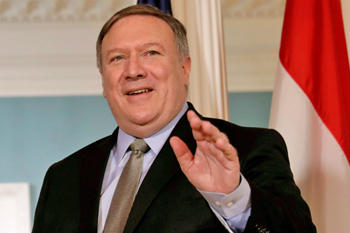
Mr Pompeo arrives in New Delhi on Tuesday for talks that are aimed at laying the ground for a meeting between U.S. President Donald Trump and Indian Prime Minister Narendra Modi later in the week at a G20 meeting in Japan.

India is embroiled in disputes with the United States over tariffs, Indian price caps on imported medical devices, most from the United States, and Indian rules on e-commerce that impose conditions on the operations of major U.S. companies such as Amazon and Walmart.

Another issue that has alarmed India is the possibility of U.S. restrictions on work visas for Indian professionals in retaliation for India's insistence on local data storage by big foreign firms, even though the State Department said on Thursday it had no such plan.

"U.S.-India trade ties, at least between our capitals, are certainly worsening. We both have leaders who look at trade as a zero-sum game," said Richard Rossow, a U.S.-India expert at Washington's the Center for Strategic and International Studies.

The Indian government led by PM Modi, who was re-elected last month with a big majority, says it has been trying to negotiate solutions to the disputes with the United States but that, as a developing country, it has to protect the interests of its people.

Donald Trump has repeatedly criticised India for its high tariffs and last month raised the stakes with the withdrawal of a decades-old trade privilege.

Indian and U.S. officials said trade would be addressed during Mike Pompeo's visit but emphasised the broader political and security relationship.

"There will be certain issues between us that will be on the table at all points of time," an Indian government official said. "But it should not detract from the overall direction of the relationship, which is positive."

Both countries are wary of the growing might of China.

U.S. officials said Mr Pompeo will seek to advance the U.S. strategic partnership with India.

"India is a crucial partner in the Trump administration's vision for a free and open Indo-Pacific region; It shares our concerns about challenges to our shared interests in the region," a senior official of the U.S. State Department told reporters on Friday.

The official said Mr Pompeo would "talk specifically ... about expanding security, energy and space cooperation," and noted that the two countries were gearing up for their first-ever tri-service military exercises in the Bay of Bengal later this year.

At the same time, the U.S. side was hoping the visit would provide a "kick-start" to move quickly to resolve longstanding irritants over trade and market access for U.S. firms.

"A serious process, a credible process and a candid process is going to be critical," the official said. "We need to get a conversation started quickly."

India and the United States eyed each other warily over decades of Cold War suspicion, when India was closer to the then Soviet Union.

But the United States has become one of India's top arms suppliers over the past decade, selling more than $15 billion of weapons such as transport planes, long-range submarine hunters and helicopter gunships.

U.S. firms Lockheed Martin and Boeing are in the race for a contract to build 110 fighter planes in a deal estimated at $20 billion.

In 2016, the United States declared India a major defence partner, opening the way for sales of high-tech military equipment seen as part of a U.S. aim to build up the country as a counterweight to China in the region.

But here too, new strains have emerged over an Indian plan to buy S-400 surface-to-air missile systems from Russia, which can trigger U.S. sanctions under the Countering American Adversaries Through Sanctions Act (CAATSA), prohibiting any engagement with Russia's defence sector.

India, which signed the deal with Russia last year, has been hoping for a waiver, but that has not been forthcoming.

U.S. principal deputy assistant secretary for South and Central Asia, Alice Wells, told Congress this month Washington had "serious concerns" about the possible Indian purchase and there was no available CAATSA waiver when it came to the S-400.

"We are continuing our conversations about how the U.S. or other defence providers could assist India," she added.

Comments

Add new comment

  • Coastaldigest.com reserves the right to delete or block any comments.
  • Coastaldigset.com is not responsible for its readers’ comments.
  • Comments that are abusive, incendiary or irrelevant are strictly prohibited.
  • Please use a genuine email ID and provide your name to avoid reject.
P A Hameed Padubidri
November 26,2025

CD.jpg

Constitution Day, also known as Samvidhan Divas, is observed every year on November 26 to honor the adoption of the Constitution of India and to recognize the visionary effort that shaped the world’s largest democracy.

Historical Background

It’s on November 26, 1949, the Constituent Assembly of India formally adopted the Constitution.This date is commemorated to acknowledge the completion of nearly three years of drafting, debate, and refinement.

On January 26, 1950, the Constitution came into force, marking India’s transition from a dominion to a sovereign republic.

The date 26 January was chosen to honor the “Purna Swaraj” declaration made in 1930 that marked the relentless efforts & sacrifices of the many. 

Why Constitution Day is Celebrated

* To honor & remember the framers of the Constitution, especially Dr. B. R. Ambedkar, the Chairman of the Drafting Committee, & many others. 

* To remind the citizens of the values, responsibilities, and rights enshrined in the Constitution.

* To promote constitutional values & literacy among students, institutions, and the general public.

* To reaffirm the nation’s commitment to justice, equality, liberty, fraternity and secular values. 

Vision and Significance of the Constitution

It establishes the fundamental political and legal framework for the nation.

Defines the structure, powers and functions of:
    •    The Executive
    •    The Legislature
    •    The Judiciary
    •    Guarantees a comprehensive set of Fundamental Rights, including:

-Equality before law
-Freedom of speech & expression
-Protection of life and personal liberty
-Freedom of religion
-Embeds Directive Principles of State Policy, guiding governance toward social justice and welfare.
-Introduces Fundamental Duties to ensure civic responsibility among citizens.

Key Features Celebrated on Constitution Day

-The Indian constitution is considered one of the longest written constitutions of the world. It’s systematically drafted considering almost all aspects that properly fits to the country. 

-Blend of multiple global constitutional principles while staying rooted in Indian values and realities.

-Framework that balances Federalism, Secularism, Democracy and Rule of Law. This makes everyone-from President to common man-below the law & are equal in the sight of law. 

-Another feature is that it’s based on built-in mechanisms for amendments, ensuring the Constitution grows with changing needs.

Message of the Day

The core ethos of this  Constitution Day is not merely about looking back at history-it’s a reminder of the continuous duty to protect democratic values, respect diversity and uphold the principles that define India as a sovereign, socialist, secular and democratic republic.

Happy Constitution Day to all my compatriots

Comments

Add new comment

  • Coastaldigest.com reserves the right to delete or block any comments.
  • Coastaldigset.com is not responsible for its readers’ comments.
  • Comments that are abusive, incendiary or irrelevant are strictly prohibited.
  • Please use a genuine email ID and provide your name to avoid reject.
News Network
November 26,2025

students.jpg

Bengaluru, Nov 26: Karnataka is taking its first concrete steps towards lifting a three-decade-old ban on student elections in colleges and universities. Deputy Chief Minister D.K. Shivakumar announced Wednesday that the state government will form a small committee to study the reintroduction of campus polls, a practice halted in 1989 following incidents of violence.

Speaking at a 'Constitution Day' event organised by the Karnataka Congress, Mr. Shivakumar underscored the move's aim: nurturing new political leadership from the grassroots.

"Recently, (Leader of the Opposition in Lok Sabha) Rahul Gandhi wrote a letter to me and Chief Minister (Siddaramaiah) asking us to think about restarting student elections," Shivakumar stated. "I'm announcing today that we'll form a small committee and seek a report on this."

Student elections were banned in Karnataka in 1989, largely due to concerns over violence and the infiltration of political party affiliates into campus life. The ban effectively extinguished vibrant student bodies and the pipeline of young leaders they often produced.

Mr. Shivakumar, who also serves as the Karnataka Congress president, said that former student leaders will be consulted to "study the pros and cons" of the re-introduction.

Acknowledging the history of the ban, he added, "There were many criminal activities taking place back then. We’ll see how we can conduct (student) elections by regulating such criminal activities."

The Deputy CM reminisced about his own journey, which began on campus. He recalled his political activism at Sri Jagadguru Renukacharya College leading to his first Assembly ticket in 1985 at the age of 23. "That's how student leadership was at the time. Such leadership has gone today. College elections have stopped," he lamented, adding that for many, college elections were "like a big movement" where leaders were forged.

The move, driven by the Congress high command's push to cultivate young talent, will face scrutiny from academics and university authorities who have, in the past, expressed concern that the return of polls could disrupt the peaceful academic environment and turn campuses into political battlegrounds.

Comments

Add new comment

  • Coastaldigest.com reserves the right to delete or block any comments.
  • Coastaldigset.com is not responsible for its readers’ comments.
  • Comments that are abusive, incendiary or irrelevant are strictly prohibited.
  • Please use a genuine email ID and provide your name to avoid reject.
Agencies
November 22,2025

indiapak.jpg

New York/Washington: US President Donald Trump has again claimed to have solved the conflict between India and Pakistan, repeating his assertion during a meeting with New York City Mayor-elect Zohran Mamdani in the Oval Office.

Mamdani flew to Washington DC for his first meeting with Trump in the White House on Friday. Trump said he “enjoyed” the meeting, which he described as “great.”

During remarks in the Oval Office, with Mamdani standing next to him, Trump repeated his claim that he solved the May conflict between India and Pakistan.

"I did eight peace deals of countries, including India and Pakistan,” he said.

On Wednesday, Trump had said he threatened to put 350 per cent tariffs on India and Pakistan if they did not end their conflict, repeating his claim that he solved the fighting between the nuclear-armed neighbours and that Prime Minister Narendra Modi had called him to say “we're not going to go to war.”

Since May 10, when Trump announced on social media that India and Pakistan had agreed to a “full and immediate” ceasefire after a “long night” of talks mediated by Washington, he has repeated his claim over 60 times that he “helped settle” the tensions between India and Pakistan.

India has consistently denied any third-party intervention. India launched Operation Sindoor on May 7, targeting terror infrastructure in Pakistan and Pakistan-occupied Kashmir in retaliation for the April 22 Pahalgam attack that killed 26 civilians. India and Pakistan reached an understanding on May 10 to end the conflict after four days of intense cross-border drone and missile strikes.

Mamdani emerged victorious in the closely-watched battle for New York City Mayor, becoming the first South Asian and Muslim to be elected to sit at the helm of the largest city in the US.

He had been the front-runner in the NYC Mayoral election for months and defeated Republican nominee Curtis Sliwa and political heavyweight former New York State Governor Andrew Cuomo, who ran as an independent candidate and was officially endorsed by Trump just hours before the elections.

Indian-descent Mamdani is the son of renowned filmmaker Mira Nair and Columbia University professor Mahmood Mamdani. He was born and raised in Kampala, Uganda and moved to New York City with his family when he was 7. Mamdani became a naturalised US citizen only recently, in 2018.

Comments

Add new comment

  • Coastaldigest.com reserves the right to delete or block any comments.
  • Coastaldigset.com is not responsible for its readers’ comments.
  • Comments that are abusive, incendiary or irrelevant are strictly prohibited.
  • Please use a genuine email ID and provide your name to avoid reject.