Paytm accuses Google of trying to dominate India's digital ecosystem

News Network
September 21, 2020

Noida, Sept 21: Financial services app Paytm has accused Google of making policies that are over and above the laws of India after it was briefly delisted from the Playstore last week.

"As a startup, we are running law-abiding businesses and building for India. Google and its employees are making policies which are over and above the laws of our country, and are arbitrarily implementing them," it said in a blogpost.

Paytm said Google owns Android which is the operating system on which over 95 per cent of smartphones in India run. Google, as a result, has enormous control over which apps you download through its Playstore policies.

"It also makes billions of dollars in advertising revenues from the Indian startups that make these apps. In many cases like maps, email, payments, shopping and cloud storage, Google also has apps that compete with other apps, including, of course, the apps that are made by Indian startups."

Paytm said it had launched a campaign where users could collect cricket stickers and scratch cards to earn UPI cashback. The offer was applicable on recharges, utility payments, UPI money transfers and adding money to Paytm wallet.

On September 18, it got an email from Google Play Support informing that the Paytm Android app had been delisted.

This was the first time that Google was sending it a notification regarding its UPI cashback and scratch cards campaign.

"Contrary to accepted practise, we were not given any opportunity to respond to their concerns or put forth our views. We maintain that our cashback campaign was within guidelines, as well as all laws of the land. We did not break any rules and there was no violation. It is not related to gambling in any manner whatsoever," said Paytm.

Comments

Add new comment

  • Coastaldigest.com reserves the right to delete or block any comments.
  • Coastaldigset.com is not responsible for its readers’ comments.
  • Comments that are abusive, incendiary or irrelevant are strictly prohibited.
  • Please use a genuine email ID and provide your name to avoid reject.
News Network
January 16,2026

tourism.jpg

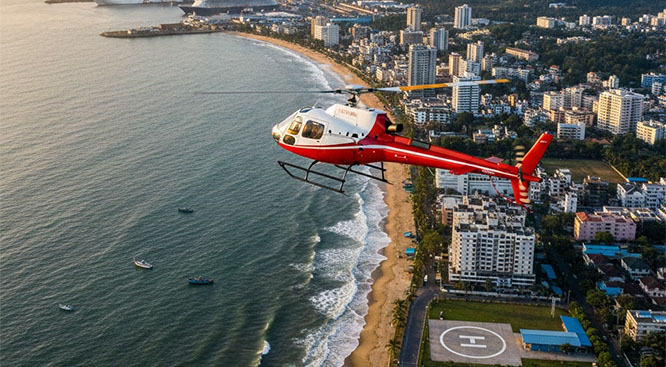
Following a record-breaking response to experimental joyrides during the Karavali Utsava, the Dakshina Kannada district administration has signaled a major shift toward high-end travel. Officials are now laying the groundwork to transform Mangaluru into a permanent heli-tourism hub, connecting the state’s most sacred pilgrim centers and untouched coastal gems via the skies.

The move comes as the Karnataka government readies a specialized tourism policy for the coast, aimed at drawing global investors. With Mangaluru already serving as a critical nexus for education, healthcare, and maritime trade, the introduction of a scheduled helicopter service is seen as the "missing link" in the region’s economic evolution.

By the Numbers: A Flying Success

The data from the recent 10-day trial (beginning December 26) paints a clear picture of high demand:

•    Total Passengers: 1,032
•    Ride Duration: 7 minutes
•    Ticket Price: ₹3,500 per person
•    Origin of Tourists: Significant turnout from Kerala, Udupi, and Karwar.

Bridging the Gap for Global Travelers

Deputy Commissioner Darshan HV emphasized that the vision extends far beyond festival joyrides. Currently, international tourists arriving via luxury cruises at the New Mangalore Port (peak season December–April) often find themselves "landlocked" by time.

"Foreign visitors staying for just 24 to 48 hours currently struggle to visit inland attractions like Chikkamagaluru or Kodagu due to road travel times," a senior official noted. "A permanent heli-link would make these Western Ghats destinations accessible in under 30 minutes."

Beyond Tourism: Medical and Logistics

The administration is also looking at the humanitarian and logistical benefits. As a medical powerhouse, Mangaluru’s private hospitals could utilize the proposed permanent helipads for:

1.    Cardiac Emergencies: Rapid transfer of critical patients.
2.    Organ Transplants: Vital "green corridors" through the air to save lives.
3.    Regional Connectivity: Linking remote areas like Puttur, Sullia, and Beltangady to the main city.

While the Karavali Utsava has traditionally focused on beach-side festivities, the DC confirmed that the district is now evaluating formal proposals from private operators. The goal is to establish a network of permanent helipads that will eventually offer regular sorties to Kudremukh National Park and the scenic heights of the Western Ghats.

Comments

Add new comment

  • Coastaldigest.com reserves the right to delete or block any comments.
  • Coastaldigset.com is not responsible for its readers’ comments.
  • Comments that are abusive, incendiary or irrelevant are strictly prohibited.
  • Please use a genuine email ID and provide your name to avoid reject.
News Network
January 23,2026

Mangaluru: The Karnataka Government Polytechnic (KPT), Mangaluru, has achieved autonomous status from the All India Council for Technical Education (AICTE), becoming the first government polytechnic in the country to receive such recognition in its 78-year history. The status was granted by AICTE, New Delhi, and subsequently approved by the Karnataka Board of Technical Education in October last year.

Officials said the autonomy was conferred a few months ago. Until recently, AICTE extended autonomous status only to engineering colleges, excluding diploma institutions. However, with a renewed national focus on skill development, several government polytechnics across India have now been granted autonomy.

KPT, the second-largest polytechnic in Karnataka, was established in 1946 with four branches and has since expanded to offer eight diploma programmes, including computer science and polymer technology. The institution is spread across a 19-acre campus.

Ravindra M Keni, the first dean of the institution, told The Times of India that AICTE had proposed autonomous status for polytechnic institutions that are over 25 years old. “Many colleges applied. In the first round, 100 institutions were shortlisted, which was further narrowed down to 15 in the second round. We have already completed one semester after becoming an autonomous institution,” he said. He added that nearly 500 students are admitted annually across eight three-year diploma courses.

Explaining the factors that helped KPT secure autonomy, Keni said the institution has consistently recorded 100 per cent admissions and placements for its graduates. He also noted its strong performance in sports, with the college emerging champions for 12 consecutive years, along with active student participation in NCC and NSS activities.

Autonomous status allows KPT to design industry-oriented curricula, conduct examinations, prepare question papers, and manage academic documentation independently. The institution can also directly collaborate with industries and receive priority funding from AICTE or the Ministry of Education. While academic autonomy has been granted, financial control will continue to rest with the state government.

“There will be separate committees for examinations, question paper setting, boards of studies, and boards of examiners. The institution will now have the freedom to conduct admissions without government notifications and issue its own marks cards,” Keni said, adding that new academic initiatives would be planned after a year of functioning under the autonomous framework.

Comments

Add new comment

  • Coastaldigest.com reserves the right to delete or block any comments.
  • Coastaldigset.com is not responsible for its readers’ comments.
  • Comments that are abusive, incendiary or irrelevant are strictly prohibited.
  • Please use a genuine email ID and provide your name to avoid reject.
News Network
January 14,2026

utifti.jpg

The National Commission for Allied and Healthcare Professions (NCAHP) has announced that admissions to undergraduate programmes in physiotherapy and occupational therapy will henceforth be conducted exclusively through the National Eligibility-cum-Entrance Test (NEET).

In a press release issued by Prof. U. T. Iftikhar Ali Fareed, Chairman of the Karnataka State Allied and Healthcare Council, stated that the NCAHP has clarified the category-wise degree nomenclature and admission criteria for allied and healthcare undergraduate programmes, effective from the academic year 2026–27.

According to the notification, admissions to the Bachelor of Physiotherapy (BPT) – Category 3 and Bachelor of Occupational Therapy (BOT) – Category 6 will be conducted only through NEET, in accordance with the National Commission for Allied and Healthcare Professions Act, 2021.

All Vice-Chancellors of public, private, and deemed-to-be universities in Karnataka have been asked to ensure strict compliance with the NCAHP guidelines and to disseminate the information widely among affiliated colleges, faculty, and students.

Prof. Ifthikar Ali emphasized that universities must take necessary steps to implement the admission procedure for the academic year 2026–27 and subsequent years.
 

Comments

Add new comment

  • Coastaldigest.com reserves the right to delete or block any comments.
  • Coastaldigset.com is not responsible for its readers’ comments.
  • Comments that are abusive, incendiary or irrelevant are strictly prohibited.
  • Please use a genuine email ID and provide your name to avoid reject.