Mobs kill one in Sri Lanka as communal riots spread despite nationwide curfew

Agencies
May 14, 2019

Colombo, May 14: Mobs slashed to death a Sri Lankan Muslim man despite a nationwide curfew imposed Monday night after anti-Muslim riots spread to three districts north of the capital in a violent backlash against Easter suicide bombings.

The 45-year-old man died shortly after admission to a hospital in Puttalam district during the rioting which began Sunday in the area, a police official told AFP.

“Mobs had attacked him with sharp weapons at his carpentry workshop,” the official said. “This is the first death from the riots.”

Prime Minister Ranil Wickremesinghe said the curfew was declared to prevent unidentified groups destabilising the country by orchestrating communal violence.

“At several places in the North-Western Province these groups created trouble, damaged property,” Wickremesinghe said in a televised address to the nation.

“Police and security forces have contained the situation, but these (unidentified) groups are still trying to create trouble.”

Wickremesinghe said the unrest would hinder investigations into the April 21 attacks that targeted three Christian churches and three luxury hotels, killing 258 people and wounding nearly 500.

In a separate TV address, Police Chief Chandana Wickramaratne warned police will take stern action against rioters, and constables have been issued orders to use maximum force.

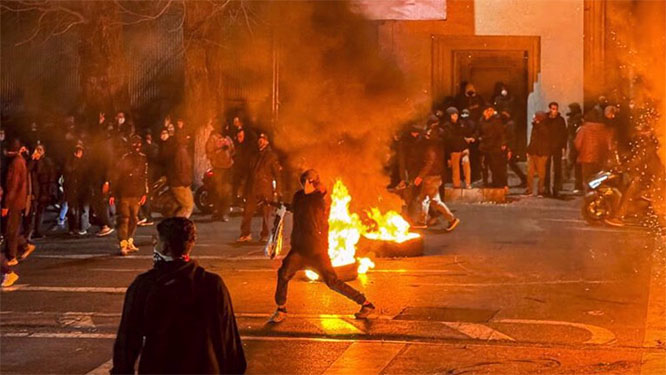
Residents in the North-Western Province were ordered to stay indoors after Christian-led mobs torched dozens of Muslim-owned shops, vehicles and mosques on Sunday and Monday.

The attacks came during the Muslim holy fasting month of Ramadan.

Later the curfew was extended to cover the entire country of 21 million people.

Police said there were sporadic incidents of mobs throwing stones and torching shops, motorcycles and cars owned by Muslims. In the town of Hettipola, at least three shops were torched.

In the town of Minuwangoda, just north of Colombo, a Muslim-owned hotel and a mosque were attacked by stone-hurling mobs armed with sticks.

“Several shops have been attacked,” a senior police officer told news agency. “When mobs tried to attack mosques, we fired in the air and used tear gas to disperse them.”

The officer added that “there are people trying to make political capital out of this situation.”

PM warns against rumours

Earlier Monday, authorities banned Facebook, WhatsApp and other social media platforms.

Platforms were similarly blocked after the Easter attacks.

The prime minister urged the public not to believe rumours and warned that civil unrest will stretch the already thinly deployed security forces.

“I appeal to all citizens to remain calm and not be swayed by false information,” Wickremesinghe said on Twitter, which was not targeted in the social media blockade.

A state of emergency has been in place since the bombings -- which the Islamic State group claims to have helped -- and security forces have been given sweeping powers to detain suspects.

The latest wave of unrest started when a mob targeted Muslim-owned shops in the town of Chilaw, 80 kilometres (50 miles) north of Colombo on Sunday in anger at a Facebook post by a shopkeeper.

“Don’t laugh more, 1 day u will cry,” he wrote, which local Christians took to be a warning of an impending attack.

The group smashed the man’s shop and vandalised a nearby mosque prompting security forces to fire in the air to disperse the crowd, but the violence spread.

There had already been clashes last week between Christians and Muslims in Negombo, the town north of Colombo that was targeted by the suicide attackers.

The main body of Islamic clerics, the All Ceylon Jamiyyathul Ulama (ACJU), said there was increased suspicion of Muslims after the Easter Sunday killings.

“We call upon the members of the Muslim communities to be more patient and guard your actions and avoid unnecessary postings or hosting on social media,” the ACJU said.

Internet service providers said they have been instructed by the telecommunications regulator to block access to Facebook, WhatsApp, YouTube and Instagram.

Schools reopen

The latest unrest came as Catholic churches resumed public Sunday masses for the first time since the bombings.

Dozens of people have been detained since the Easter attacks, and with security heightened students are only allowed into schools after checks for explosives.

But attendance has been extremely low, according to education authorities.

Muslims make up around 10 percent of Buddhist-majority Sri Lanka’s population and Christians about 7.6 percent.

Comments

Add new comment

  • Coastaldigest.com reserves the right to delete or block any comments.
  • Coastaldigset.com is not responsible for its readers’ comments.
  • Comments that are abusive, incendiary or irrelevant are strictly prohibited.
  • Please use a genuine email ID and provide your name to avoid reject.
News Network
December 5,2025

Mangaluru: In a significant step to curb online hate and intimidation, Mangaluru City Police have registered a suo motu case against multiple Instagram accounts accused of circulating alleged provocative and threatening content.

While monitoring social media activity on Tuesday, Kankanady Town PSI Anitha Nikkam identified the Instagram handle ‘team_targetttt_900’ for posting a hate message alongside images of lethal weapons. Another account, ‘team_nagara_900’, allegedly shared a threatening post targeting activist Bharath Kumdelu, tagging additional pages such as KARAVALI-OFFICIAL.

Several other accounts — including ‘immu_bhai.fan’, ‘target_boy_900’, ‘kings_of_manglore’, ‘team_target_boys.900’, ‘arshad_mangalore’, ‘target_ka19_ullal’, ‘team_target__’, ‘troll_tigersz_900’, ‘tr_group_900’, and ‘team_target_900’ — are also under scrutiny for spreading similar inflammatory material, police said.

Authorities have urged citizens, especially young social media users, to report suspicious pages and avoid engaging with groups that glorify violence or threaten individuals. Online hate can quickly escalate into real-world harm, and police stress that sharing or promoting such content can attract legal consequences.

Comments

Add new comment

  • Coastaldigest.com reserves the right to delete or block any comments.
  • Coastaldigset.com is not responsible for its readers’ comments.
  • Comments that are abusive, incendiary or irrelevant are strictly prohibited.
  • Please use a genuine email ID and provide your name to avoid reject.
News Network
December 2,2025

A major upgrade in safety and monitoring is planned for Haj 2026, with every Indian pilgrim set to receive a Haj Suvidha smart wristband linked to the official Haj Suvidha mobile app. The initiative aims to support pilgrims—especially senior citizens—who may struggle with smartphones during the 45-day journey.

What the Smart Wristband Will Do

Officials said the device will come with:
•    Location tracking
•    Pedometer
•    SOS emergency button
•    Qibla compass
•    Prayer timings
•    Basic health monitoring

SP Tiwari, secretary of the UP State Haj Committee, said the goal is to make the pilgrimage safer and more comfortable.

“Most Hajis are elderly and not comfortable with mobile apps,” he said. “The smartwatch will help locate pilgrims who forget their way or cannot communicate their location.”

The wristbands will be monitored by the Consulate General of India in Saudi Arabia, similar to mobile tracking via the Haj Suvidha App.

Free Distribution and Training

•    Smart wristbands will be given free of cost.
•    Training for pilgrims will be conducted between January and February 2026.
•    Sample units will reach state Haj committees soon.
•    Final devices will be distributed as pilgrims begin their journey.

New Rules for Accommodation

Two major decisions have also been finalised for Haj 2026:
1.    Separate rooms for men and women – including married couples. They may stay on the same floor but must occupy different rooms, following stricter Saudi guidelines.
2.    Cooking banned – gas cylinders will not be allowed; all meals will be provided through official catering services arranged by the Haj Committee of India.

These decisions were finalised during a meeting of the Haj Committee of India and state representatives in Mumbai.

Haj Suvidha App Launched Earlier

The government launched the Haj Suvidha App in 2024, offering:

•    Training modules
•    Accommodation and flight details
•    Baggage information
•    SOS and translation tools
•    Grievance redressal

Haj 2026 Quota and Key States

•    India’s total Haj quota for 2026: 1,75,025 pilgrims
•    70% (1,25,000) allotted to the Haj Committee of India
•    30% (around 50,000) reserved for Haj Group Organisers

Uttar Pradesh has the largest allocation (around 30,000 seats), though approximately 18,000 pilgrims are expected to go this year. States with high pilgrim numbers include Kerala, Maharashtra and Gujarat.

Dates of Haj 2026

The pilgrimage is scheduled to take place from 24 May to 29 May, 2026 (tentative).
Haj is one of the five pillars of Islam and is mandatory for Muslims who meet the required conditions.

Comments

Add new comment

  • Coastaldigest.com reserves the right to delete or block any comments.
  • Coastaldigset.com is not responsible for its readers’ comments.
  • Comments that are abusive, incendiary or irrelevant are strictly prohibited.
  • Please use a genuine email ID and provide your name to avoid reject.
News Network
November 26,2025

students.jpg

Bengaluru, Nov 26: Karnataka is taking its first concrete steps towards lifting a three-decade-old ban on student elections in colleges and universities. Deputy Chief Minister D.K. Shivakumar announced Wednesday that the state government will form a small committee to study the reintroduction of campus polls, a practice halted in 1989 following incidents of violence.

Speaking at a 'Constitution Day' event organised by the Karnataka Congress, Mr. Shivakumar underscored the move's aim: nurturing new political leadership from the grassroots.

"Recently, (Leader of the Opposition in Lok Sabha) Rahul Gandhi wrote a letter to me and Chief Minister (Siddaramaiah) asking us to think about restarting student elections," Shivakumar stated. "I'm announcing today that we'll form a small committee and seek a report on this."

Student elections were banned in Karnataka in 1989, largely due to concerns over violence and the infiltration of political party affiliates into campus life. The ban effectively extinguished vibrant student bodies and the pipeline of young leaders they often produced.

Mr. Shivakumar, who also serves as the Karnataka Congress president, said that former student leaders will be consulted to "study the pros and cons" of the re-introduction.

Acknowledging the history of the ban, he added, "There were many criminal activities taking place back then. We’ll see how we can conduct (student) elections by regulating such criminal activities."

The Deputy CM reminisced about his own journey, which began on campus. He recalled his political activism at Sri Jagadguru Renukacharya College leading to his first Assembly ticket in 1985 at the age of 23. "That's how student leadership was at the time. Such leadership has gone today. College elections have stopped," he lamented, adding that for many, college elections were "like a big movement" where leaders were forged.

The move, driven by the Congress high command's push to cultivate young talent, will face scrutiny from academics and university authorities who have, in the past, expressed concern that the return of polls could disrupt the peaceful academic environment and turn campuses into political battlegrounds.

Comments

Add new comment

  • Coastaldigest.com reserves the right to delete or block any comments.
  • Coastaldigset.com is not responsible for its readers’ comments.
  • Comments that are abusive, incendiary or irrelevant are strictly prohibited.
  • Please use a genuine email ID and provide your name to avoid reject.